Local SEO Tips for Small Business (2026)
Local SEO tips for small businesses: improve GBP, reviews, local pages, and call answering so rankings turn into booked customers.
February 24, 2026
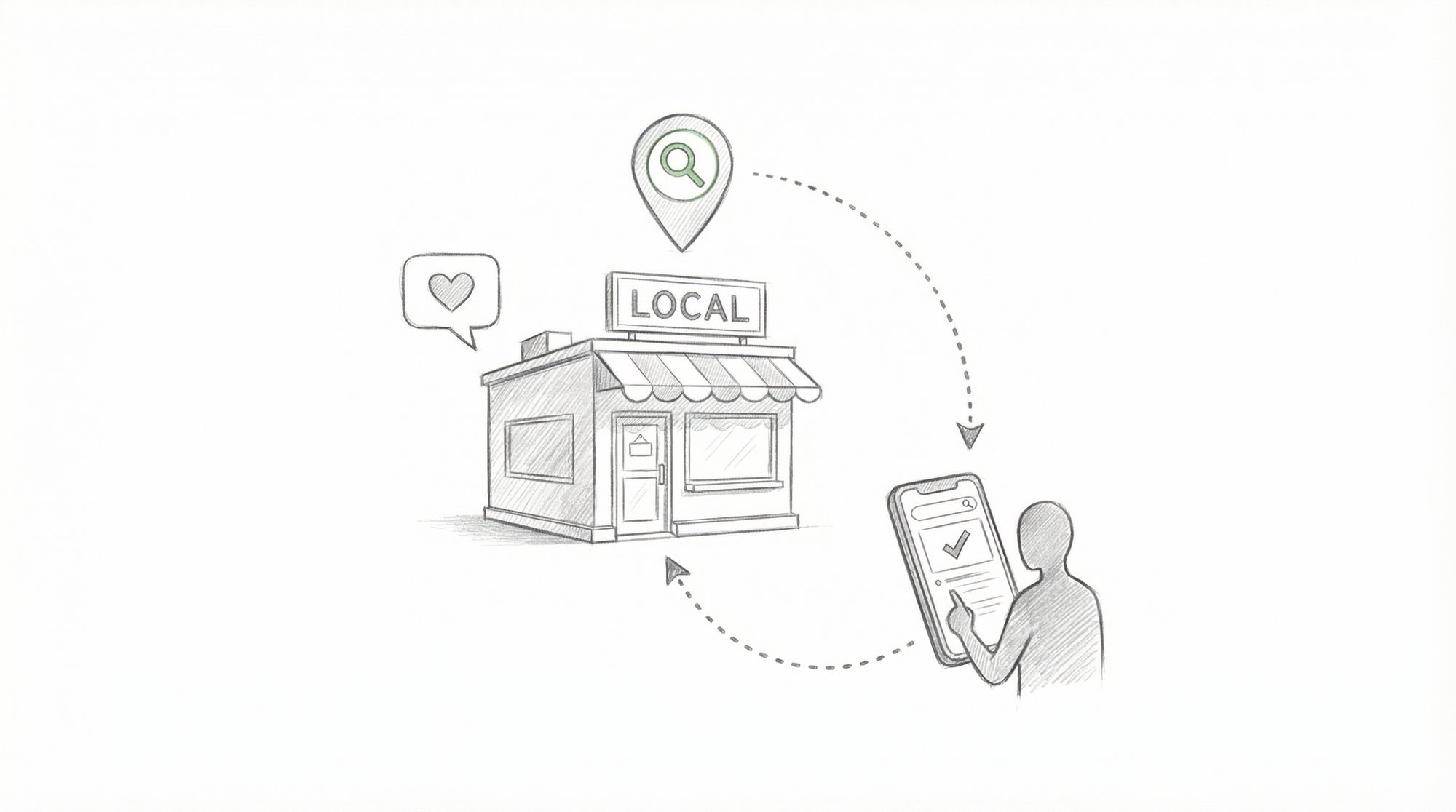
Most small businesses don't lose to competitors on quality. They lose on visibility.
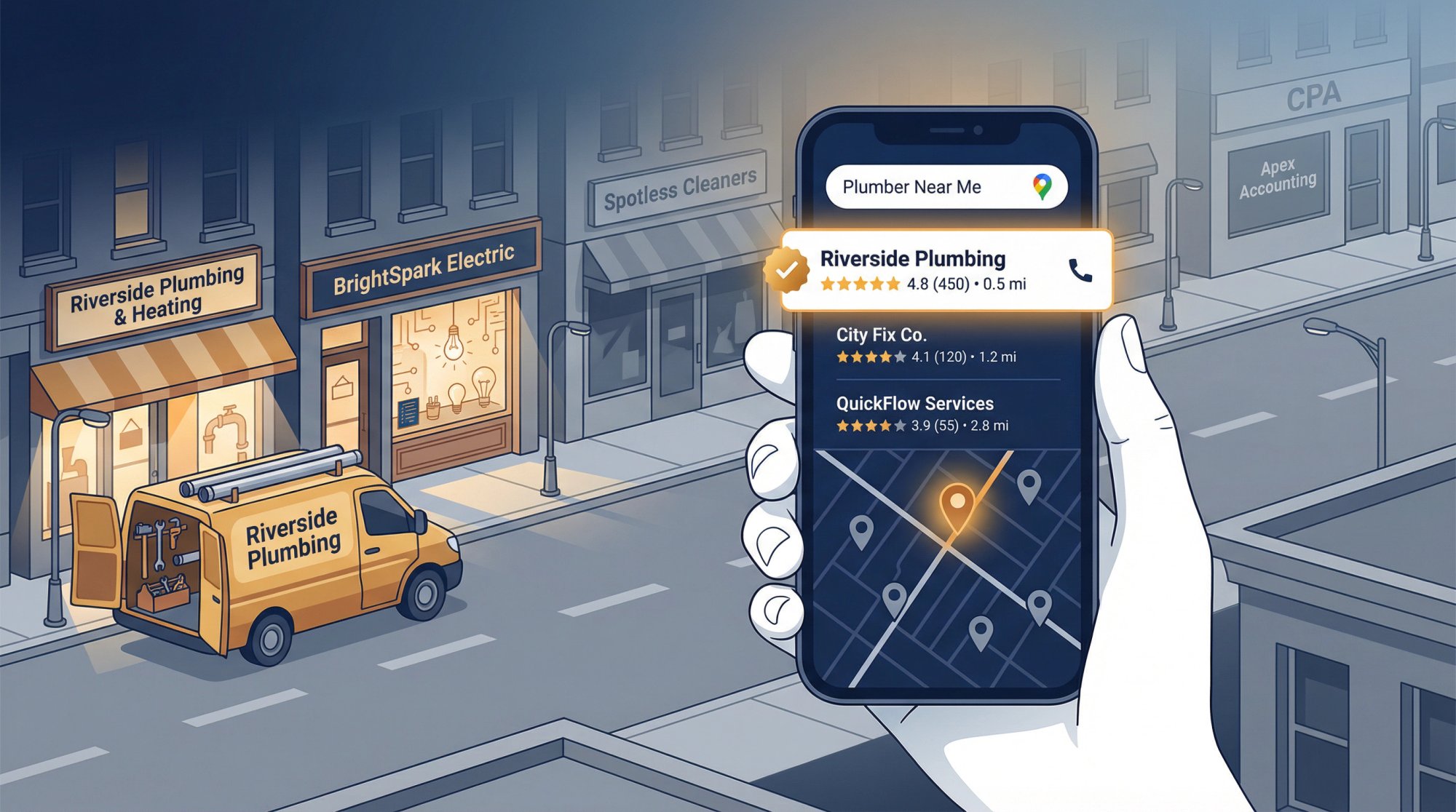
Someone in your city needs an electrician, a plumber, a cleaning crew, or a CPA right now. They pull up Google, look at the local map results, and call the first business that looks credible. If you're not showing up, that call goes to someone else. It doesn't matter that you've been doing this for 15 years, that your work is excellent, or that your prices are fair.
This guide covers the local SEO tips for small businesses that actually produce results in 2026. We're not covering SEO theory. We're covering what to do, in what order, so your business shows up when nearby customers need what you offer. And because ranking is only half the battle, we'll also cover what happens when those calls start coming in.
How Google Ranks Local Businesses in Search#
Before touching anything, it helps to understand what you're actually trying to accomplish.
According to Google's official local ranking guidelines, local results are ranked based on three factors:
-
Relevance: Does your business match what the person searched for?
-
Distance: How close are you (physically or in terms of your service area) to the searcher?
-
Prominence: How well-known and trusted is your business, both online and offline?
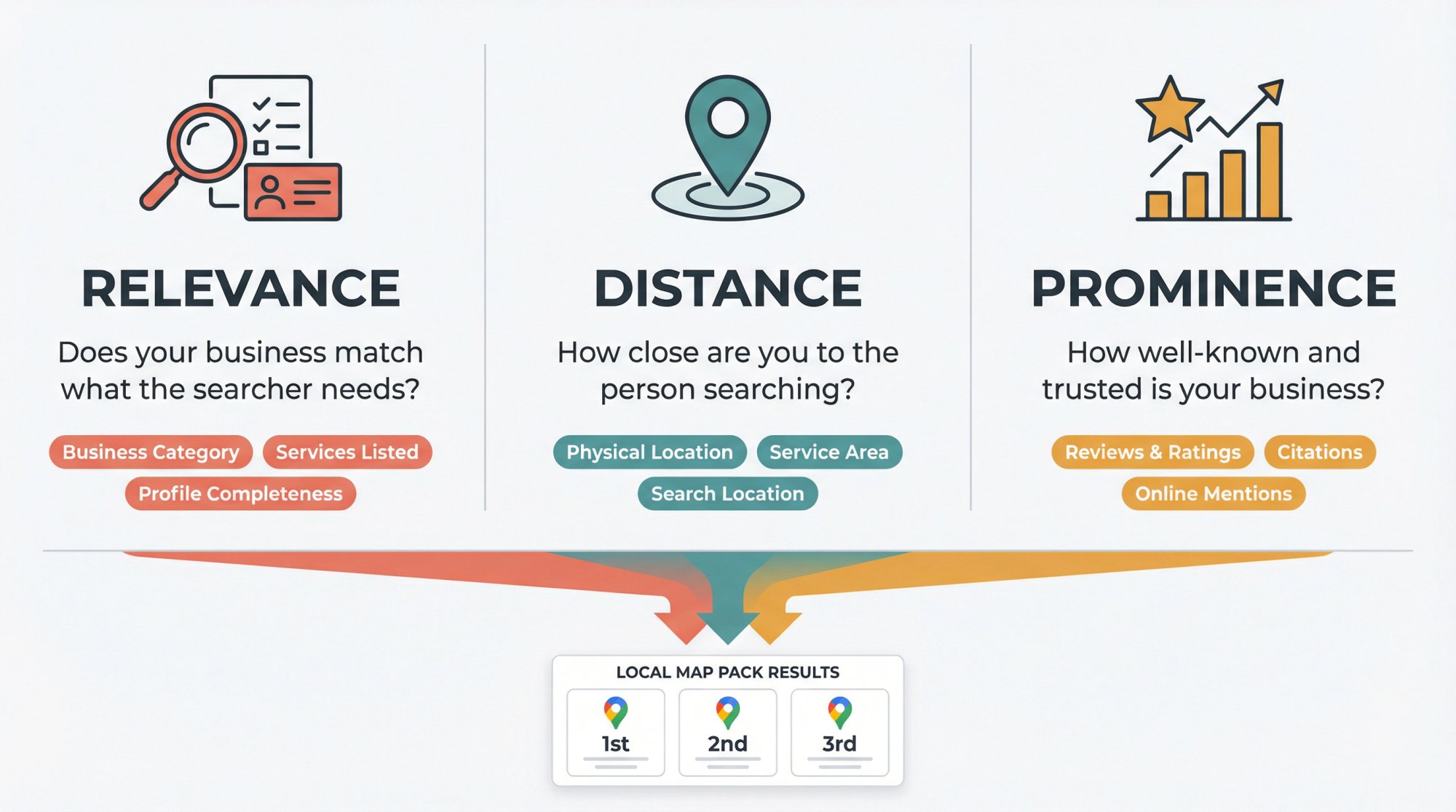
That's it. Every local SEO tip you'll ever read is essentially trying to improve one of those three. When you complete your Google Business Profile, you're improving relevance. When you get listed in local directories consistently, you're building trust signals that feed into prominence. When you earn reviews, you're improving both prominence and conversion rate.
Worth noting: since July 31, 2024, Google has shut down Business Profile chat and call history. If your strategy assumed customers would message you through Google, that option is gone. They'll call now. We'll get to why that matters, including why customers hang up instead of leaving a voicemail when no one answers.
How to Set Up and Optimize Your Google Business Profile#
Google Business Profile (GBP) is your single most important local SEO asset. If you do nothing else in this guide, get this right.
How to Name Your Business on Google Without Getting Suspended#
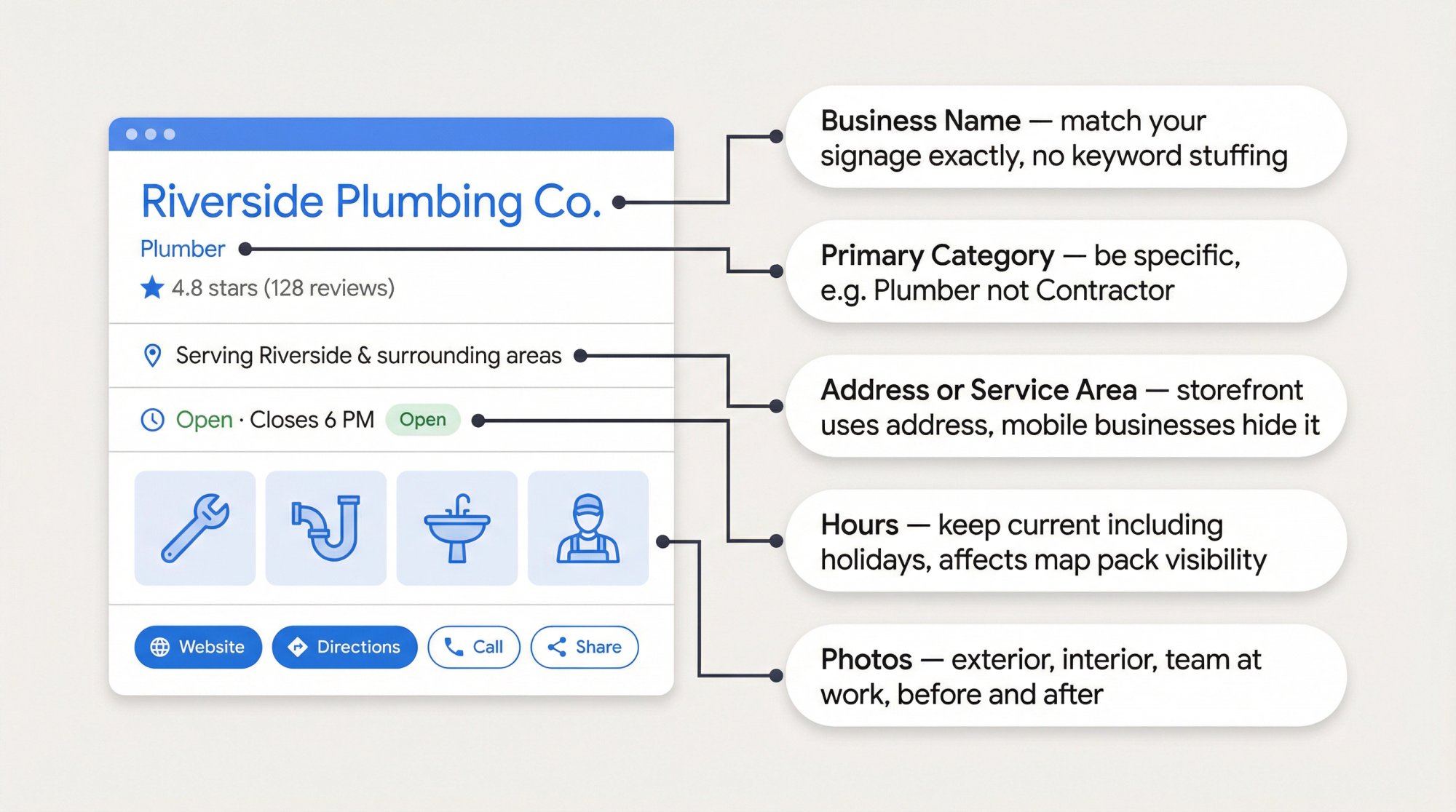
Google's Business Profile guidelines are explicit: your business name should match exactly what you use on signage, your website, and your other marketing. No keyword stuffing in the name. No phone numbers. No taglines.
This is one of the fastest routes to suspension. Businesses that stuff "best plumber near me" into their listing name get flagged. Use your actual name.
How to Choose the Right Google Business Category#
The category you choose is one of the strongest relevance signals you control. Google says to pick the category that best represents what your business does.
The rule of thumb: be specific. "Plumber" beats "Contractor" if plumbing is your main work. "Family Law Attorney" beats "Law Office" if that's your specialty. Get as close to the real thing as possible.
Physical Address vs. Service Area: Which to Use on Google#
This depends on how your business works:
-
Storefront: list your actual physical address
-
Service-area business (you go to customers): hide your address and define the areas you serve
Don't use a mailbox address, a coworking space, or a virtual office. Per Google's guidelines, virtual offices are only eligible if they're actually staffed during business hours and customers can visit. Most aren't.
Why Keeping Your Hours Accurate Affects Local Rankings#
Hour accuracy sounds like a housekeeping task. It's more than that. Recent analysis of local search ranking factors found hours of operation rated as a surprisingly high influence factor for local map pack visibility. The logic is simple: "open now" is part of being useful.
Keep your regular hours current. Update for holidays. If you're closed December 25th but your listing says you're open, you're hurting yourself twice: frustrated customers and a trust signal that says you're not on top of your listing. During high-volume periods, like peak HVAC season in summer or tax season in spring, missing calls when you're busy compounds the problem significantly.
How to Add Services and Photos to Your Google Business Profile#
For services: add them with plain-English names, using the exact language customers use when they call or write reviews. Not internal jargon. If customers say "furnace repair," don't call it "HVAC system maintenance service." Match their language.
For photos: these are proof, not decoration. Aim for:
-
Exterior (so people can find you)
-
Interior (so they know what to walk into)
-
Team at work (real, not stock)
-
Before/after shots for home services
-
Branded vehicles if you have them
-
Licenses and credentials where appropriate
New photos added over time also signal "active business" to Google and to prospective customers.
Key insight: Google's own tips for improving local ranking are almost boring in how basic they are: complete your information, verify your location, keep hours accurate, manage and respond to reviews, add photos. That's it. But boring consistency done relentlessly beats clever tactics that burn out.
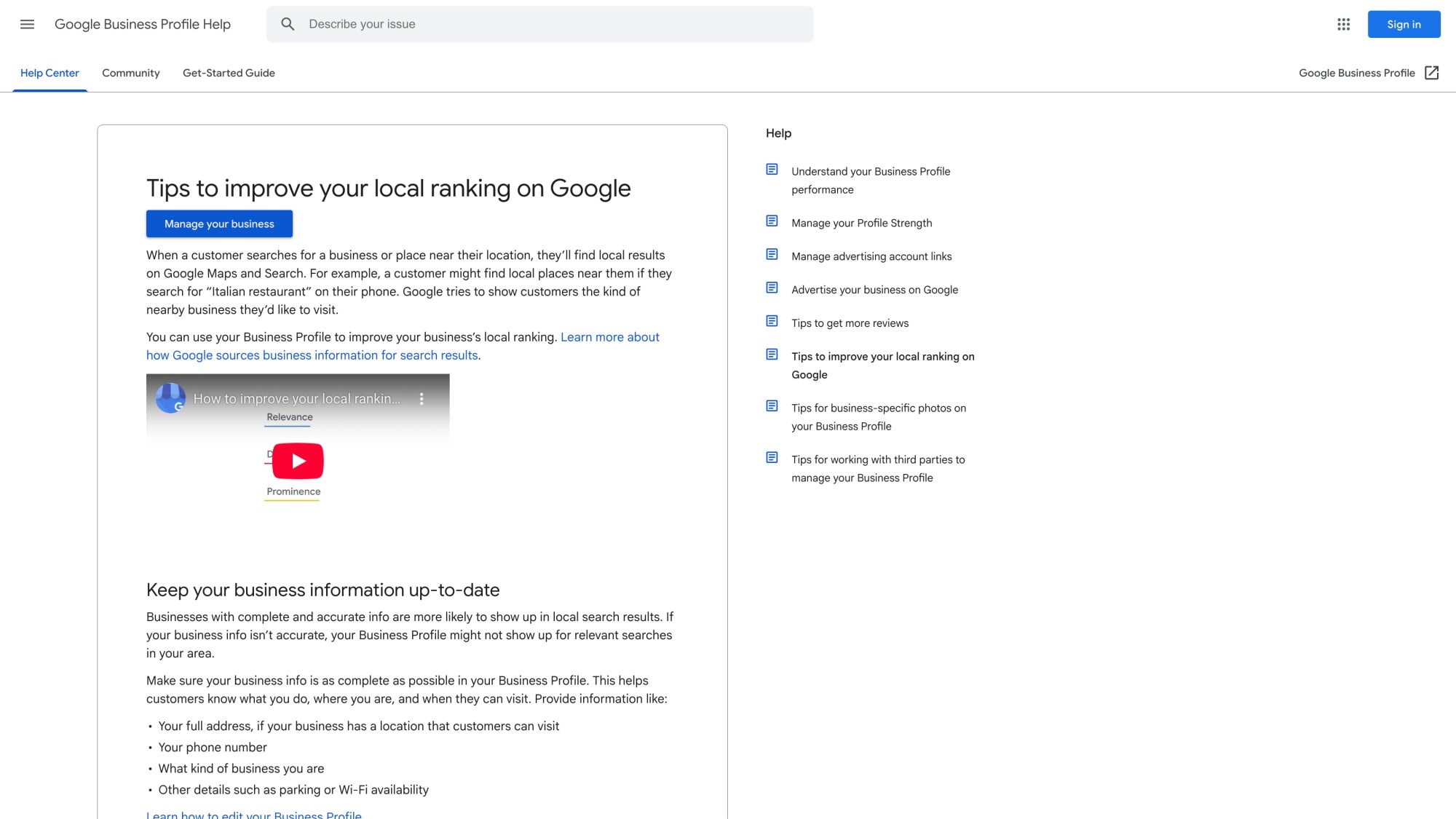
Here is what Google's official help page for local ranking looks like, the same page our ranking guidance above comes from:
How to Optimize Your Website for Local SEO#
Your Google Business Profile can get you into the map pack. Your website helps you win local organic results (the blue links below the map) and reinforces your prominence and relevance signals.
What to Put on Your Business Location Page#
Even if you only have one location, you need a dedicated location page. A strong one includes:
-
Your NAP (name, address, phone number) exactly as listed in GBP and everywhere else
-
Your service area: cities, neighborhoods, counties
-
Your primary services, with links to individual service pages
-
Proof: licenses, insurance, years in business, awards
-
Real photos (not stock)
-
FAQs specific to your local area (permit questions, local codes, weather-related issues)
-
Testimonials and review highlights
Automated answering for small businesses also plays a role here: when a visitor calls from your location page, having someone ready to answer turns that traffic into a booked job.
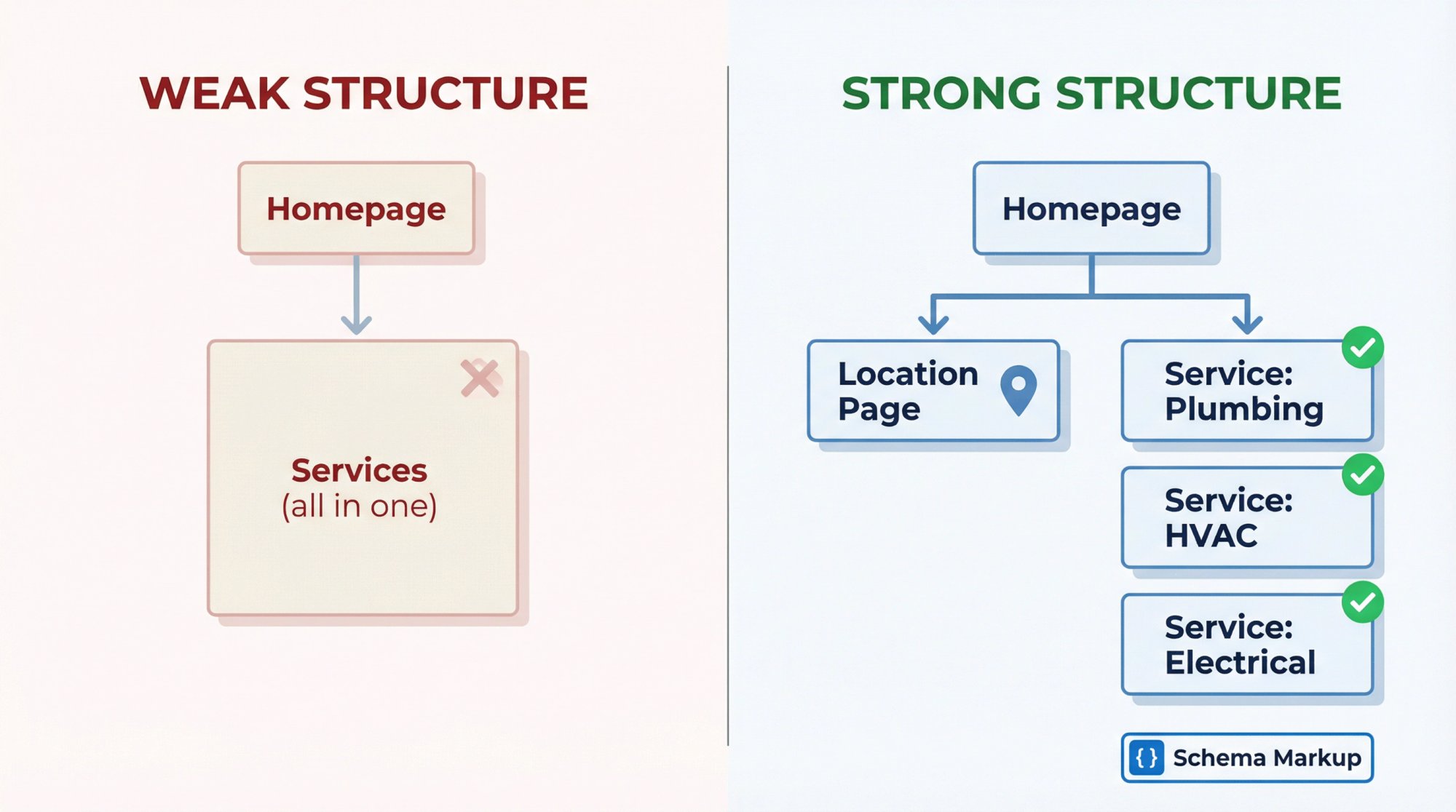
How to Create Service Pages That Rank Locally#
If you offer 10 services and have one generic "Services" page, Google is forced to guess what you actually do. That's not good for relevance.
One dedicated page per service. Each page should answer:
-
What it is
-
Who it's for
-
Rough pricing range (if you can share it)
-
Timeline
-
What's included
-
What can go wrong
-
What happens when they call you
Add location-based language by describing where you work naturally. "We serve homeowners in Denver, Aurora, and Lakewood" is better than stuffing "Denver plumber Denver plumbing Denver" into every paragraph. Think carefully about how you handle those calls once service pages start generating inquiries.
How to Add LocalBusiness Schema Markup to Your Website#
Schema markup tells search engines exactly what your business is and where it operates. Google's structured data documentation for local businesses explains how to add it using JSON-LD.
Don't expect schema to rank you on its own. Think of it as removing ambiguity. When your GBP, website, citations, and schema all say the same thing clearly, you become easier to trust.
How to Build Local Citations and Business Listings#
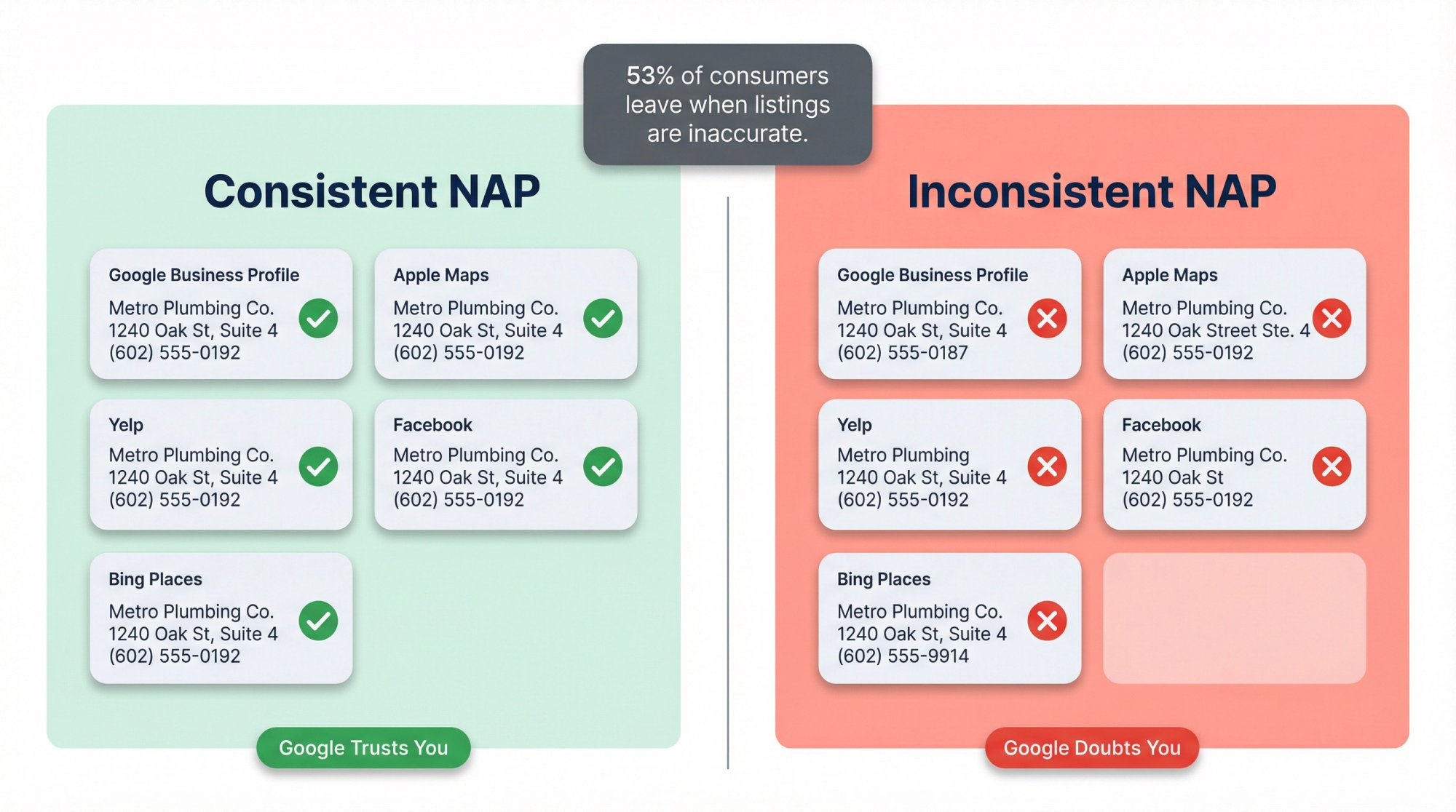
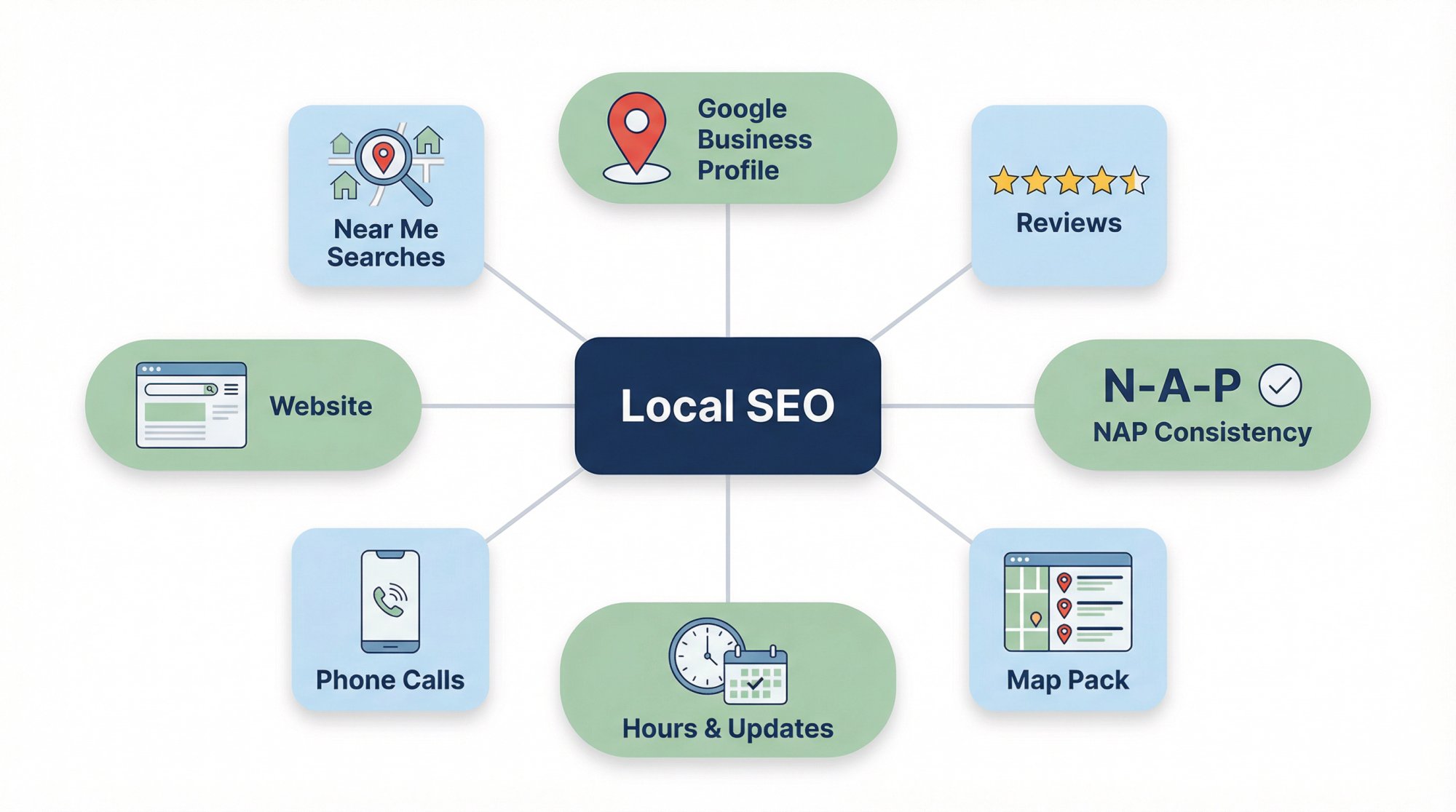
A "citation" is any online mention of your business name, address, and phone number (NAP). It doesn't need to be a link. Just consistent, accurate data across the web.
Why does this matter? Google cross-checks your business details against what's listed across the web. Inconsistent data makes you look less trustworthy.
A 2025 local search consumer behavior study found that 53% of consumers say inaccurate listings will drive them away from a business, and that's before you factor in the SEO impact.
Which Business Directories Matter Most for Local SEO#
Build these in order, because they cover the most ground:
① Google Business Profile (claimed and verified)
② Apple Maps via Apple Business Connect (a growing share of your customers use iPhones and Apple Maps)
③ Bing Places
④ Yelp
⑤ Facebook
⑥ Nextdoor (especially valuable for home services)
⑦ Better Business Bureau (industry-dependent)
Then, depending on your field: legal directories like Avvo or FindLaw, home services platforms like Angi or Thumbtack, or real estate aggregators.
Having consistent listings also supports your small business phone system setup, since the phone number in your citations needs to match what customers actually reach you at.
How Local Data Aggregators Work (And Why They Matter)#
In the US, major local data aggregators (including Foursquare, Data Axle, and TransUnion Digital Business Profile, formerly Neustar Localeze) push data to hundreds of other platforms. Getting clean data into these aggregators saves you from chasing individual minor listings forever.
Check Your Current Listings Before Adding New Ones#
Before adding new listings, audit what already exists. Search your business name, address, and phone number. You may find duplicate listings, old addresses, or wrong phone numbers floating around. Fix those first. Standardize everything (St. vs. Street, Suite vs. Ste) before you expand.
How to Get More Google Reviews Consistently#
Reviews are both a ranking signal and a conversion lever.
BrightLocal's 2026 Local Consumer Review Survey found that 97% of consumers read reviews for local businesses, 41% always read reviews before choosing (up from 29% the prior year), and 74% specifically look for reviews written within the last three months.
That last number matters. Old reviews aren't "banked trust." A pile of 5-star reviews from 2021 tells customers less than a handful of recent ones from this year.
How to Set Up a Repeatable Review Request Process#
Most businesses get reviews in bursts:
-
A big job goes well, so you ask everyone that week
-
Then nothing for three months
-
Then you realize the listing is going stale
A better approach is treating review generation like any other customer follow-up. Make it a repeatable part of your workflow.
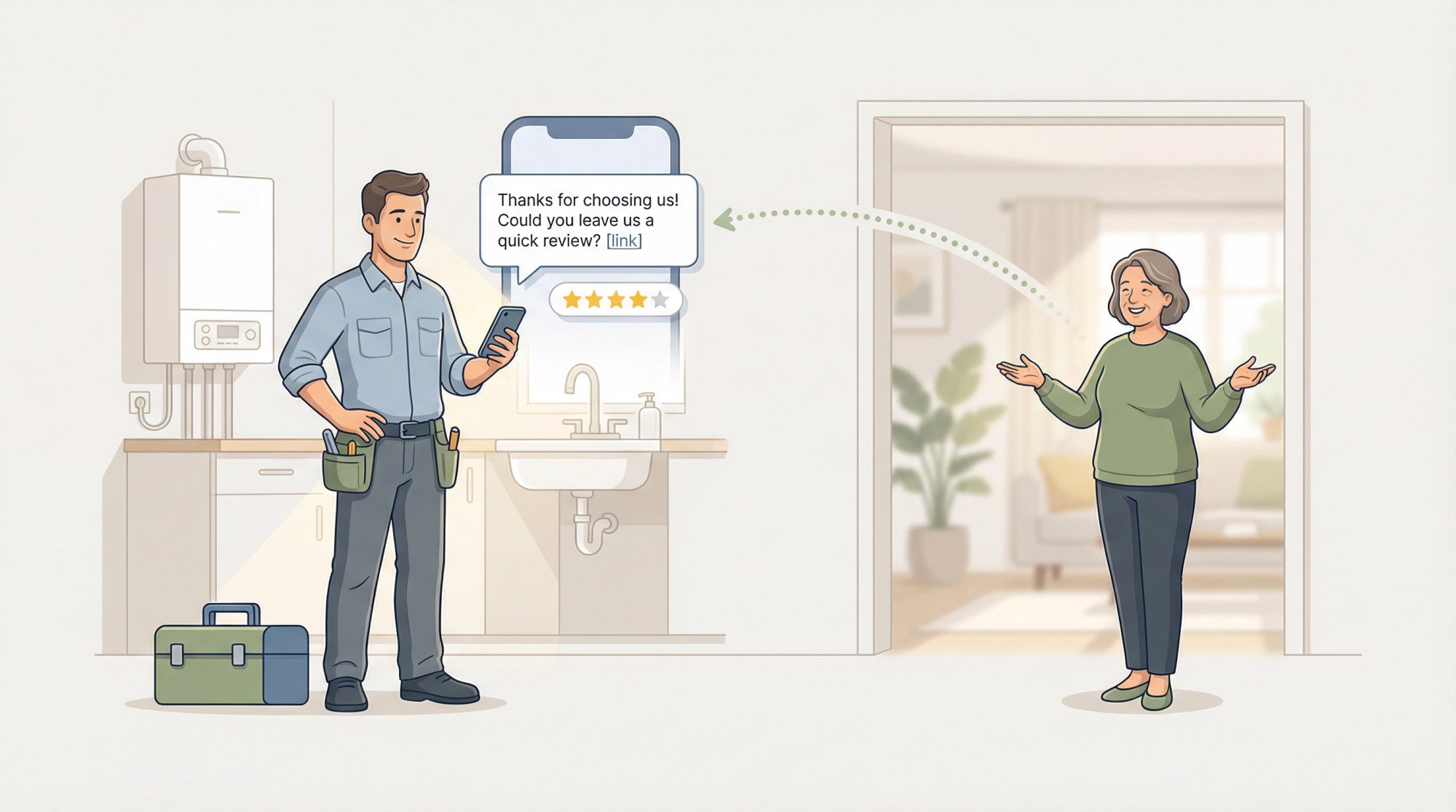
The best time to ask: immediately after value is delivered.
Some examples:
→ HVAC: the system is running and the homeowner is relieved. HVAC businesses that answer every call during peak season are already ahead of competitors who let calls roll to voicemail.
→ Law: the consultation is done and the client has clear next steps. Law firms that capture every inquiry professionally make a strong first impression that sets the stage for reviews later.
→ Auto shop: the car is ready and the customer understands the repair
→ Cleaning: the "wow" moment when they walk in and see the result. Knowing how to increase customer satisfaction at every touchpoint makes review requests feel natural, not transactional.
Review Request Templates: What to Say via SMS and Email#
These are simple on purpose. Fussy, long review requests feel transactional.
Via SMS:
Thanks again for choosing [Business Name]. If you have 30 seconds, could you leave us a quick review? It really helps other local customers find us: [link]
Via email:
Subject: Quick favor?
Hi [Name], thanks for working with us. Reviews help other local customers know what to expect. If you can share a quick note (good or bad), we read them all: [link]
One important rule: never offer discounts, gifts, or anything of value in exchange for a review. Google's review policies explicitly prohibit incentivized reviews and other forms of rating manipulation.
How to Respond to Google Reviews (Good and Bad)#
Google's own guidance on review replies is worth reading directly. The short version: keep replies clear, helpful, and polite. Keep them short. Be "a friend, not a salesperson." Handle negative reviews calmly and offer to help.
People read your responses before deciding whether to call. A thoughtful, calm response to a negative review can actually build more trust than a pile of five-star reviews with no owner engagement. Managing customer expectations starts before the first call and carries through every review you respond to.
Why Fake Reviews Can Get Your Profile Suspended#
Fake reviews are tempting when a competitor seems to be pulling ahead. Don't. Google's content policies define fake engagement as content that doesn't reflect a genuine experience, and Google states that profiles violating these policies can lose the ability to receive new reviews, have reviews unpublished, or show warning messages on the profile.
Build the real thing. It takes longer and it's worth it.
How to Get Local Backlinks and Mentions for Your Business#
Prominence, Google's third ranking factor, is essentially this question: "How confident is Google that you're real, reputable, and established?" One of the clearest signals is whether other websites mention or link to you.
Local links carry weight because they're hard to fake. A real sponsorship of a local youth sports league means you're actually part of the community.
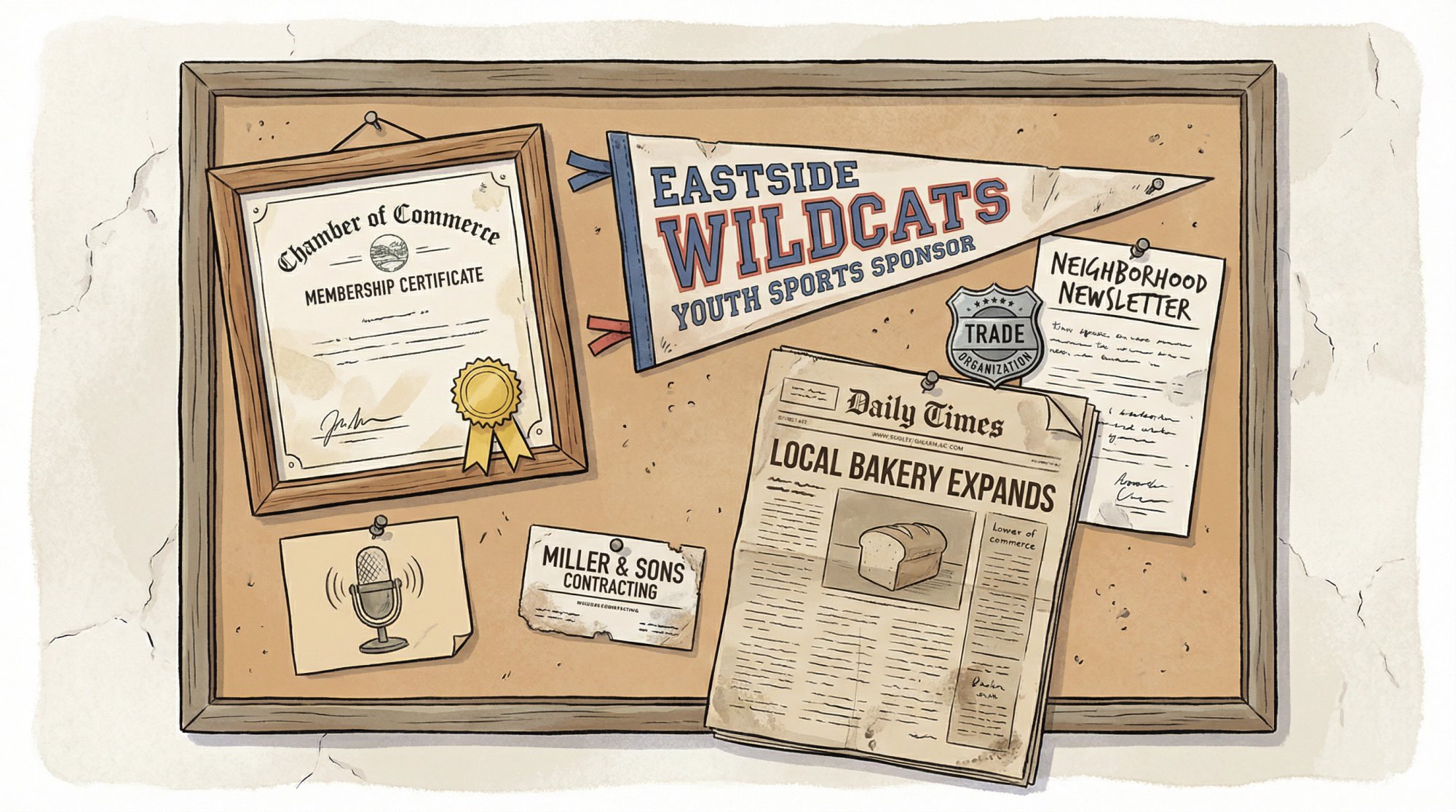
The best sources to pursue:
-
Chamber of commerce membership (most have member directories)
-
Local business associations in your industry or geography
-
Local sponsorships: school events, charity runs, neighborhood organizations
-
Supplier and partner pages: if you're a preferred contractor for a local supplier, ask to be listed on their website
-
Local newspapers and neighborhood newsletters
-
Trade organizations and licensing bodies
-
Local podcasts (even a short guest appearance often comes with a link)
You don't need 100 of these. A handful of genuine local links from real community sources outperform dozens of low-quality directory links. Understanding which industries most need outsourced receptionist services helps clarify why phone availability and local presence go hand in hand for businesses building authority in their community.
What Local SEO Content Actually Works in 2026#
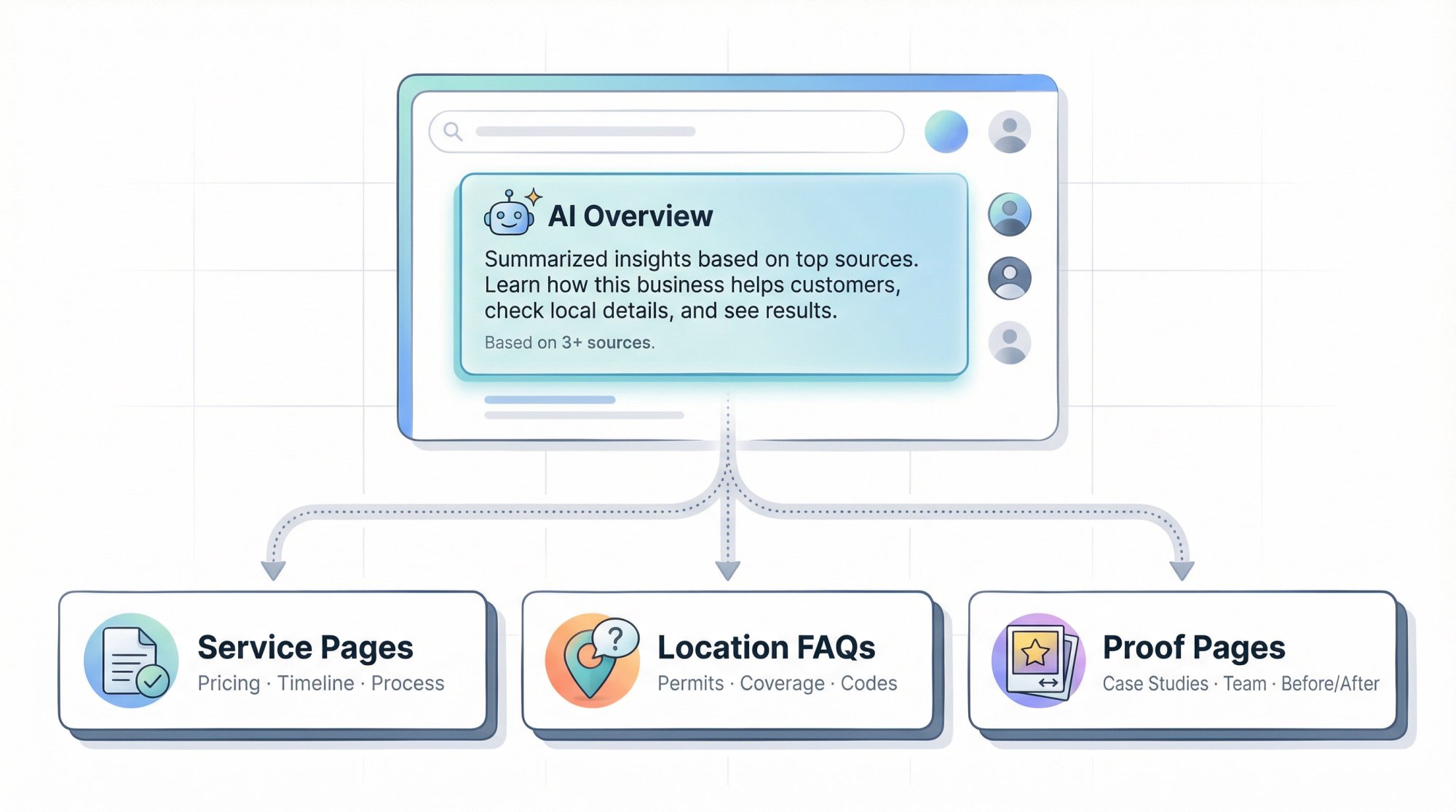
Local SEO used to be almost entirely about your GBP and citations. That's still the foundation, but a 2025 local search consumer behavior study found that 60% of users click on AI-generated overviews in Google Search, and 84% search for local businesses online daily. The implication: search engines are summarizing you before people even visit your site.
This means your content needs to be clear enough for an AI system to summarize accurately, not just for humans to read. Understanding what customer service automation looks like helps contextualize how AI-driven search and AI-powered business tools work together.
The Best Types of Content for Local Business SEO#
Service pages that answer the hard questions.
Most small business service pages describe what they do without answering the questions customers actually have: How much does this cost? How long will it take? What do I need to do to prepare? What if something goes wrong? Pages that answer these honestly convert better and rank better.
Location-specific FAQs.
People search things like "does installing a new electrical panel require a permit in [city]?" and "do you service [specific neighborhood]?" If your pages answer those questions, you show up for those searches.
Proof pages.
Case studies. Before/after galleries. "Our process" pages. "Meet the team" pages. These aren't just nice to have. They help reviews and referrals convert, because people feel like they already know you before they call.
What to Do When Local SEO Starts Driving Calls#
This is the part most local SEO guides skip.
You do the work. You fix your GBP, build citations, gather reviews, earn links. Your phone starts ringing more. And then... you miss calls because you're on a job, because it's 8pm, because you're with another customer.
That's not an SEO failure. But it's a revenue failure.
According to Google's own announcement, Business Profile chat is gone as of July 2024. Customers can't message you through Google anymore. The phone is the primary contact channel for local businesses. And your best leads are the ones who call: they're high-intent, ready to buy, and making a real-time decision about who to hire.
The problem? Most small businesses miss a significant portion of their calls, especially:
-
After business hours
-
When staff are with other customers
-
During high-volume periods (think HVAC in July, accountants in April)
-
On weekends
A caller who doesn't reach you at 6:30pm on a Thursday isn't necessarily going to call back tomorrow. They're calling the next business on the list right now. The real cost of unanswered calls is bigger than most business owners realize, and how much business you lose from voicemail alone often surprises them.
Why Missing Calls After SEO Success Costs You Revenue#
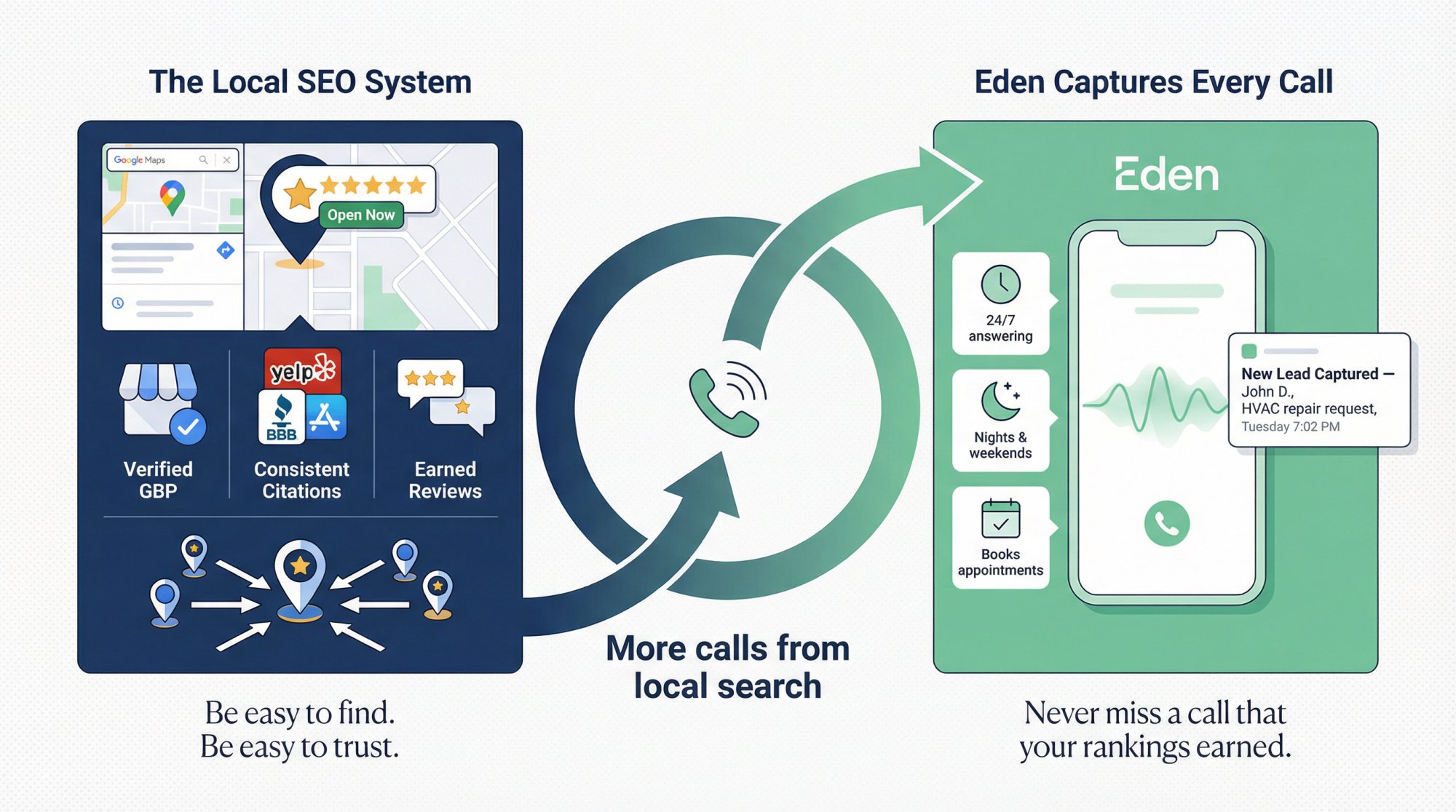
We built Eden specifically for this problem. When your local SEO starts working and calls increase, Eden answers calls 24/7 using natural AI conversation. It captures the caller's name, number, and what they need. If you're on Pro, it can even book appointments directly.
The setup takes about five minutes: pick a phone number, point it at your business, and set up call forwarding so calls route to Eden when you're unavailable. Our call forwarding setup guide covers every major carrier and VoIP provider step by step.
If you want more control (answer when you can, hand off to Eden only when you can't), that's conditional call forwarding. Your phone rings first. Eden only picks up if you don't answer within a set number of rings. You stay in control, and nothing falls through the cracks.
For businesses that are closed overnight, the after-hours answering solution means you're capturing leads that would otherwise hit voicemail and disappear. For calls that come in on weekends, the same principle applies.
A quick summary of what Eden handles:
| Feature | What It Means for You |
|---|---|
| 24/7 AI answering | No more missed calls during evenings, weekends, or busy periods |
| Instant lead capture | Name, callback number, and service need sent to you in real time |
| Bilingual (English and Spanish) | Serve every caller in your community |
| IntelliSpam filtering | Robocalls blocked automatically. Only real customers get through |
| Searchable call transcripts | Every conversation logged so nothing gets lost |
| Five-minute setup | Provider-specific call forwarding guides for every major carrier |
Learn how AI phone answering works and why it's become the most practical choice for small businesses that can't afford to miss calls. For a full overview, see our guide to AI call answering services.
Local SEO brings customers to your phone. Eden makes sure that phone is always answered.
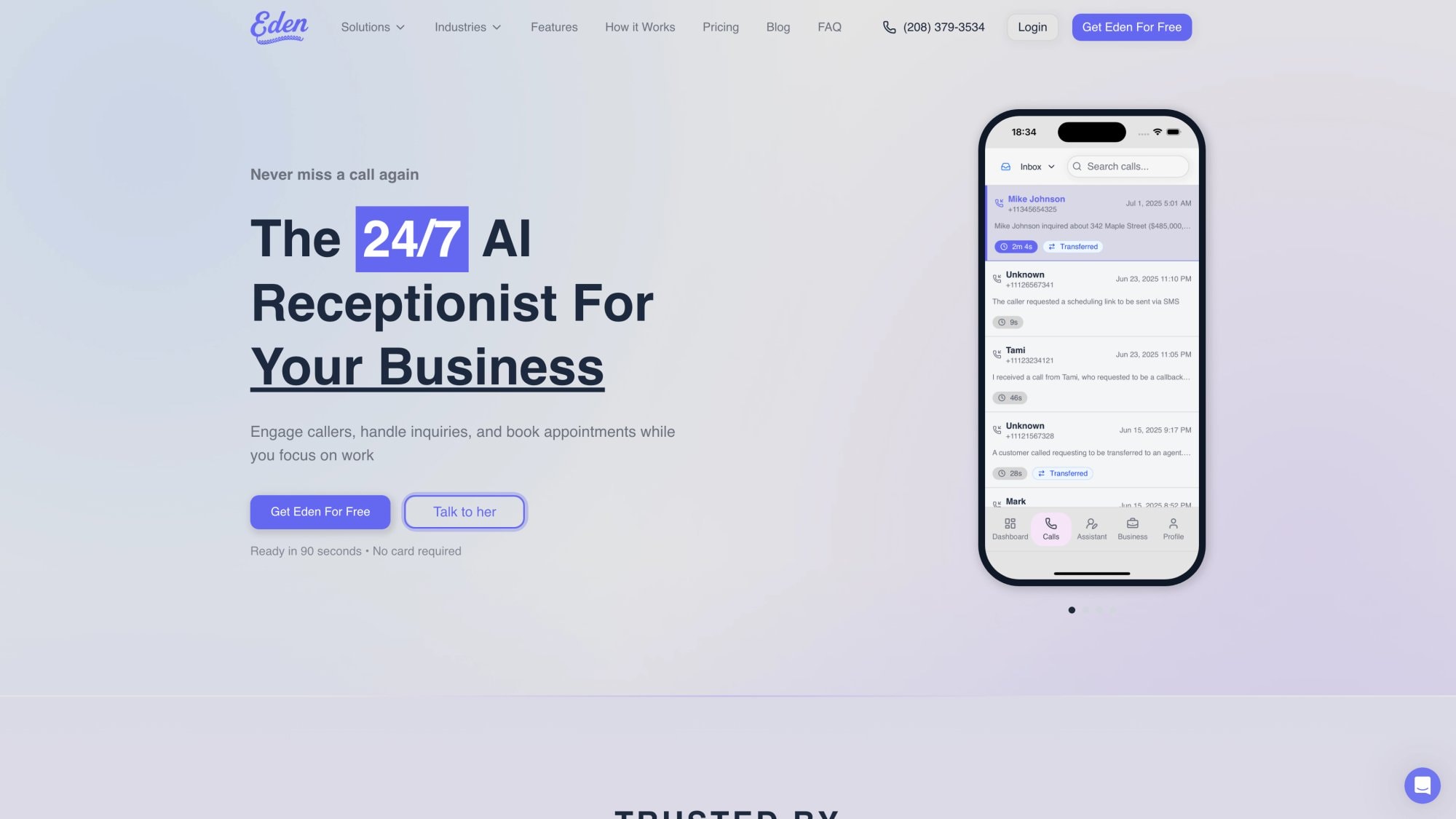
This is what Eden's homepage looks like: the AI receptionist built specifically to answer the calls your local SEO drives:
Try it free: 30 minutes of call time at no cost. Get started at ringeden.com
Local SEO Action Plan: 7-Day, 30-Day, and 90-Day Roadmap#
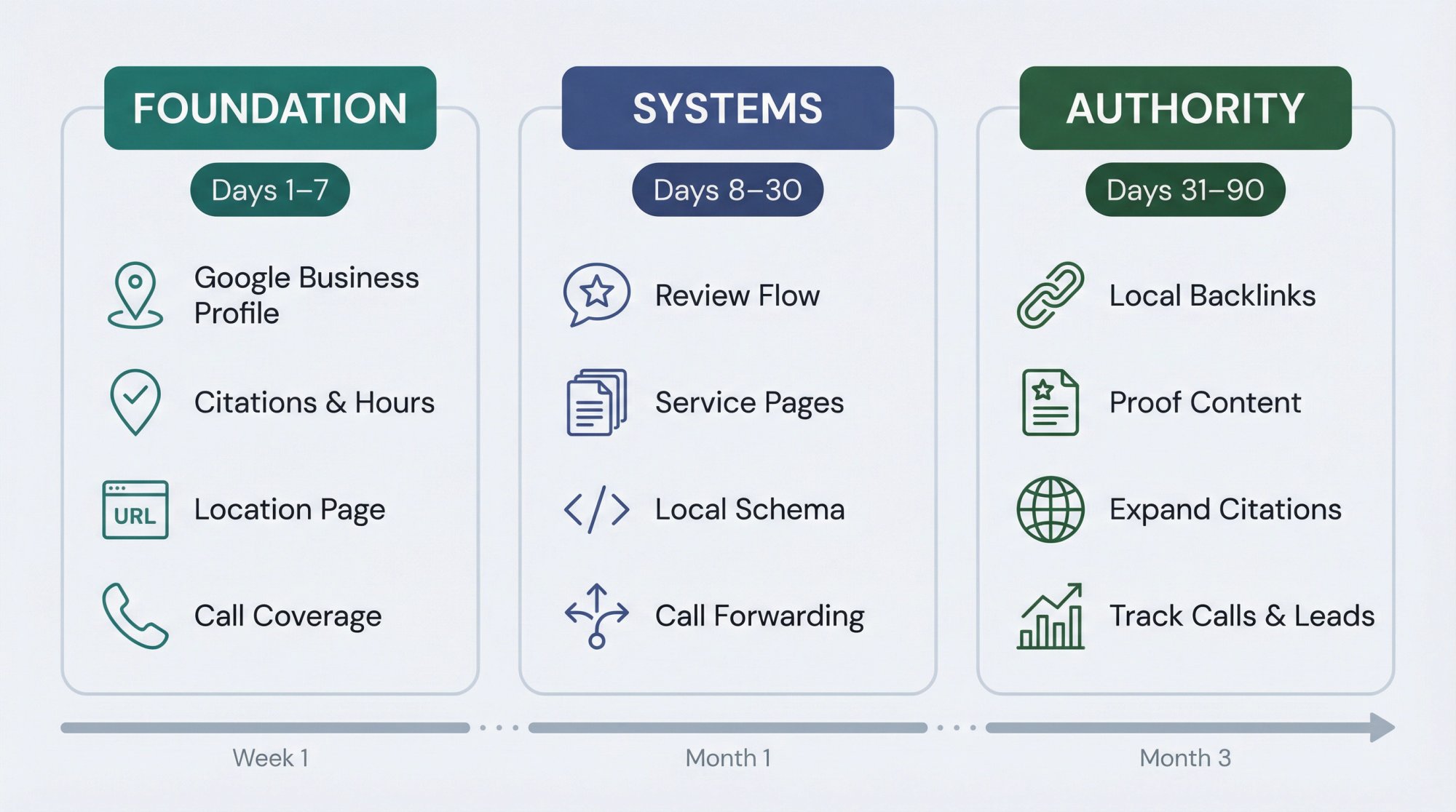
Local SEO compounds over time, which means starting with the highest-ROI actions first matters. Here's the full roadmap:
| Phase | Timeframe | Focus |
|---|---|---|
| Foundation | Days 1 to 7 | Fix what's actively hurting you: GBP, hours, address, citations |
| Systems | Days 8 to 30 | Build review flow, add service pages, get schema in place |
| Authority | Days 31 to 90 | Earn local links, create proof content, expand citations |
Days 1 to 7: Fix What's Hurting Your Local Rankings Now#
This week is about fixing the things that cost you the most when they're wrong.
-
Claim and verify your Google Business Profile
-
Fix your business name to exactly match your signage and website (no keyword stuffing). See Google's Business Profile guidelines
-
Set your correct primary category
-
Update hours (including upcoming holidays)
-
Add your services, description, and photos
-
Fix address vs. service area settings. See the guidelines here
-
Clean up your top four citations: Apple Maps, Bing Places, Yelp, Facebook
-
Add a proper location page to your website
-
Set up a phone answering service or call coverage so the calls you're about to generate are actually answered
Days 8 to 30: Build Your Review System and Service Pages#
Now that your foundation is solid, build the systems that bring steady traffic.
-
Set up your review request flow (SMS and/or email template)
-
Brief your team on when and how to ask
-
Start responding to existing reviews weekly. See Google's guidance here
-
Publish 3 to 5 service pages for your most important offerings
-
Add LocalBusiness schema to your location page. See Google's structured data documentation
-
Set up call forwarding to your answering service so your new traffic has somewhere to go
Days 31 to 90: Earn Local Authority and Links#
By now your baseline is clean and your review flow is running. Add authority.
-
Pursue 1 to 2 local links per month (chamber, associations, sponsorships, partners)
-
Publish 2 to 4 proof-based content pieces (case studies, galleries, before/after)
-
Expand citations if needed (submit to data aggregators for broader coverage)
-
Track calls and form fills from GBP, not just rankings
Common Local SEO Mistakes That Cost Small Businesses Rankings#
The most common local SEO errors are also the most fixable. Here's what to watch for.
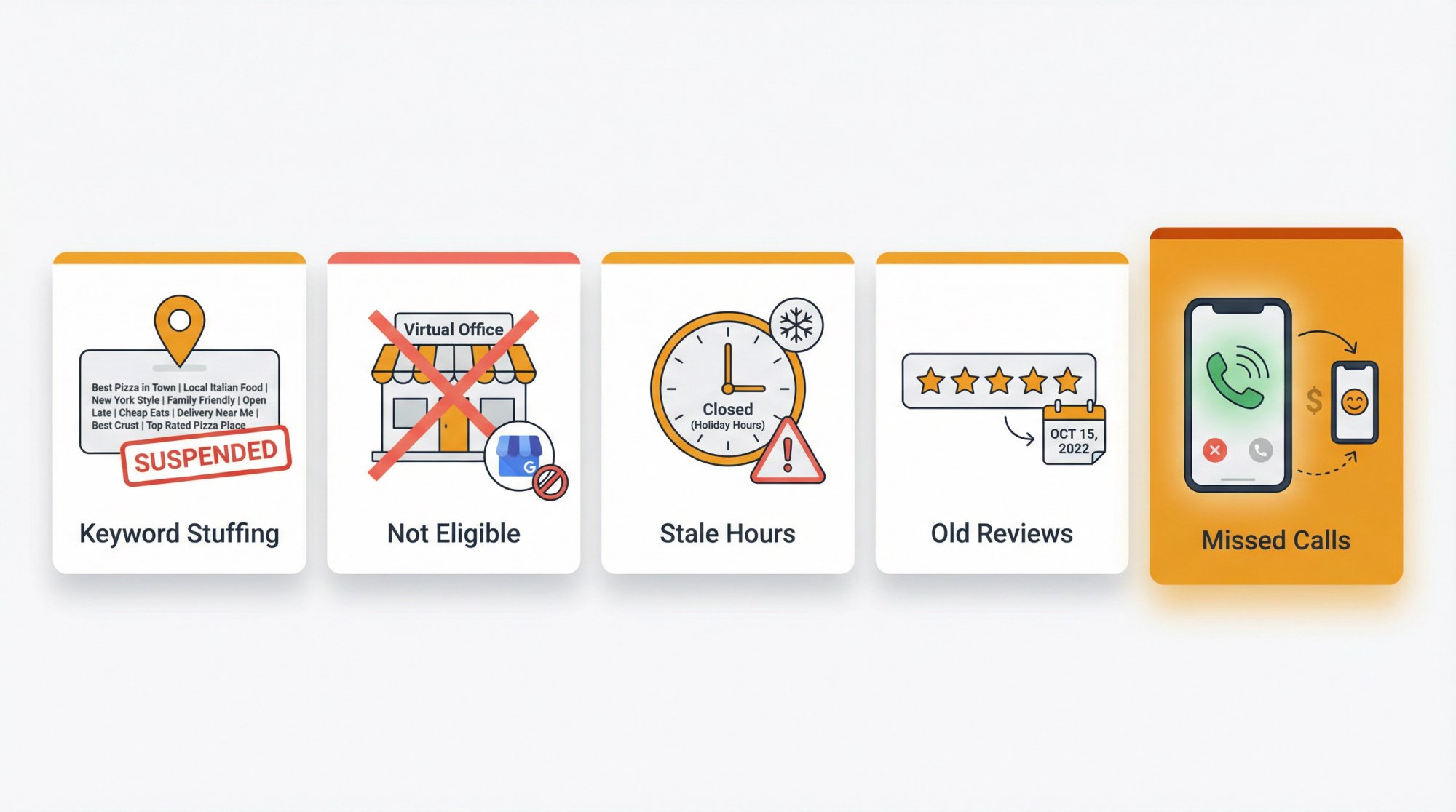
Keyword-stuffing the GBP business name. Tempting. Risky. Google explicitly prohibits unnecessary information in the business name, and it can get your profile suspended. Use your real name.
Using a virtual office or mailbox address. These aren't eligible for GBP unless they meet specific criteria. A coworking space address where no customers are actually received isn't going to cut it.
Letting hours go stale. Especially around holidays. Inaccurate hours cost you trust and potentially ranking. Google recommends keeping your business info updated, and hours accuracy is one of its listed tips for improving local ranking.
Treating reviews as a one-time push. BrightLocal's 2026 survey found that 74% of consumers look specifically for reviews written in the past three months. A burst of reviews two years ago isn't giving you the recency signal customers need.
Ranking well but missing calls. This is silent and devastating. Your SEO is working. Customers are calling. But you're in the field, or it's after hours, or you're with someone else. A lost caller doesn't wait, they call your competitor. When the phone rings while you're with a client, having a plan matters. Setting up conditional call forwarding so Eden catches what you can't is one of the simplest operational fixes a local business can make.
Monthly Local SEO Checklist for Small Businesses#
Run through this once a month to keep everything current.
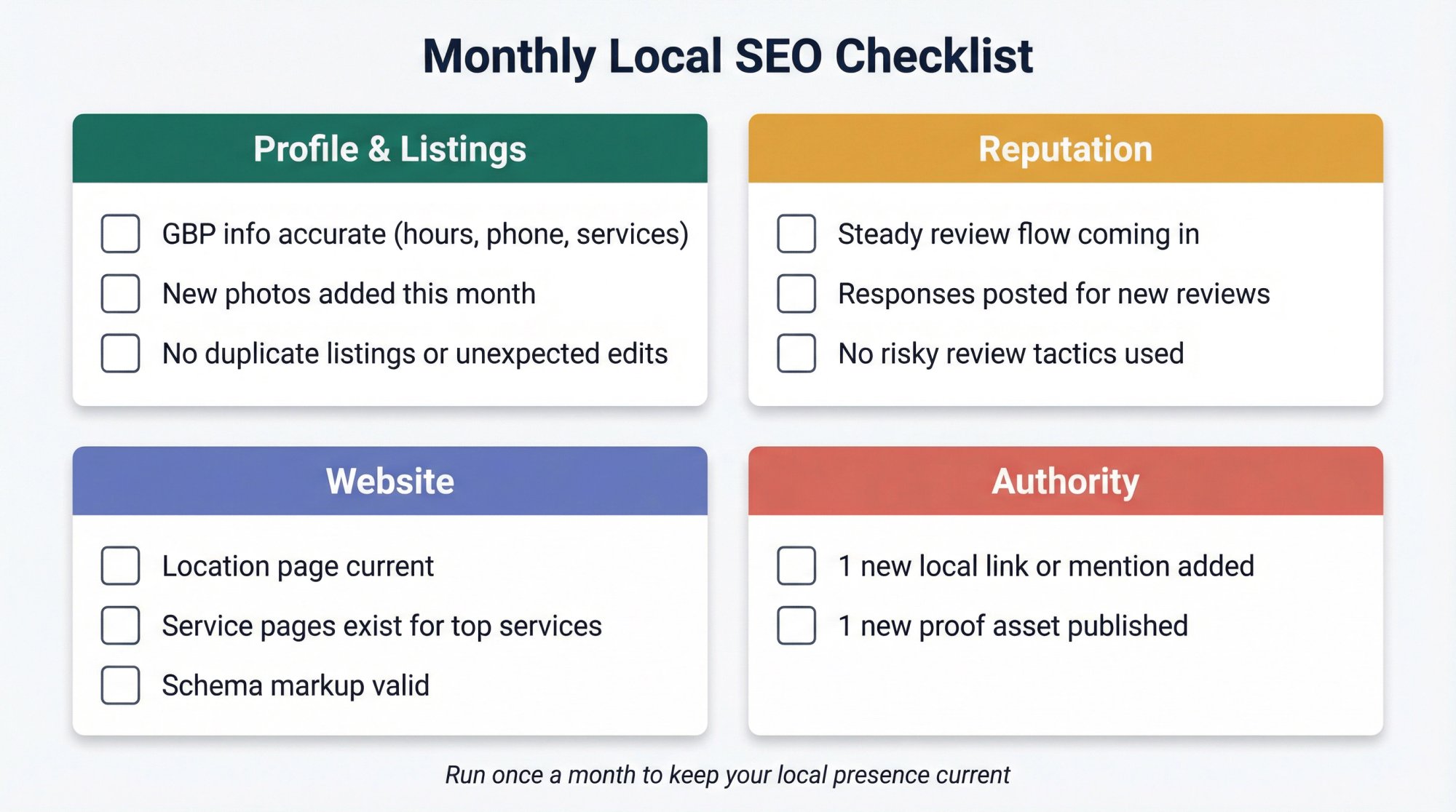
Profile and Listings
-
GBP info accurate (hours, phone, services)
-
New photos added in the last 30 days
-
No duplicate listings or unexpected "suggested edits"
-
Apple Maps and Bing listings accurate
Reputation
-
Steady review flow coming in (not a drought)
-
Responses posted for new reviews, following Google's review reply guidelines
-
No risky tactics (incentives, gating, fake reviews). See Google's review policies
Website
-
Location page current (team, proof, FAQs)
-
Service pages exist for your top-revenue services
-
Schema valid. See Google's structured data documentation
Authority
-
1 new local link or mention added
-
1 new proof asset (case study, gallery, before/after) published
Frequently Asked Questions: Local SEO for Small Businesses#
How long does local SEO take to work?
Realistically, three to six months before you see meaningful movement in competitive markets. Some actions (like fixing GBP errors or completing missing fields) can have faster effects. Citation cleanup and review building compound over time. The 7-day actions above tend to show results fastest because you're fixing errors that are actively hurting you.
Does my business need a website to rank in local search?
No. You can appear in the map pack with just a Google Business Profile. But a website significantly improves your chances because it reinforces your relevance and prominence signals. It also converts visitors better than a GBP alone.
What's the difference between local SEO and regular SEO?
Regular SEO (often called "organic" SEO) focuses on ranking blue links for any searcher anywhere. Local SEO focuses specifically on geographic searches: "near me" queries, city plus service searches, and the map pack. Local SEO prioritizes your GBP, NAP consistency, local citations, and reviews more heavily than broad link-building.
How many reviews do I need?
There's no magic number. What matters more is recency and pace. Consistently getting 2 to 4 new reviews per month beats having 150 reviews all from 2019. Set a sustainable system rather than chasing a target.
Can I ask customers to remove bad reviews?
You can ask, but you can't require it or offer compensation for removing reviews. That violates Google's review policies. The better approach: respond to the negative review professionally and publicly, then reach out privately to resolve the issue. A resolved complaint often turns into a changed review on its own.
What is NAP and why does it matter?
NAP stands for Name, Address, Phone number. It's the core data that ties your business identity together across Google, directories, and the web. When your NAP is inconsistent (different phone numbers, abbreviated vs. full addresses), it creates confusion for both search engines and customers. Keep it identical everywhere.
How do I appear in "near me" searches?
Near-me searches are triggered by geographic intent, not the literal phrase "near me" in your profile. To rank for them: have a verified GBP, accurate location or service area, category match, strong reviews, and local citations. There's no "near me" keyword to stuff into your listing. A virtual receptionist for small business ensures that once those searches convert into calls, every call is handled.
Should I respond to negative reviews publicly?
Yes, always. Google recommends responding to all reviews, including negative ones. A calm, helpful response shows prospective customers that you're a real business that cares. Leaving negative reviews unanswered looks worse than the review itself.
What happens if my Google Business Profile gets suspended?
You'll lose visibility in local results immediately. Common causes: name keyword-stuffing, address issues (virtual office, ineligible location), guideline violations. If suspended, you'll need to appeal through Google's reinstatement process. This can take weeks. Prevention is far better than dealing with suspension after the fact.
Do I need to hire an SEO agency to do local SEO?
Not necessarily. The fundamentals (GBP optimization, citations, review building, location page) are absolutely learnable and doable by a small business owner or a team member. An agency makes sense when you want to scale faster, operate in highly competitive markets, or don't have time to manage it yourself. Start with the basics yourself so you understand what you're paying for if you do hire someone. And if you can't afford a full-time receptionist, that doesn't mean calls have to go unanswered. Even asking whether you need a virtual receptionist at all is a useful starting point.
What should I do once calls start increasing?
That's the right question to ask early. The benefits of using AI receptionists become especially clear when call volume grows faster than your ability to manually answer. An AI receptionist vs. voicemail vs. human comparison helps clarify your options at different stages of growth.
Local SEO Is a Long-Term System, Not a Quick Fix#
You don't win at local search by finding a clever exploit. You win by being consistently and verifiably trustworthy: accurate data everywhere, regular reviews, a clear website, genuine local presence.
The businesses that win are the ones that are easy to verify, easy to understand, and consistently described across every platform where customers might find them.
Do the fundamentals relentlessly. Add proof and authority over time. And as your local SEO starts working and more calls come in, make sure your business is actually capturing them. Eden is the simplest way we know to make sure no inbound call goes unanswered (day, night, weekend, or holiday). Explore the full AI receptionist solution or see how automated answering for small businesses fits into a complete local growth strategy.
Ready to stop missing calls? Start your free trial at ringeden.com. 30 minutes free, no credit card required.
Ready to Transform YourCustomer Experience?
Join hundreds of businesses using Eden AI to handle calls, book appointments, and provide 24/7 customer support.