Do I Need a Business Phone Number? (2026)
A business phone number isn't legally required, but once real customers call, you want one. Which type to get, when it matters, and what Google needs.
February 24, 2026
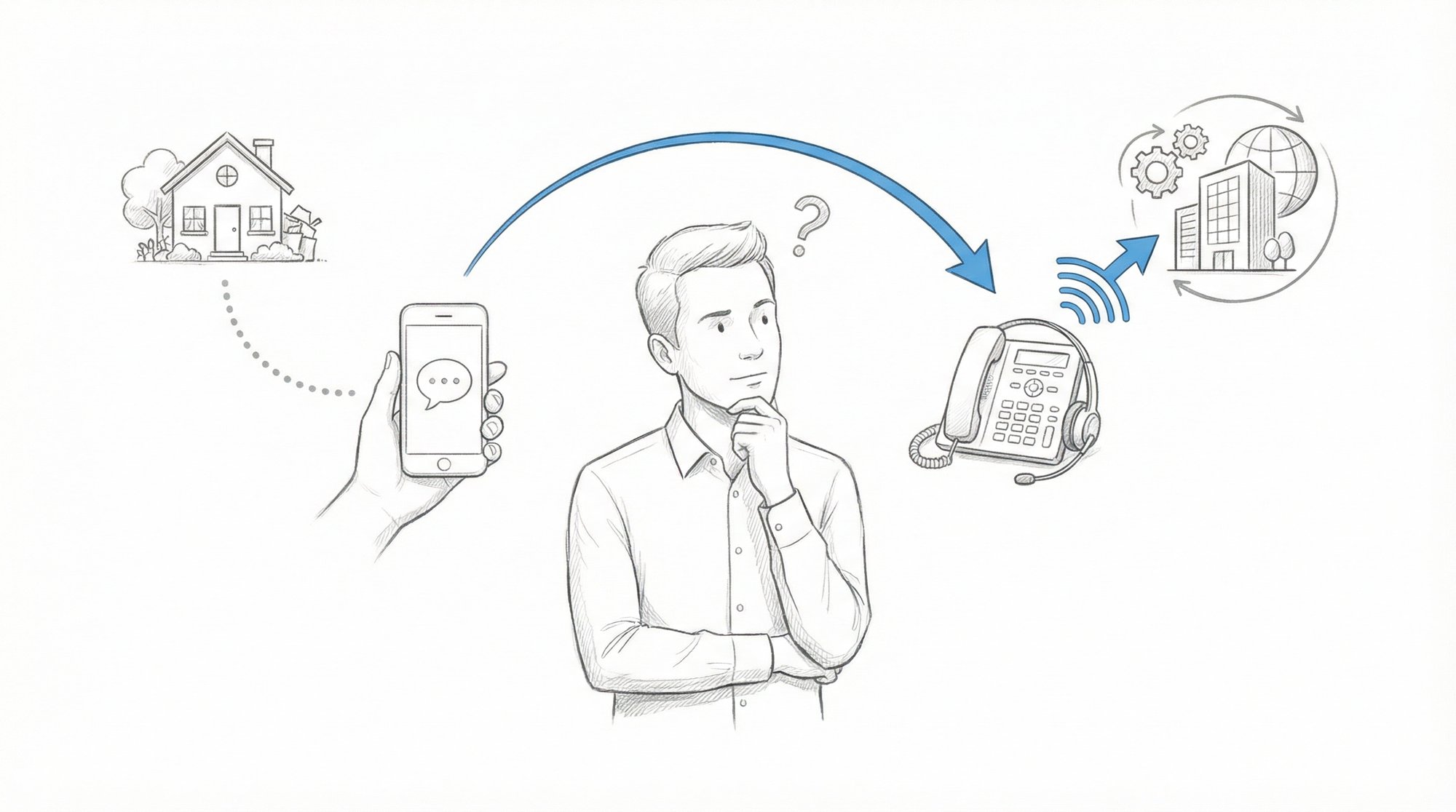
If you're typing "do I need a business phone number" into Google, you're probably not asking about legal requirements. You're asking something more specific, something that's actually keeping you up at night.
Maybe you're wondering if you can keep using your personal cell without it looking unprofessional. Maybe a client texted you at 10pm last night and you couldn't turn it off. Maybe you just hired someone and you're realizing your whole phone setup is tied to your personal identity. Or maybe your Google Business Profile is getting complicated and you don't know if your current number is messing up your local search rankings.
The short answer: a business phone number isn't legally required in most cases. But if real customers call your business, you almost certainly want one. And the reasons have less to do with looking professional and more to do with not losing money.
This guide covers the practical reality of business phone numbers in 2026: what they actually are, what type you need, what Google expects, what texting compliance looks like now, and exactly where a tool like Eden fits into the picture.
What Is a Business Phone Number (and How Does It Work)?#
Most people think of a phone number as something tied to a device. It's not. A phone number is a routing address. Nothing more.
Think of it like a mailing address. A customer "sends" a call to your number, and the phone network routes it to wherever you tell it to go: your cell phone, a colleague's phone, voicemail, a call queue, an automated system, or an AI receptionist. The number itself doesn't ring anywhere specific. You decide where it rings.
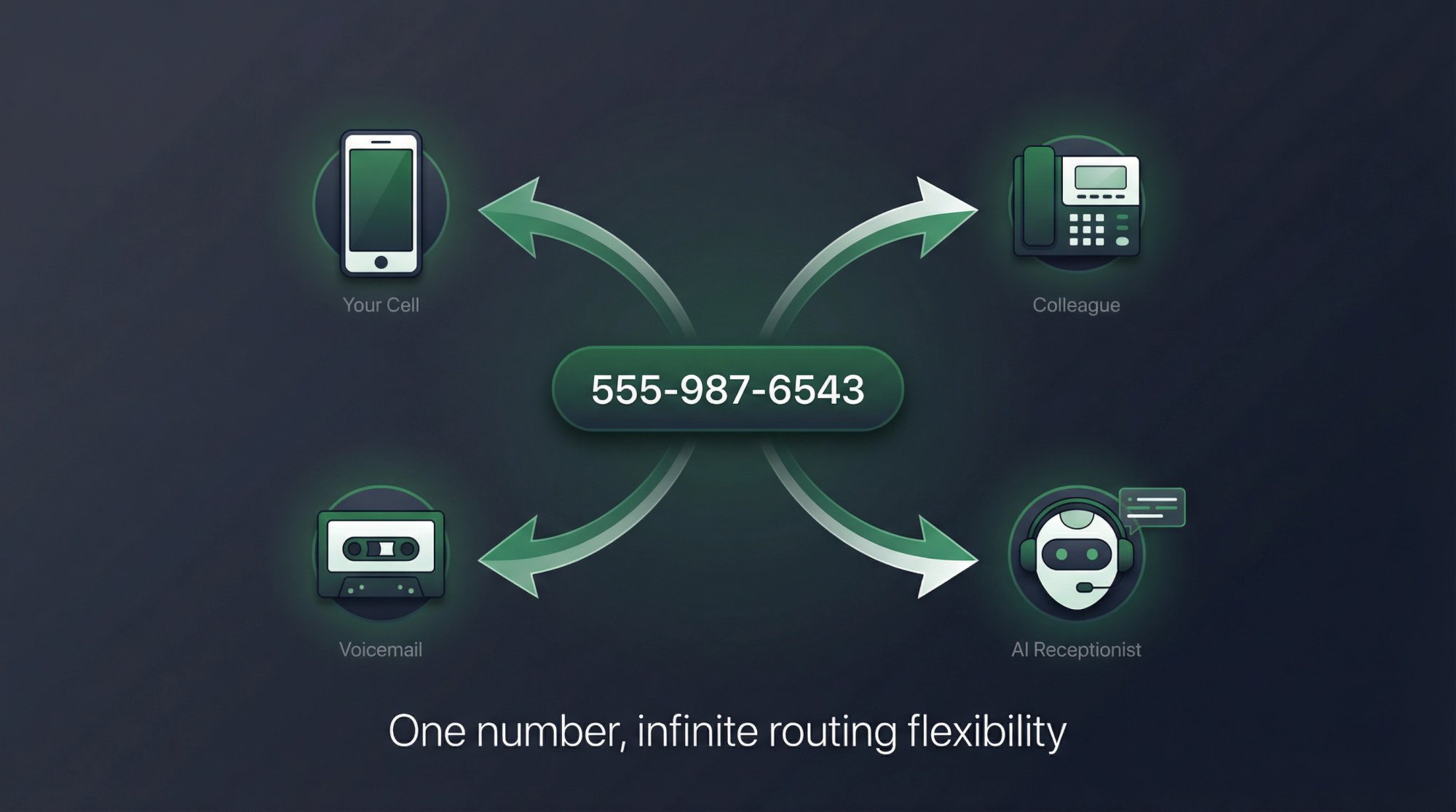
That distinction matters because when people say "get a business phone number," they're usually asking for four different things at once:
-
Ownership: the business controls the number, not any individual employee
-
Routing: calls reach someone reliably, on whatever device or system makes sense
-
Separation: work calls don't bleed into your personal life (or vice versa)
-
Brand consistency: customers see the same number across your website, Google listing, ads, and business cards
A personal cell number you use for business technically routes calls too. But it gives you only one of those four things (separation, loosely). It doesn't give you true business ownership, meaningful routing control, or any brand consistency you can build on. Understanding what inbound calls mean to a business helps clarify why this foundation matters.
Do You Actually Need a Business Phone Number?#
In most cases, you don't legally need a separate business phone number. There's no federal requirement, no state license requirement tied to it, and most business structures (LLC, sole prop, S-corp) don't mandate one.
But "legally required" and "actually need" are different questions.
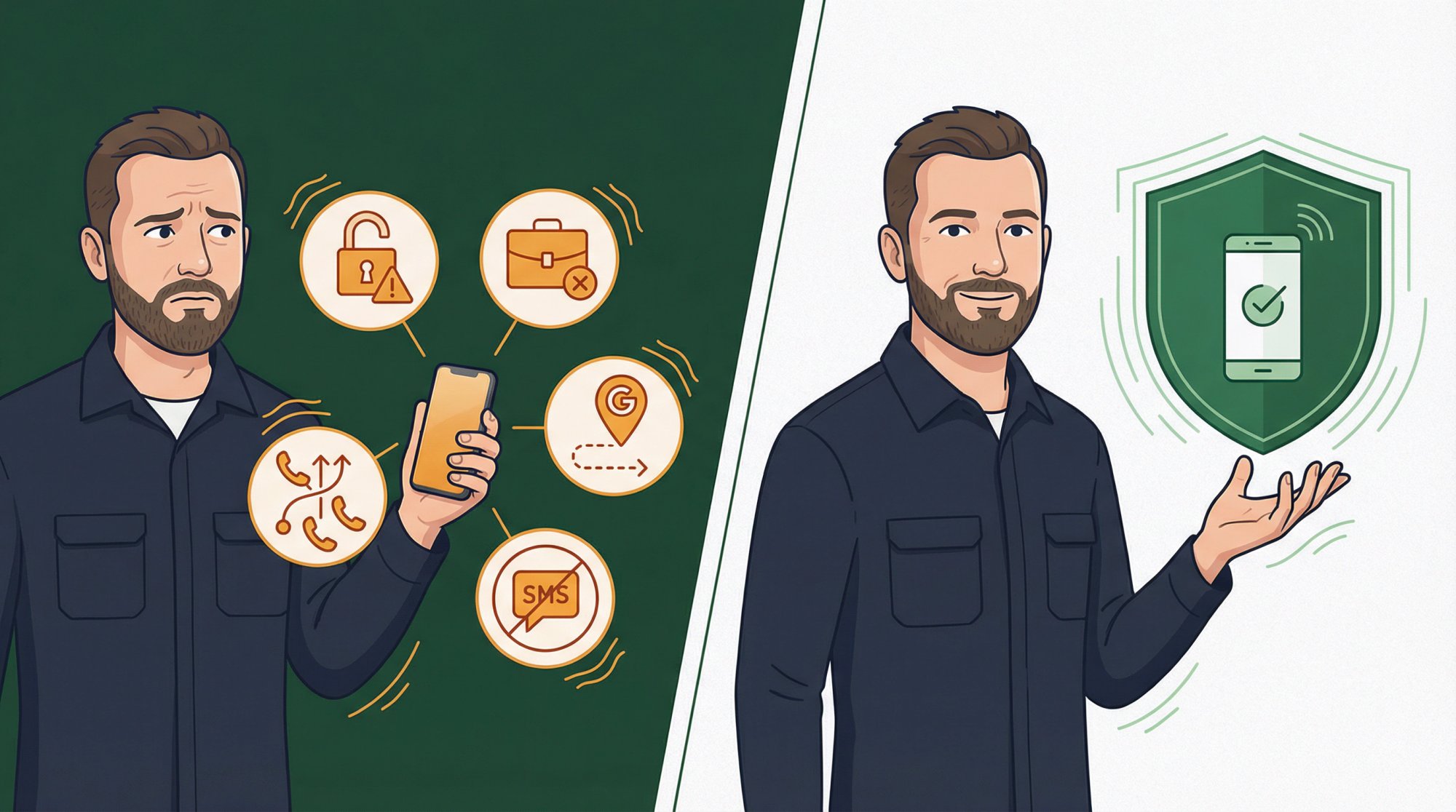
Get a Business Number Now If Any of These Apply#
You care about privacy. Once your personal cell is publicly listed, you can't un-list it. It gets scraped into data brokers, cold call databases, and spam lists immediately. That's not reversible.
You want the number to be a company asset. If your main business line is linked to an employee's personal account and that employee leaves, you either lose the number or negotiate to get it back. Neither is fun.
Calls need to reach more than one person, or in a specific order. The moment you need a ring group, an overflow system, or department routing, you're in "phone system" territory. A call handling service is the foundation of that.
You care about your Google Business Profile and local SEO. Research on NAP consistency makes it clear: your Name, Address, and Phone number appearing consistently across your website and listings is foundational to local search rankings. A personal number that changes or that you later replace creates inconsistency that can hurt you, and when you eventually do switch, how you handle the transition matters as much as the new number itself.
You want to text customers from any kind of software. Business texting through apps, CRMs, or scheduling platforms requires compliance steps like A2P 10DLC registration. That's not possible with a purely personal number on a personal carrier plan.
When You Can Delay Getting a Business Number#
-
You're genuinely pre-revenue with very few calls
-
You only need voice (no texting workflows)
-
You're fine being personally reachable at all hours
-
You accept that when you eventually switch numbers, you'll face SEO and marketing cleanup work
Even then, we'd treat it as a temporary situation, not a long-term strategy. If you're wondering whether a virtual receptionist might be the right next step once you do get a business number, that's a question worth answering now rather than later.
What Happens When You Skip a Business Phone Number#
Two things are colliding in 2026 that make this more expensive than it used to be.
The first: people don't answer calls from numbers they don't recognize. Research found that 80% of unidentified calls go unanswered and 48% of consumers never pick up unidentified calls at all. If your business number looks like a random cell, you're fighting those odds every time you call a lead back.
The second: voicemail is basically dead as a lead capture tool. Analysis of home services businesses found that less than 3% of callers pushed to voicemail actually leave a message. So when a call goes unanswered, you're not getting a voicemail you can follow up on. You're just losing the lead entirely. There's an entire phenomenon around why customers hang up instead of leaving a voicemail, and the short version is that they'd rather call a competitor than talk to a recording.
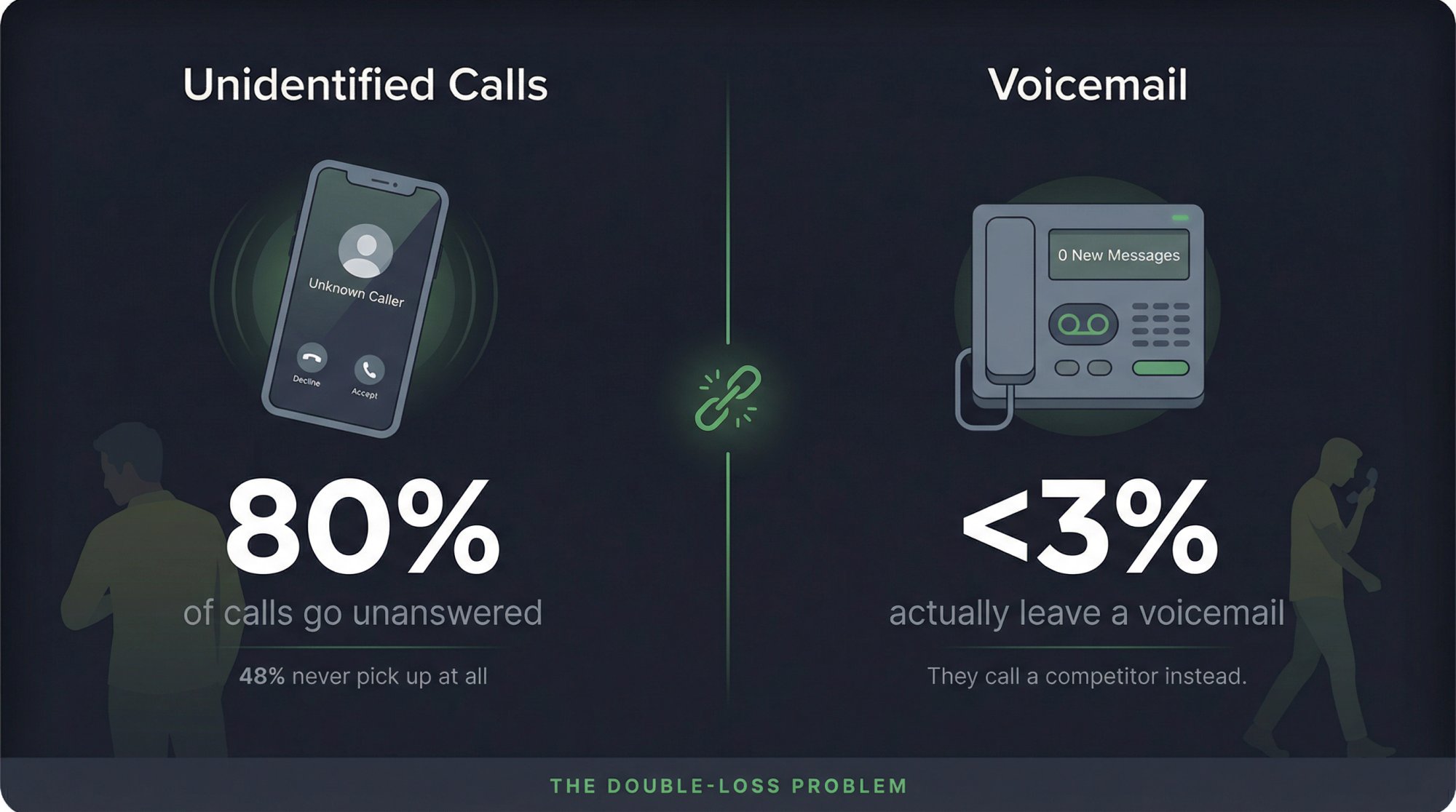
The double-loss problem: You miss the call and you miss the message. Most small businesses don't even know how much money they're losing from unanswered calls.
A business number alone doesn't solve this. But it's the foundation that lets you actually build solutions: routing, after-hours handling, spam filtering, lead capture automation, call recording for quality review. None of that works cleanly without a business-owned number that you fully control.
What Google Requires for Your Business Phone Number#
If you run any kind of local business and you care about Google, your phone number strategy matters more than most people realize.
Google's Business Profile guidelines include three phone-related rules that affect how you should think about this:
| Google's Rule | What It Actually Means |
|---|---|
| Use a local phone number instead of a central call center number when possible | Customers trust local numbers; they signal you're actually in their market |
| Don't use numbers that redirect users away from the actual business | Forwarding is fine; disappearing-number setups aren't |
| The phone number must be under the direct control of the business | You own and manage it; it's not tied to a vendor or employee's personal account |
That third point is worth sitting with. "Direct control" isn't about the digits. It's about whether you, the business, actually own and manage that number, or whether it's tied to a third party, an employee's personal account, or a vendor who might change the routing without you knowing.
Can I Use Call Tracking Numbers on Google Business Profile?#
If you're running Google Ads or any kind of attribution-based marketing, you've probably encountered call tracking numbers. These are forwarding numbers used to measure which channels drive calls.
The good news: Google's own community guidance confirms you can use a call tracking number as your primary number and list your main stable number as an "additional number" in Google Business Profile. Google Ads itself uses forwarding numbers for call reporting, which is essentially the same mechanism.
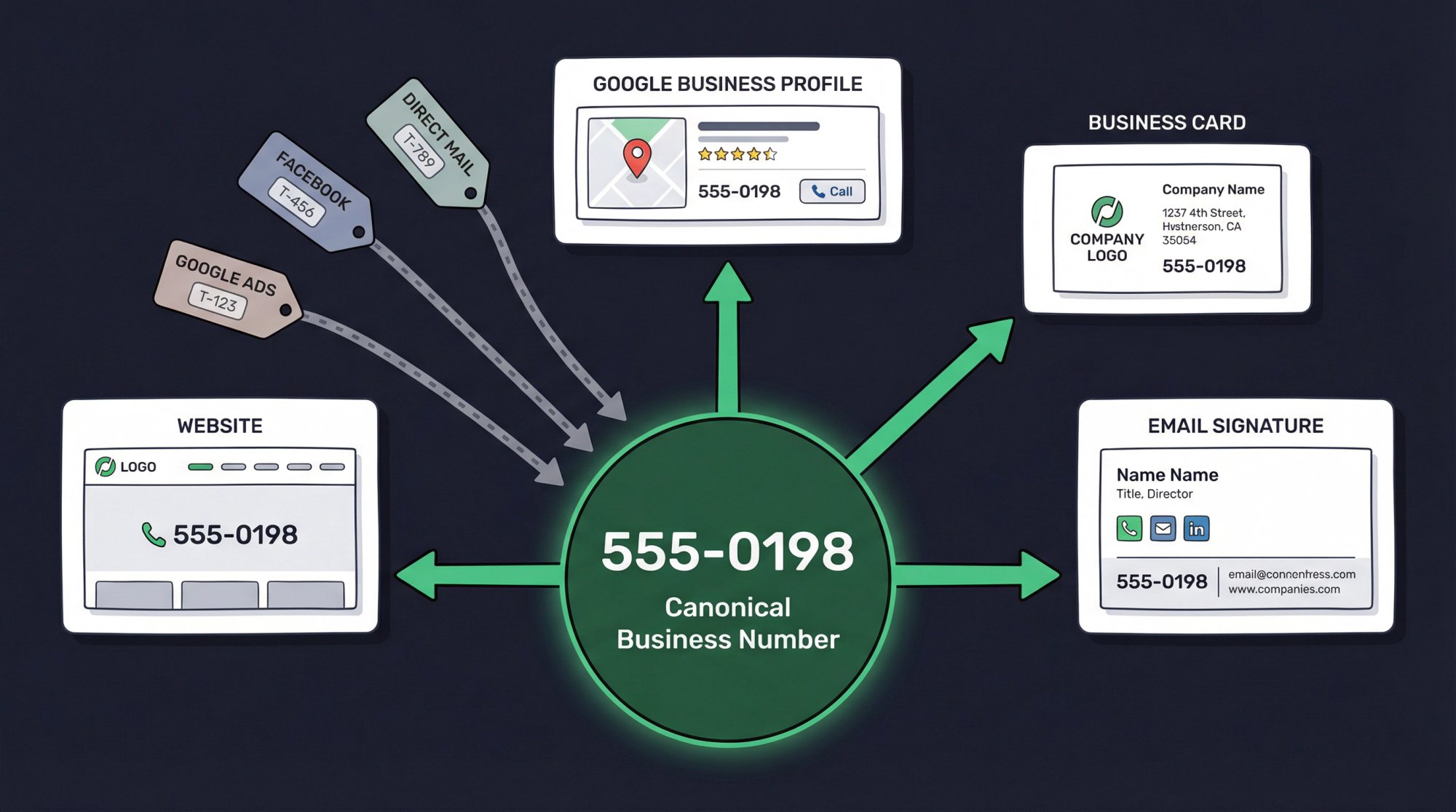
The risk: if you're constantly changing which number appears publicly, you're creating NAP inconsistency and making your attribution messy. The smart approach is a stable architecture:
-
One canonical number that lives on your website header, Google Business Profile, invoices, and email signature
-
Channel-specific tracking numbers for Google Ads, Facebook, mailers, etc. that forward into your main routing
-
Your stable number stays visible somewhere (typically in the "Additional phone" field in GBP)
This way you get attribution data without fragmenting your SEO signals.
Business Phone Number Types: Which One Do You Need?#
There's no single "correct" answer here. Your best setup depends on where you are right now and where you're headed.
Option A: Keep Your Current Number and Add Routing#
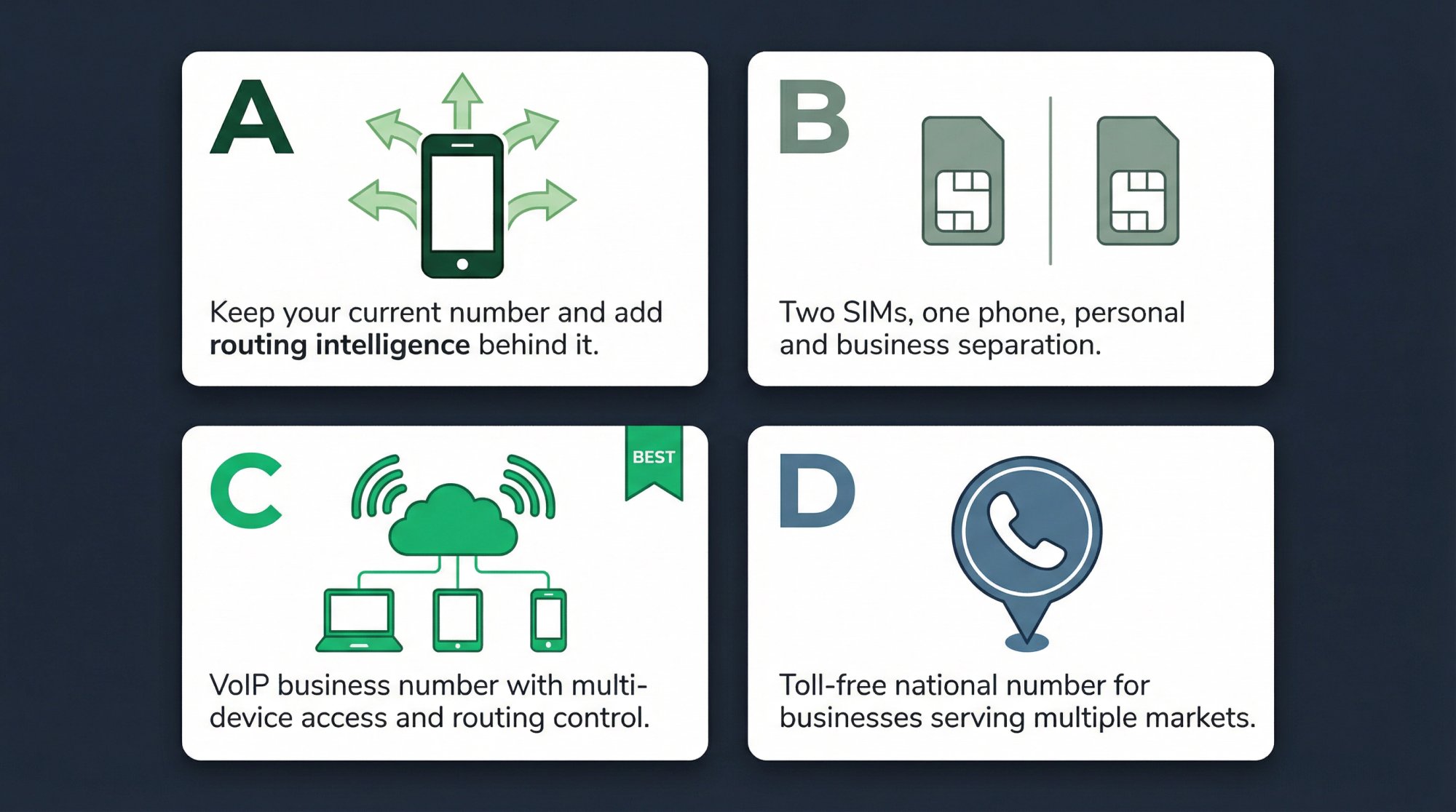
If you're already listed everywhere with your current number, this is often the lowest-friction upgrade. Your existing number stays on your website, cards, and listings. You simply add routing intelligence behind it:
-
Conditional call forwarding (only when you don't answer)
-
An overflow or after-hours answering service
-
An AI receptionist for small business that picks up what your team can't
The number stays stable. Your SEO signals stay intact. And you immediately start capturing calls you were losing.
Option B: Add a Second Business Line (eSIM or Carrier)#
This is the "two SIMs, one phone" approach. Simple to set up, and it gives you separation between personal and business calls.
The downside: it's separation, not a system. You don't get shared team access, call analytics, routing logic, or business texting compliance. It's a fine first step, but most businesses outgrow it quickly.
Option C: Get a VoIP Business Number (Best for Most)#
This is where most businesses land, and usually the right call.
VoIP services give you a business-owned number with real routing control, multiple device access, call analytics, and typically texting capabilities with proper compliance support. See our comparison of VoIP phone systems for small business for a detailed breakdown of current options and what to look for. You can also explore our guide on virtual phone systems for small business to understand the full feature set these platforms offer.
Here's what current list pricing looks like for some common providers (always verify directly, as these change):
| Provider | Entry Plan | Mid Tier | Top Tier |
|---|---|---|---|
| Google Voice (Workspace) | $10/user/mo (Starter) | $20/user/mo (Standard) | $30/user/mo (Premier) |
| Dialpad | $15/user/mo (Standard) | $25/user/mo (Pro) | Enterprise |
| OpenPhone | $19/user/mo (Starter) | $33/user/mo (Business) | $47/user/mo (Scale) |
| RingCentral | Varies by package | Varies | Varies |
This category gives you the best blend of business ownership, flexibility across devices, scalability for a growing team, and integration potential. If you want a side-by-side analysis of the top options, our small business phone systems comparison covers the key trade-offs.
Option D: Get a Toll-Free Business Number#
Toll-free can signal "larger company" and works well if you serve nationally or want a brand identity that transcends a single city.
Two real caveats for 2026:
First, toll-free texting has gotten significantly more complex (more on this in the texting section below). Second, if you serve a local market, a local area code often converts better simply because it feels familiar. A roofer in Phoenix with an 800 number feels less local than one with a 602.
Local vs. Toll-Free vs. Multiple Numbers: What Works Best#
If Your Business Serves a Local Market#
Use a local number as your primary public number. Keep it stable across your website and listings. Add smart routing behind it.
Google's own guidance explicitly nudges local businesses toward local numbers "whenever possible." This isn't just about preference; it reflects the reality that local numbers build trust in local searches.
If You Serve Multiple States or Operate Nationally#
Consider a combination:
→ One toll-free "front door" number for your primary brand identity
→ Local numbers for key markets (for location-specific ads and landing pages)
This lets you have the brand consistency of a single national number while still feeling local in the markets that matter most. For businesses with multiple locations needing separate coverage, a call routing solution ensures the right team handles each incoming call.
How to Get Marketing Attribution Without Hurting Your SEO#
Use the number architecture we described in the Google section:
→ One stable canonical number visible on your site, GBP, and all permanent materials
→ Channel-specific tracking numbers that route into your canonical system (for Google Ads, Facebook, direct mail)
→ Your real number visible somewhere in GBP so Google always sees a stable reference
Quick Reference: Which Business Number Type Is Right for You?#
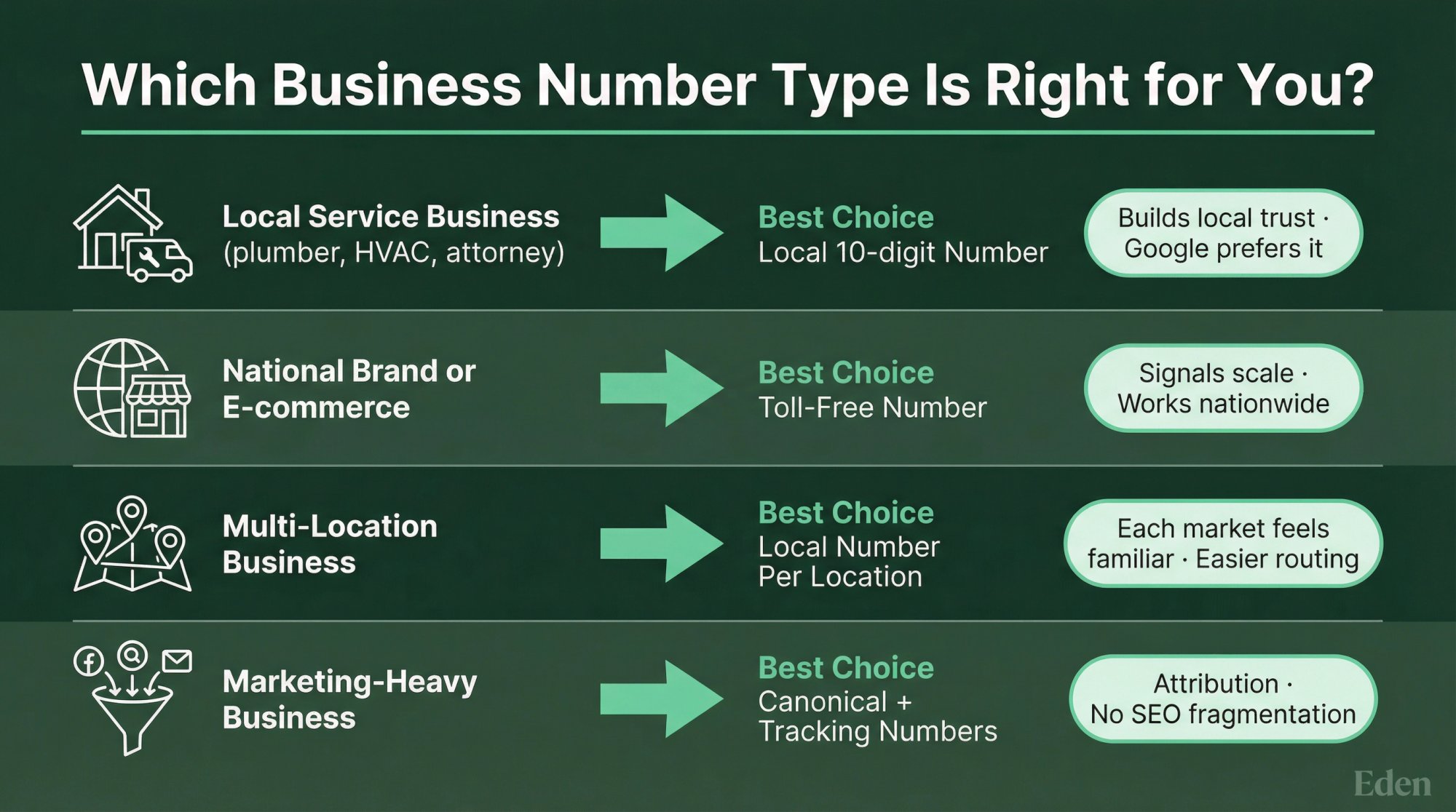
| Business Type | Best Number Choice | Why |
|---|---|---|
| Local service business (plumber, HVAC, attorney) | Local 10-digit | Builds trust with local customers; Google prefers it |
| National brand or e-commerce | Toll-free | Signals scale; works across all markets |
| Multi-location business | Local per location | Each market feels familiar; easier routing |
| Marketing-heavy business | Canonical + tracking numbers | Attribution without SEO fragmentation |
Business Texting Rules: What Changed in 2026#
This section matters a lot if texting is part of how you communicate with customers, or if you're thinking about adding it.
P2P vs. A2P Texting: What's the Difference?#
P2P (person-to-person) texting is when you manually text someone from your phone. That's the personal, informal kind.
A2P (application-to-person) texting is when software sends texts on your behalf, from a CRM, scheduling tool, marketing platform, or AI agent. Carriers treat A2P as higher risk for spam, so they require vetting. If you're already using a missed call text-back system or any automated texting, this directly applies to you.
A2P 10DLC Registration: What Local Businesses Need to Know#
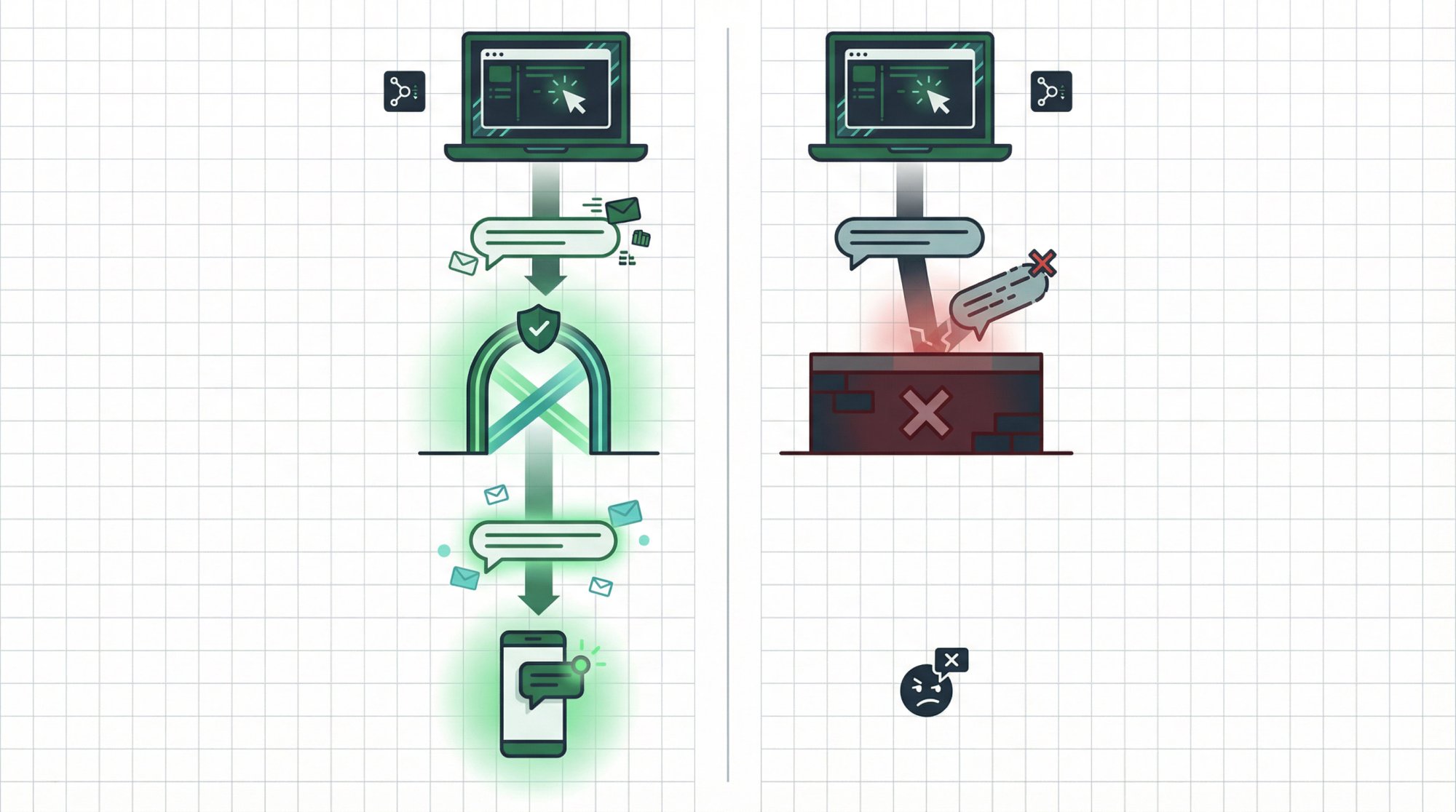
If you want reliable automated texts from a local 10-digit number, your business and messaging campaigns need to be registered through The Campaign Registry. This process is called 10DLC registration.
This isn't optional anymore. Major carriers filter unregistered A2P traffic, and your texts can be blocked or severely delayed without it.
Practical takeaway: Pick a business phone provider that supports 10DLC registration and actively helps you through the process.
Toll-Free Texting: New Verification Requirements in 2026#
As of January 31, 2024, unverified toll-free numbers are blocked from sending messages to the US and Canada until they're verified. And that requirement just got more specific: new required fields for toll-free verification became mandatory on February 17, 2026.
If you chose toll-free because it looks professional but also want texting, budget time for toll-free verification and the newer data requirements that came into effect this year.
The FCC One-to-One Consent Rule: What It Means for Your Business#
The FCC's one-to-one consent rule (effective January 27, 2025) changed how marketing texts and calls need to be consented to. The rule requires that prior express written consent applies to a single seller at a time. The old "check one box and we share your info with partners" approach no longer provides safe legal cover for automated marketing texts or calls.
In plain terms: if you buy leads or use any kind of shared lead form, assume those people have not consented to receive automated messages from you specifically. You need explicit, individual consent captured in your own flow.
Call Recording Laws: What Business Owners Need to Know#
Call recording doesn't strictly require a business phone system, but having one makes compliant recording much easier.
Two things to understand:
The FCC has no federal rules specifically governing individuals recording phone conversations, but states absolutely do. Laws vary significantly: some states require only one party to consent (you), while others require all parties to consent.
The Reporters Committee's Recording Guide is the most widely used reference for state-by-state recording law, and it explicitly notes that some states have criminal penalties for violations.
Our recommendation: If you serve customers across state lines, treat every call like an all-party consent situation. Use an automatic disclosure at the start of calls, something like:
"Just a quick note: this call may be recorded for quality purposes."
It's conservative, but it reduces legal exposure and most customers don't mind. Eden, for example, includes configurable call recording with compliant disclosure built into the setup. And the recordings are searchable, transcribed, and stored securely in your dashboard.
How to Switch Business Phone Numbers Without Losing Leads#
Changing your business phone number is like changing your business address. It's doable, but it creates cleanup work that most people underestimate.
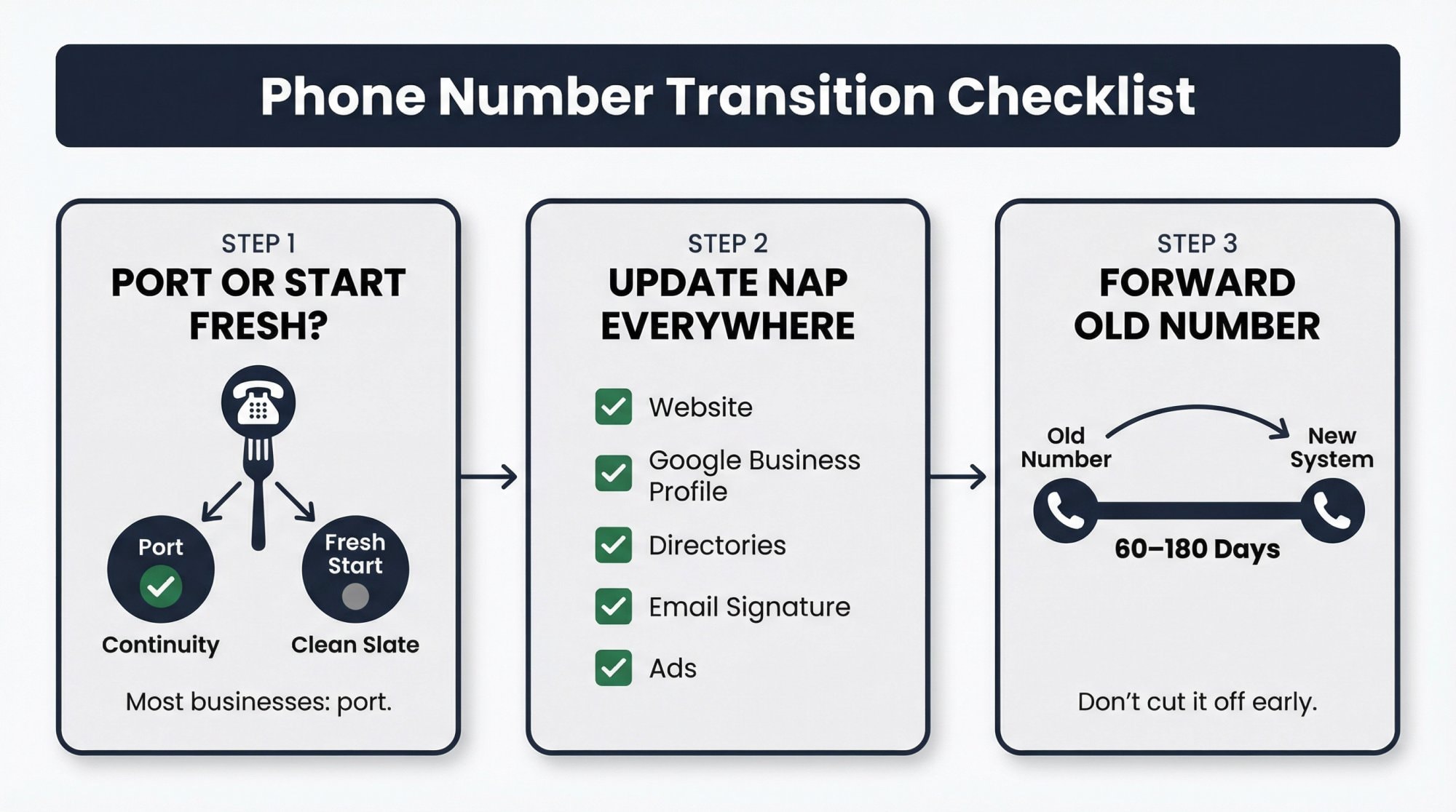
Step 1: Port Your Number or Start Fresh?#
Porting keeps continuity. Customers, directories, and business cards all still work. The FCC's consumer guide confirms you can keep your existing number when switching providers in the same geographic area.
Starting fresh can help with privacy (especially if your personal number has been widely distributed to spam lists) and can give you a cleaner slate. But you lose the recognition you've built.
For most established businesses, porting is the right call.
Step 2: Update Your NAP Listings Everywhere#
At minimum, update these immediately:
-
Website header and contact page
-
Google Business Profile
-
Major directories (Yelp, Angi, Thumbtack if you use them)
-
Email signature and invoice templates
-
Any active ads with call extensions
NAP consistency across all these touchpoints directly affects both trust and local search presence. If you're also dealing with how to stop missing calls during the transition window, that's a separate but related challenge worth planning for.
Step 3: Keep Your Old Number Forwarding for 60-180 Days#
Keep your old number forwarding to your new system for 60 to 180 days. This isn't optional. Your old number is living in people's phone contacts, on old business cards, in directory listings that take months to update, and in Google's index. If you cut it off immediately, you're losing real inbound calls from real customers who tried to reach you.
When you're ready to set up forwarding, our guide on how to forward business calls to an answering service walks you through the carrier-specific steps for a smooth transition.
Business Phone Setup by Stage: Solo to Multi-Location#
Your phone needs at the beginning are different from your needs at 20 employees. Here's how to think about this by stage.
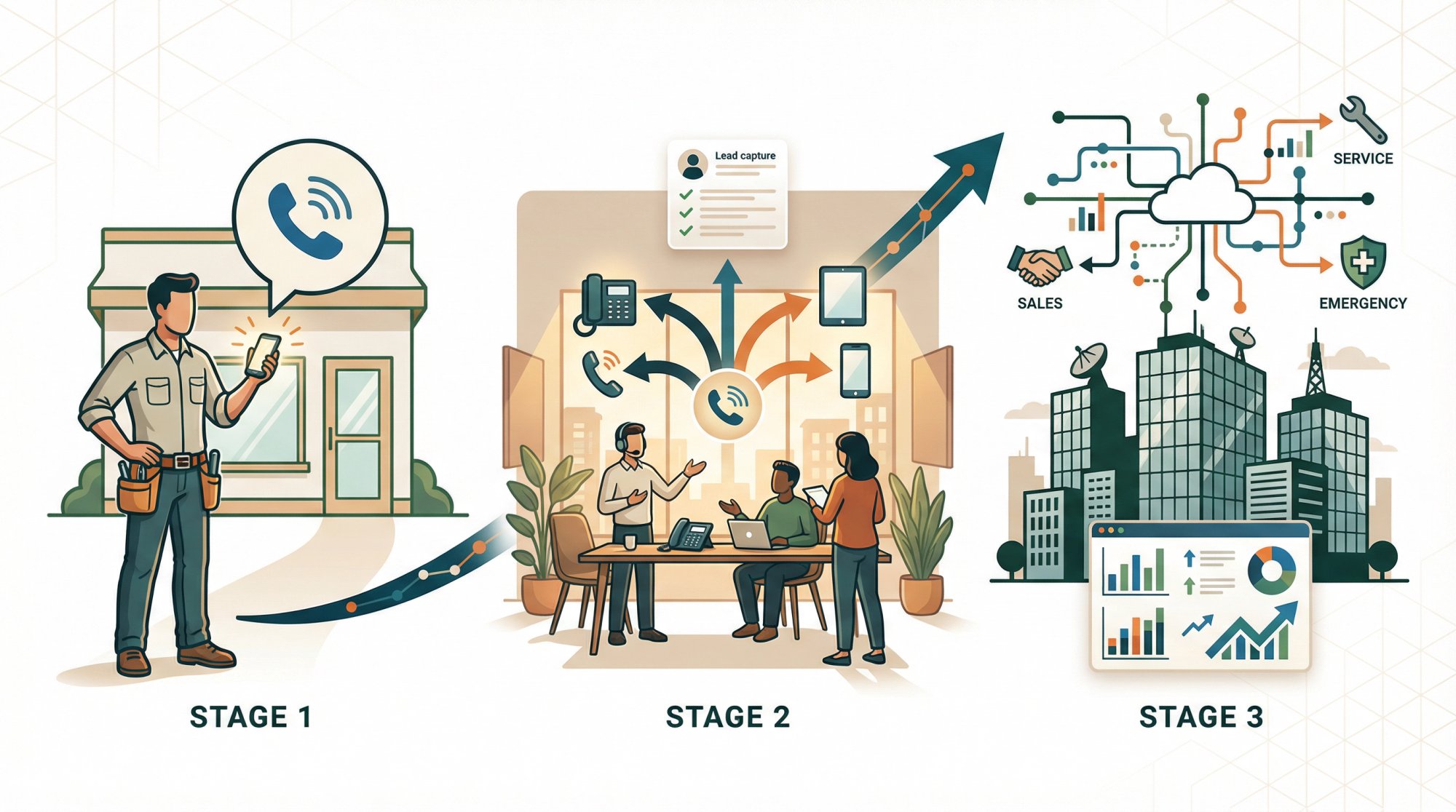
Stage 1: Solo Operator (Under 5 Calls a Day)#
Goal: Separate work from personal without adding complexity.
Get a local business number through a VoIP app (Google Voice if you're very cost-sensitive, or something with more features). Set up a proper voicemail greeting (not "Hi, this is [your name]'s cell"). Check out our professional voicemail greeting samples for scripts you can use immediately. Handle texting manually for now, and consider a simple missed-call capture tool that logs caller info when you don't answer.
Stage 2: Busy Solo or Small Team (5-30 Calls a Day)#
Goal: No missed leads. Basic routing. Fast follow-up.
① One main number owned by the business (not tied to any individual)
② Conditional call forwarding so calls route to someone when you miss them
③ Spam filtering so robocalls stop eating your time
④ Call summaries or basic CRM logging so you know what every caller wanted
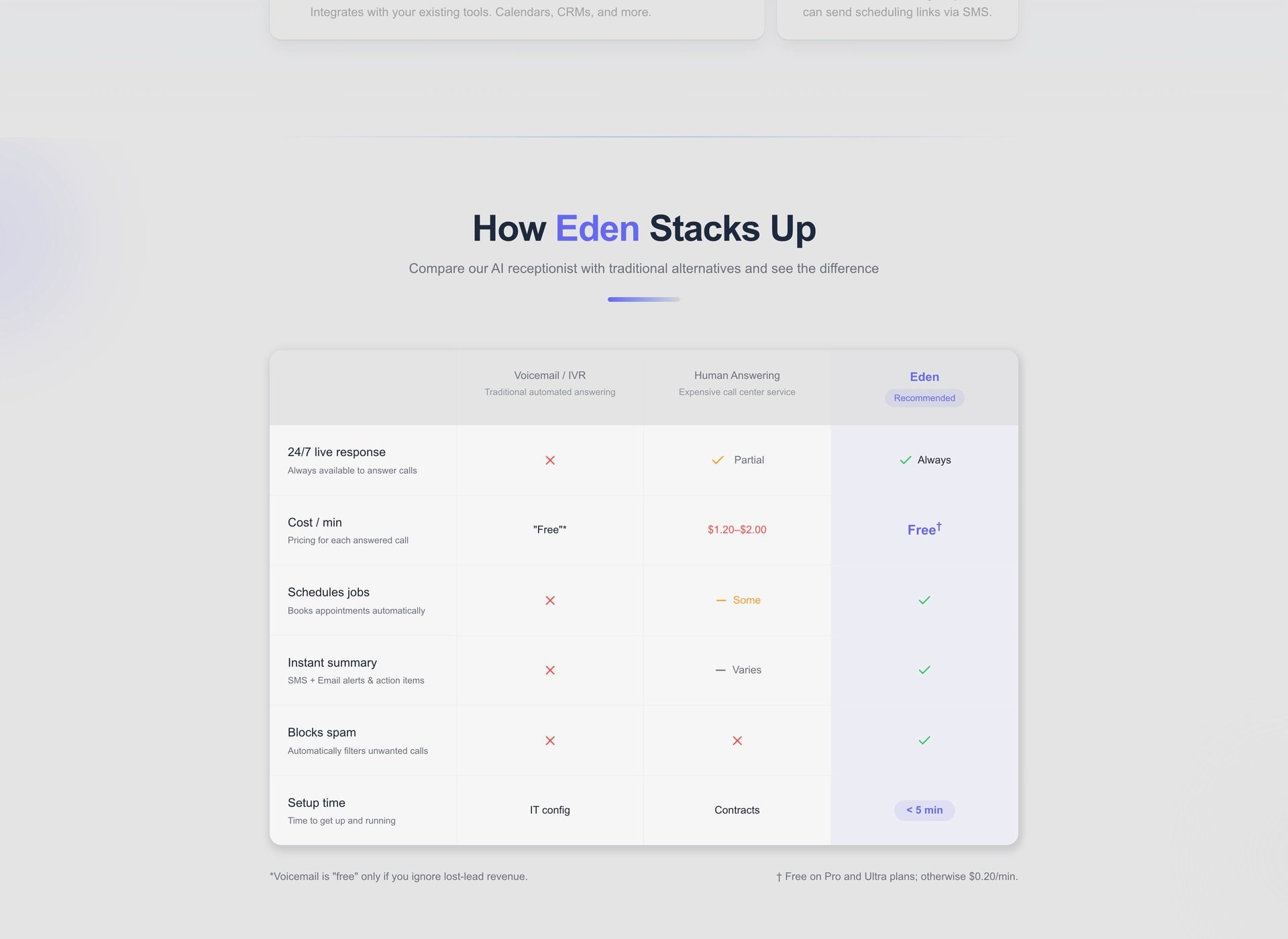
This is where an AI receptionist vs. voicemail comparison makes the economics very clear. At 15 calls per day, you're losing meaningful revenue to missed calls and slow follow-up. An automated answering service that answers 24/7 and captures lead info pays for itself quickly.
If you're not sure whether the economics work for your situation, our breakdown of how much an AI receptionist costs gives you the full picture.
Stage 3: Multi-Person Team or Multiple Locations#
Goal: Consistent customer experience regardless of who answers or when.
→ One main number per location (or per brand)
→ Ring groups and routing by intent: sales, service, emergency
→ Call recording with a compliant disclosure policy
→ Texting compliance set up (10DLC registered, opt-out handling)
→ Analytics: missed call rates, answer time, conversion tracking
At this stage, you're running a phone system, not just a number. The routing logic and data matter as much as the calls themselves. If you're not sure whether you even need a full-time receptionist at this stage, or whether an AI alternative makes more sense, our cost comparison for hiring a receptionist vs. an answering service breaks down the math.
How Eden Works With Your Business Phone Number#
We built Eden to solve the specific problem that no phone number on its own can solve: the calls you're not answering.
A business number is your front door. Eden is the receptionist who answers when you're not there, when you're busy helping someone else, after 5pm, or on weekends. It answers 24/7 in natural language, captures lead information in real time, blocks spam automatically, and hands you a complete summary of every call.
You don't need to rebuild your phone infrastructure to use Eden. There are two clean setup paths:
Keep your existing number (the better option if you're already listed everywhere)
Forward calls to Eden when you're unavailable or after-hours. Your number stays stable across all your listings and SEO signals. Nothing breaks. Eden just ensures that calls you were missing are now answered. We have a detailed call forwarding guide with carrier-specific instructions to make this take about five minutes.
Use a dedicated business number with Eden as your front desk (the cleaner option if you're early or rebranding)
You publish a new business number, Eden answers it. This is the simplest setup for someone who's just getting organized and doesn't have years of directory listings to worry about.
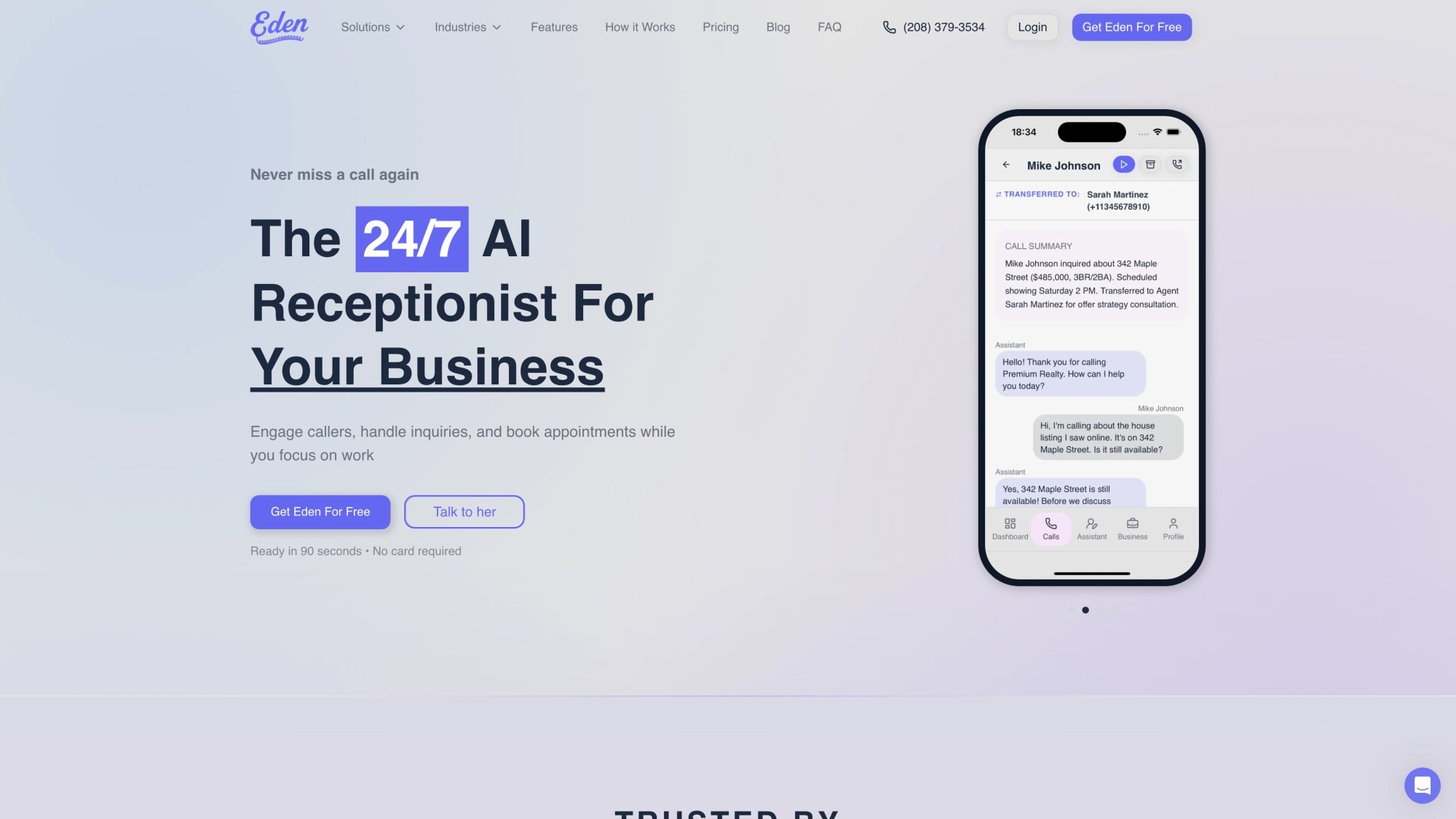
What Eden Does on Every Call#
-
Answers immediately, 24/7, in English or Spanish (see our bilingual answering service guide for more on why this matters)
-
Captures the caller's name, callback number, and reason for calling
-
Blocks robocalls and sales spam automatically with IntelliSpam filtering
-
Books appointments directly into your calendar (Pro plan)
-
Transfers calls to you or your team when the situation warrants it (Pro plan)
-
Sends you a real-time summary of every call via SMS and email
Eden Pricing Plans#
| Plan | Price | Minutes | Best For |
|---|---|---|---|
| Plus | $39/mo | 200 min | Solo operators who need basic lead capture |
| Pro | $99/mo | Unlimited | Businesses that need booking + call transfers |
There's a free trial with 30 minutes of call time. Setup takes about five minutes. You paste your website URL, forward your line, and Eden starts answering.
Start your free trial here and see what it sounds like when a real AI answers your missed calls.
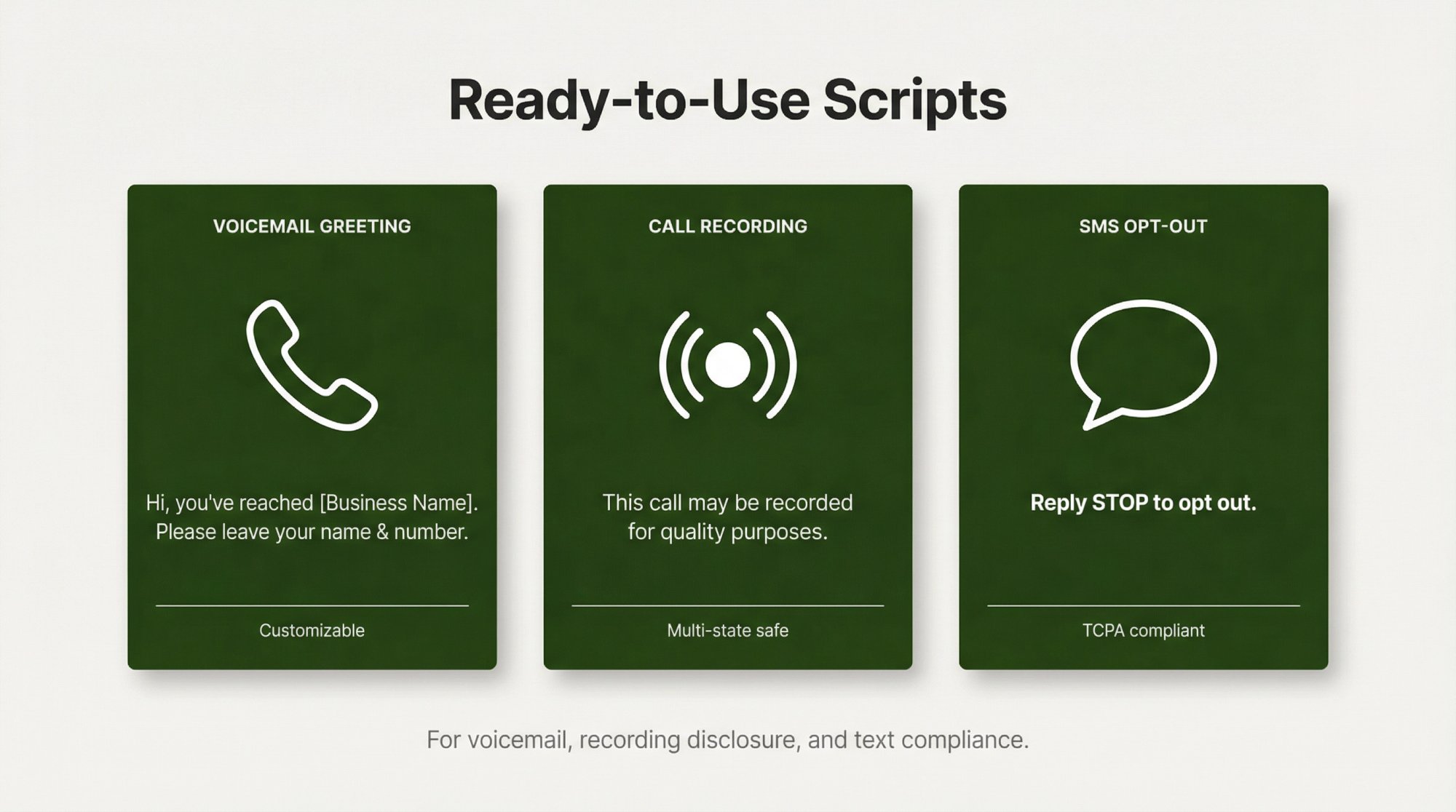
Business Phone Scripts You Can Use Right Now#
Three scripts that solve common phone situations. Use them directly or adapt them.
Business Voicemail Greeting Script#
"Hi, you've reached [Business Name]. We're with a customer right now. Please leave your name, number, and what you need, and we'll call you back as soon as possible."
If you handle urgent jobs, add:
"For emergencies, send a text to this number with the word URGENT and a brief description."
For more options and industry-specific variations, see our professional voicemail greeting samples.
Call Recording Disclosure Script#
This is the safe-default phrasing that works across jurisdictions:
"Just a quick note: this call may be recorded for quality and training purposes. How can I help you today?"
This approach aligns with the reality that recording laws vary significantly by state and that proactive disclosure is always defensible.
Automated Texting Opt-Out Message#
Required under carrier guidelines and TCPA expectations for any A2P texting campaign:
"Reply STOP to opt out of messages."
Make sure your provider handles the opt-out processing automatically.
Frequently Asked Questions#
Do I Legally Need a Business Phone Number If I Have an LLC?#
Almost always no. There's no federal or state law that requires an LLC to have a separate phone number. But operationally, treating your number as a business asset (not a personal one) is smart. A business number that the company owns is more defensible than a personal number an employee happens to use, and it becomes part of your business's infrastructure the same way your domain name is. Many small businesses that ask this question are also wondering whether they can run a business without a full-time receptionist, and the answer to both is similar: you can, but the cost of doing it wrong is higher than it looks.
Can I Use My Personal Cell Number on My Google Business Profile?#
You can. But Google's Business Profile guidelines specify that the number should be under the direct control of the business and recommend local numbers. Using your personal number means your personal identity is permanently tied to your public business listing. If you ever want to change it, you're facing an SEO and NAP cleanup project.
Can I Keep My Number If I Switch Phone Providers?#
Usually yes. The FCC's consumer guide on number porting says explicitly that if you're switching providers while staying in the same geographic area, you can keep your existing number. The process is called porting, and most VoIP providers support it. Note that porting a number from a personal carrier plan to a business VoIP service is typically possible but takes a few business days.
Do I Need Multiple Business Phone Numbers?#
Only if there's a genuine functional reason for it:
-
Multiple locations that need separate local numbers
-
Multiple distinct brands under one company
-
Marketing attribution (using tracking numbers for different channels)
-
A private internal line separate from your customer-facing line
Otherwise, one well-routed number is almost always better than three confusing ones. The number itself isn't what creates the experience. The routing and answering behind it does.
Is a Toll-Free Number Better Than a Local Number?#
Not inherently, and for most small businesses, no. Toll-free numbers can signal "larger company," but local numbers convert better for local services because they feel familiar and trustworthy to local customers. A plumber in Dallas with a 214 area code feels more credible to local homeowners than one with an 800 number. Also, toll-free texting now requires strict verification with requirements that became more stringent in early 2026, so factor that complexity in before choosing toll-free.
What Do I Need to Know Before Texting Customers From Software?#
A lot, actually. When software sends texts on your behalf (from a CRM, scheduling tool, or AI agent), it's classified as A2P (application-to-person) messaging. Carriers require your business to be registered through The Campaign Registry before your texts will reliably reach people. This is called 10DLC registration. Without it, your messages can be filtered or blocked entirely. Also, the FCC's consent rule (effective January 27, 2025) requires explicit individual consent before sending automated marketing texts. Generic "opt-in" forms that share contact info with multiple businesses no longer provide sufficient legal cover.
How Do I Switch From My Personal Number to a Business Number Without Losing Leads?#
Three steps. First, decide whether to port your existing number (continuity) or get a fresh one (clean slate). For most established businesses, porting is the right call. Second, as soon as your new system is live, update your full NAP surface area: website, Google Business Profile, key directories, email signature, and any active ads. Third, keep your old number forwarding to your new setup for at least 60 to 180 days. People have your old number in their contacts, in old listings, and on old business cards. Cutting it off too soon means losing real calls from real customers. Read more about how to stop missing calls when transitioning if you're worried about gaps during the switch.
Can an AI Receptionist Like Eden Work With My Existing Business Number?#
Yes, and this is actually how most people set it up. You keep your existing number public and forward calls to Eden, either all calls or only when you're unavailable. Nothing changes on the surface. Your number stays the same across your website and listings. Eden simply becomes what happens when someone calls. You can also go the other direction: set up a new dedicated business number and have Eden answer it as your full-time front desk. Either way, your number is your front door. Eden is who answers.

Should You Get a Business Phone Number?#
The real question isn't "do I need a business phone number?"
It's: do you want your phone channel to be a personal habit, or a business system?
A business phone number is the foundation of that system. It gives you ownership of a real business asset, the flexibility to route calls however makes sense, the consistency your Google listing and customers need, and the infrastructure for compliant texting and modern call management.
And in a world where 80% of unidentified calls go unanswered and voicemail has a less than 3% callback rate, just having the right number isn't enough. The calls that come in need to actually reach someone (or something) that captures the lead. Read our breakdown of how much business you lose from voicemail to see exactly what those numbers mean in dollars.
That's what we built Eden for. It works behind any number, answers every call, and makes sure you never wonder what that missed call actually wanted.
Start your free trial at ringeden.com and get set up in five minutes.
Ready to Transform YourCustomer Experience?
Join hundreds of businesses using Eden AI to handle calls, book appointments, and provide 24/7 customer support.