Receptionist vs. Answering Service: Cost Breakdown (2026)
Real numbers from BLS, Ruby, PATLive, and Eden show which option saves you money. Includes break-even calculator for your call volume.
January 28, 2026
If you're comparing the cost of hiring a receptionist versus using an answering service, you're probably not just asking "which number is smaller?"
You're actually asking:
• "What will it really cost to make sure every legitimate caller reaches someone competent?"
• "How do I stop doing fake math like $300/month versus $3,000/month and actually compare apples to apples?"
• "At what call volume does an answering service stop making financial sense?"
• "What hidden costs are going to surprise me six months from now?"
This guide answers those questions with real numbers, transparent math, and a framework you can use to calculate costs for your specific situation. All pricing and labor statistics are current as of January 2026, using the most recent BLS wage data, industry surveys, and published vendor pricing.
Why Most Business Owners Compare the Wrong Numbers#
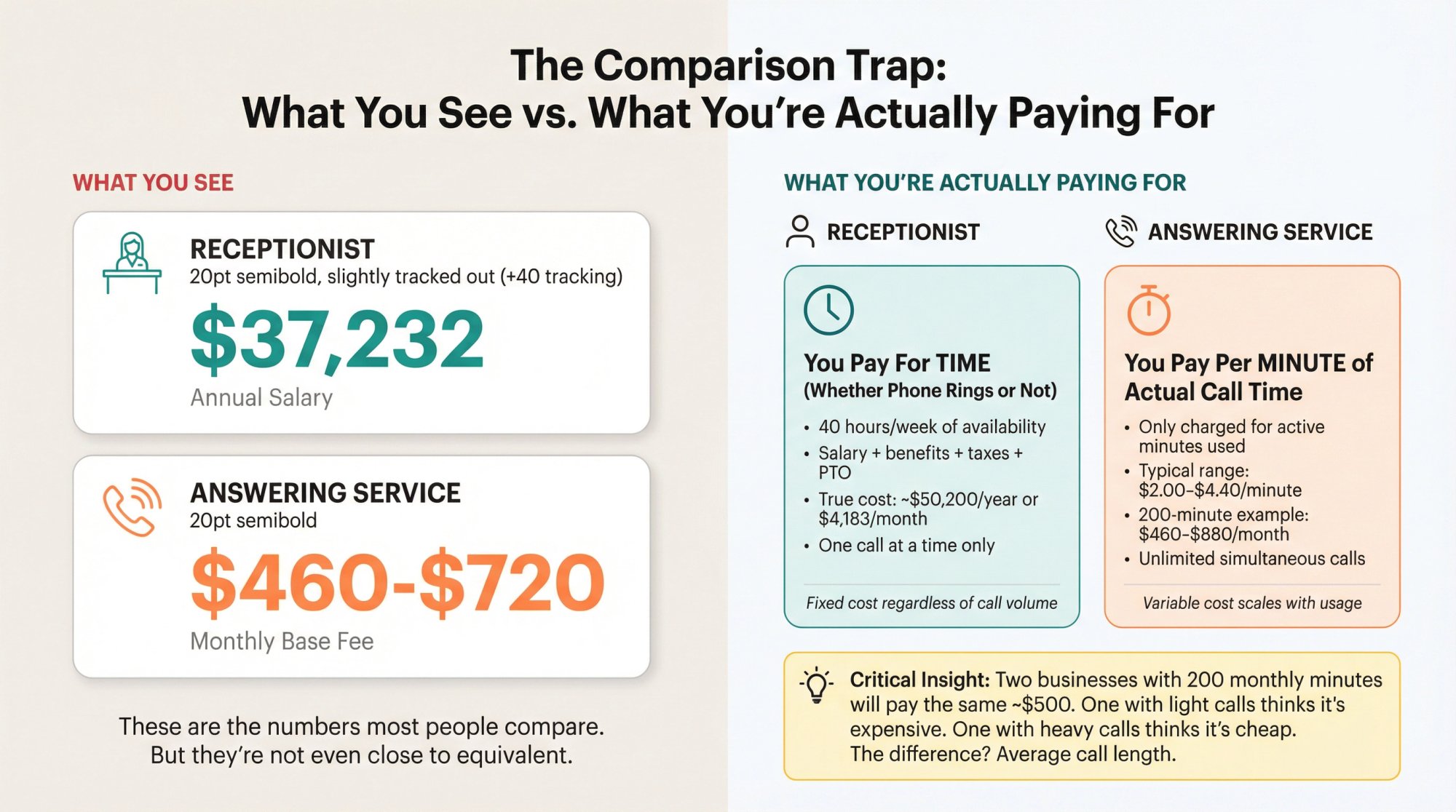
Before you look at any price tag, understand what you're actually paying for. The difference matters more than you think.
What You're Really Paying for When Hiring a Receptionist#
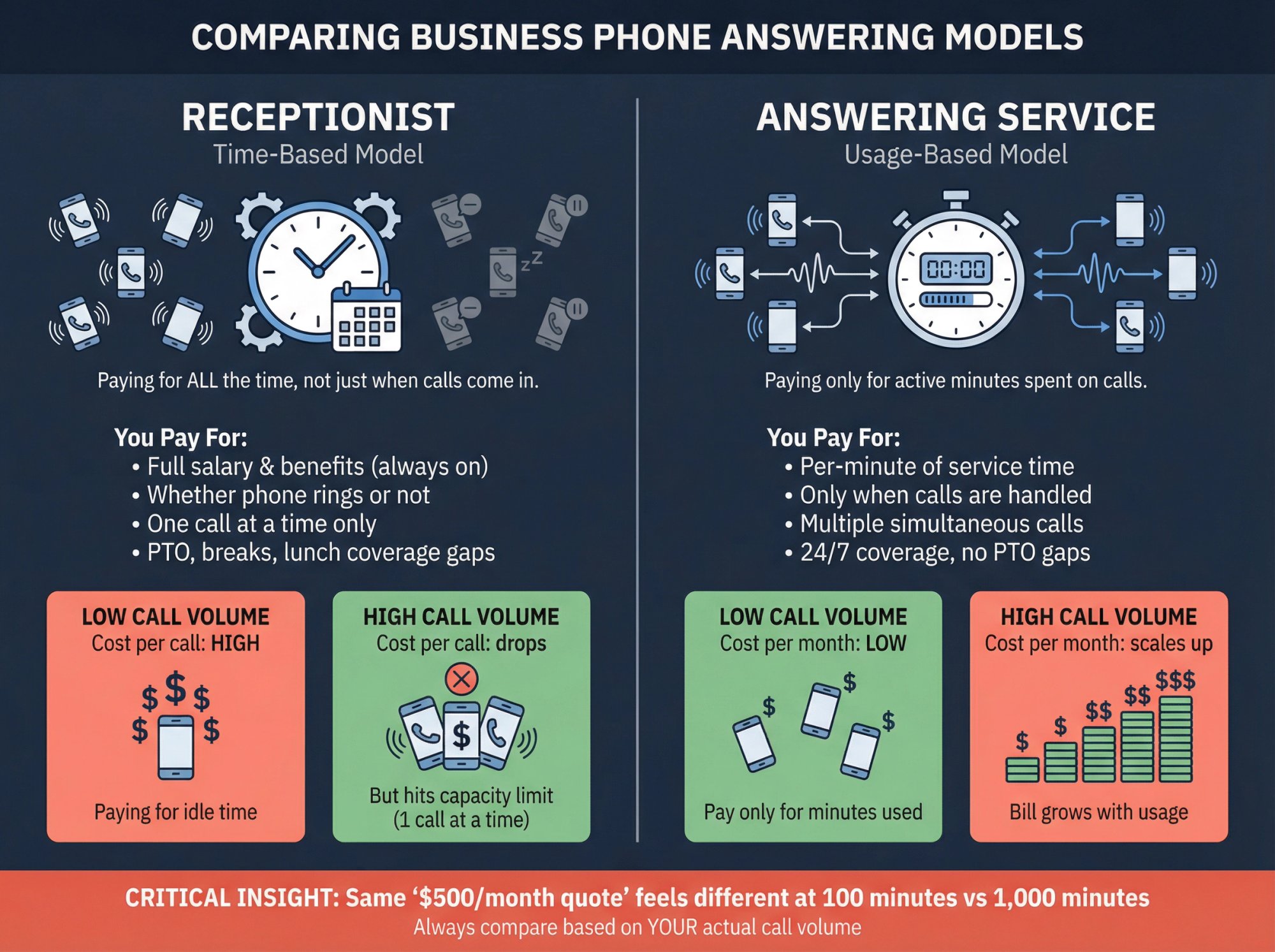
You pay for someone's time whether your phone rings or not. If calls are light, your cost per call can be shockingly high. If calls are heavy and continuous, your cost per call drops fast but you hit capacity limits (one person can only handle one call at a time).
What You're Really Paying for With an Answering Service#
You mostly pay per minute of time the service spends on your calls. If call volume is light or spiky, this is usually much cheaper. If calls are long, frequent, or complex, the bill scales up accordingly.
Critical insight: This is why two businesses can get the same "$500/month answering service quote" and one thinks it's a bargain while the other thinks they're getting ripped off. It all depends on how many minutes you're actually using.
How to Calculate Which Option Saves You Money#
You can figure this out in under an hour if you have call logs or a phone system with basic analytics.
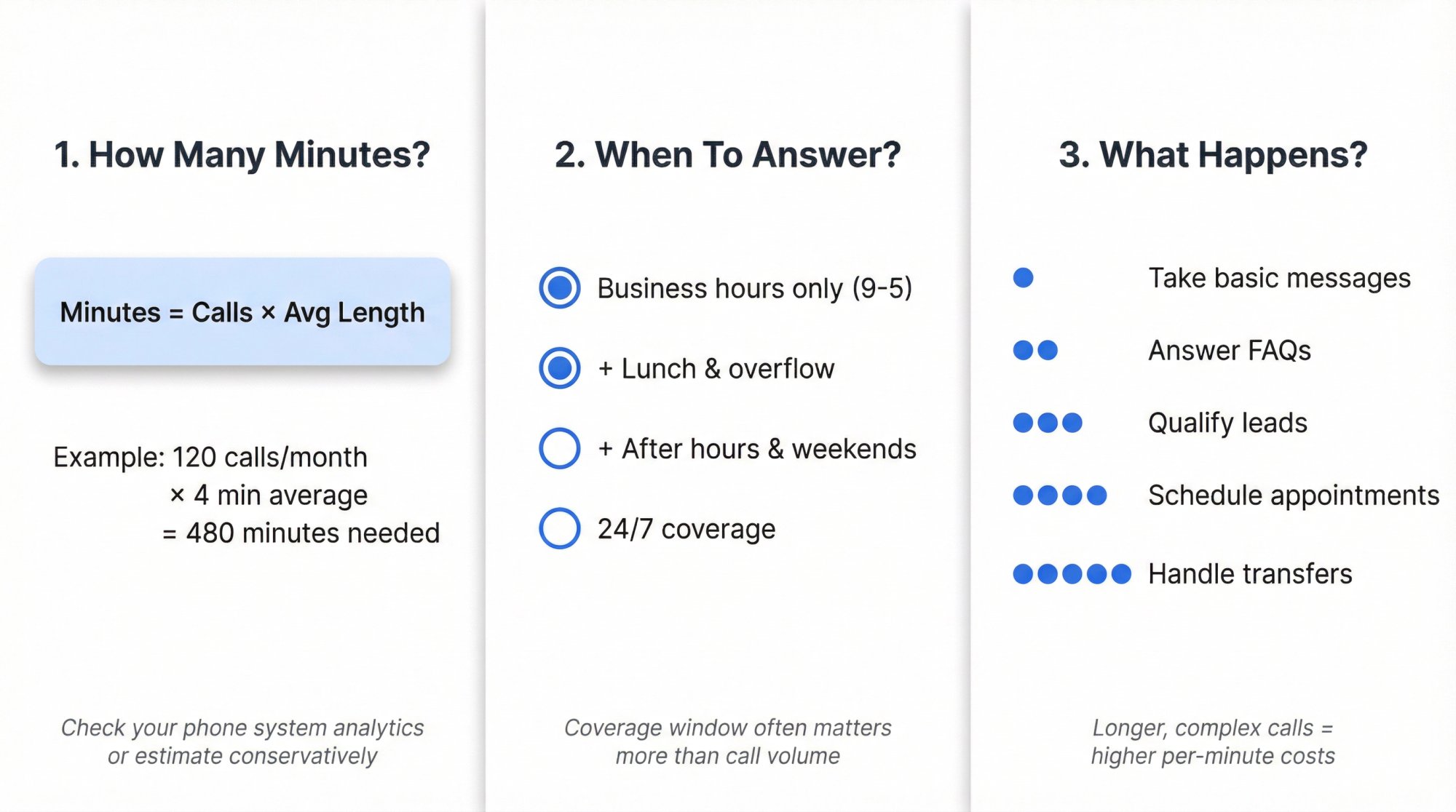
1) How Many Receptionist Minutes Do You Need Per Month?#
Answering services price by the minute because call length is what actually drives cost.
If you only track "number of calls," estimate your minutes using:
minutes = calls × average call length
Many services assume 90-second calls in their plan descriptions, but your reality might be very different. A 2-minute message-taking call costs less than a 6-minute lead qualification call.
2) When Do Calls Need to Be Answered?#
When do calls need answering?
• Business hours only?
• Business hours plus lunch breaks and "when we're busy" overflow?
• After-hours and weekends?
• 24/7?
Your coverage window often matters more than raw call volume when comparing costs. If you need 24/7 coverage, the economics change dramatically.
3) What Must Happen During Each Call?#
The complexity of each interaction directly affects both the time required and the training/capability needed:
• Just take a message?
• Qualify leads with specific questions (service needed, urgency, budget)?
• Schedule appointments into your calendar?
• Transfer urgent calls to the right person?
• Handle bilingual callers?
More complex tasks usually mean longer calls, more training investment, and higher costs in both the hiring and outsourcing models.
How Much Does a Receptionist Actually Cost? (The Real Numbers)#
Most people stop at salary. That's a mistake that can cost you thousands.
What Receptionists Are Paid in 2026#
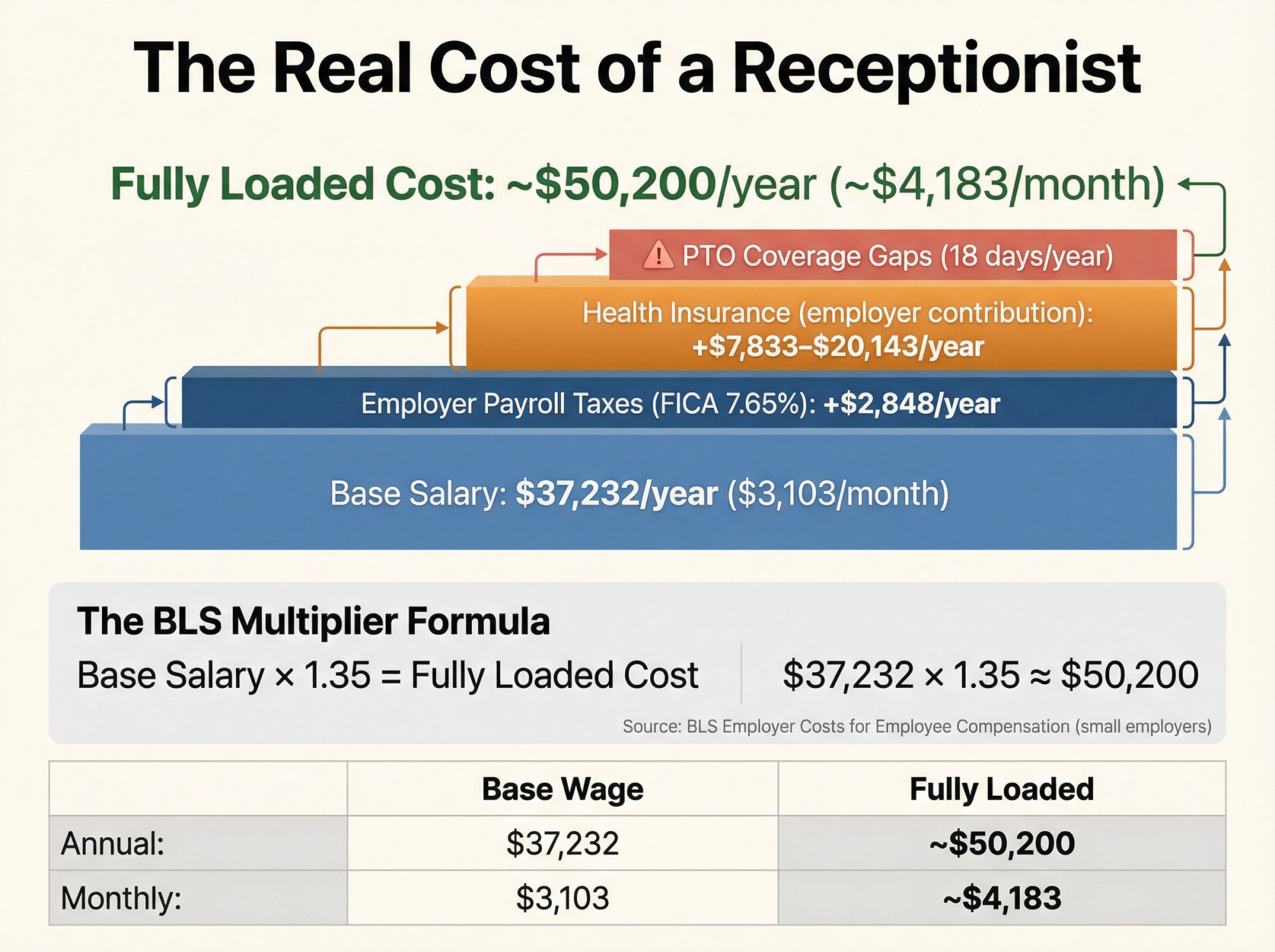
The US Bureau of Labor Statistics reports a median wage of $17.90 per hour for Receptionists and Information Clerks, using May 2024 wage data (the latest benchmark available as of the BLS Occupational Outlook Handbook's August 2025 update).
That baseline translates to:
• Annual wage (40 hours/week): $17.90 × 2,080 hours = $37,232
• Monthly wage: $37,232 ÷ 12 = $3,103
That's just the sticker price. Now the real expenses begin.
The Full Cost Stack for Hiring a Receptionist#
1) Employer Payroll Taxes (Required by Law)#
At minimum, you're paying:
• Social Security tax: 6.2% employer share
• Medicare tax: 1.45% employer share
• Total FICA: 7.65% on wages
On a $37,232 annual wage, that adds roughly $2,848 per year in employer payroll taxes.
You'll also pay:
• FUTA (federal unemployment): Technically 6.0% on the first $7,000, but most employers effectively pay 0.6% after credits (around $42 per year in the typical case)
State unemployment taxes and workers' compensation vary by state and industry, so you'll need to price those locally.
2) Health Insurance and Benefits (The Hidden Cost Most SMBs Miss)#
If you want to hire someone reliable who won't leave in three months, benefits matter.
The KFF 2025 Employer Health Benefits Survey reports average annual premiums of $9,325 for single coverage and $26,993 for family coverage. Workers typically contribute about 16% of single premiums and $6,850 toward family coverage.
If you offer health insurance, your employer contribution is roughly:
• Single coverage: $9,325 × (1 - 0.16) ≈ $7,833 per year
• Family coverage: $26,993 - $6,850 = $20,143 per year
Important blind spot: These are averages across all employers and plans. Small businesses often contribute differently or don't offer coverage at all. But if you do offer coverage to compete for quality candidates, health insurance becomes one of your biggest hidden line items.
3) Who Answers the Phone During PTO Days?#
The surprise isn't the wage cost of PTO. You expected to pay for vacation days.
The surprise is the coverage gap.
BLS data shows that after one year of service, private industry workers average about:
• 7 paid sick days
• 11 paid vacation days
That's 18 days per year when your front desk is empty.
Unless you have cross-trained backup staff, the owner picking up calls, or (ironically) an answering service anyway, those 18 days represent potential missed calls and lost business.
4) How to Estimate Fully Loaded Receptionist Costs#
If you want a fast, credible way to estimate fully loaded cost that accounts for benefits and legally required expenses, use the BLS multiplier approach.
The BLS Employer Costs for Employee Compensation report shows that for private industry employers with 1–99 workers (a good proxy for small and mid-sized businesses), average hourly compensation breaks down to:
• Wages and salaries: $27.13 per hour
• Benefits: $9.45 per hour
• Total compensation: $36.58 per hour
That implies a multiplier of:
$36.58 ÷ $27.13 ≈ 1.35×
So a clean, reality-based estimate is:
Fully loaded receptionist cost ≈ wage cost × 1.35
Applied to the BLS median receptionist wage:
• $37,232 × 1.35 ≈ $50,200 per year
• ≈ $4,183 per month
This isn't perfect, but it reflects real average employer costs for small private employers, including legally required benefits plus typical voluntary benefits.
Real-World Example: What One Receptionist Actually Costs#
Using the BLS median wage and the SMB burden multiplier:
| Cost Component | Annual | Monthly |
|---|---|---|
| Base wage (median) | $37,232 | $3,103 |
| Fully loaded (with benefits) | ~$50,200 | ~$4,183 |
Now ask yourself one brutally important question:
How many receptionist minutes do you actually need per month?
If your phone only requires 300–600 minutes of handling time per month, you're paying a lot for unused capacity. Unless your receptionist produces value elsewhere (front desk duties, admin work, billing), that's expensive idle time. This is where understanding if you really need a virtual receptionist becomes critical.
Receptionist Hiring Costs Most Business Owners Forget#
The fully loaded number above is already higher than most people expect. But there's more.
How Much It Costs to Recruit and Train a Receptionist#
Bringing on a new receptionist incurs costs beyond salary:
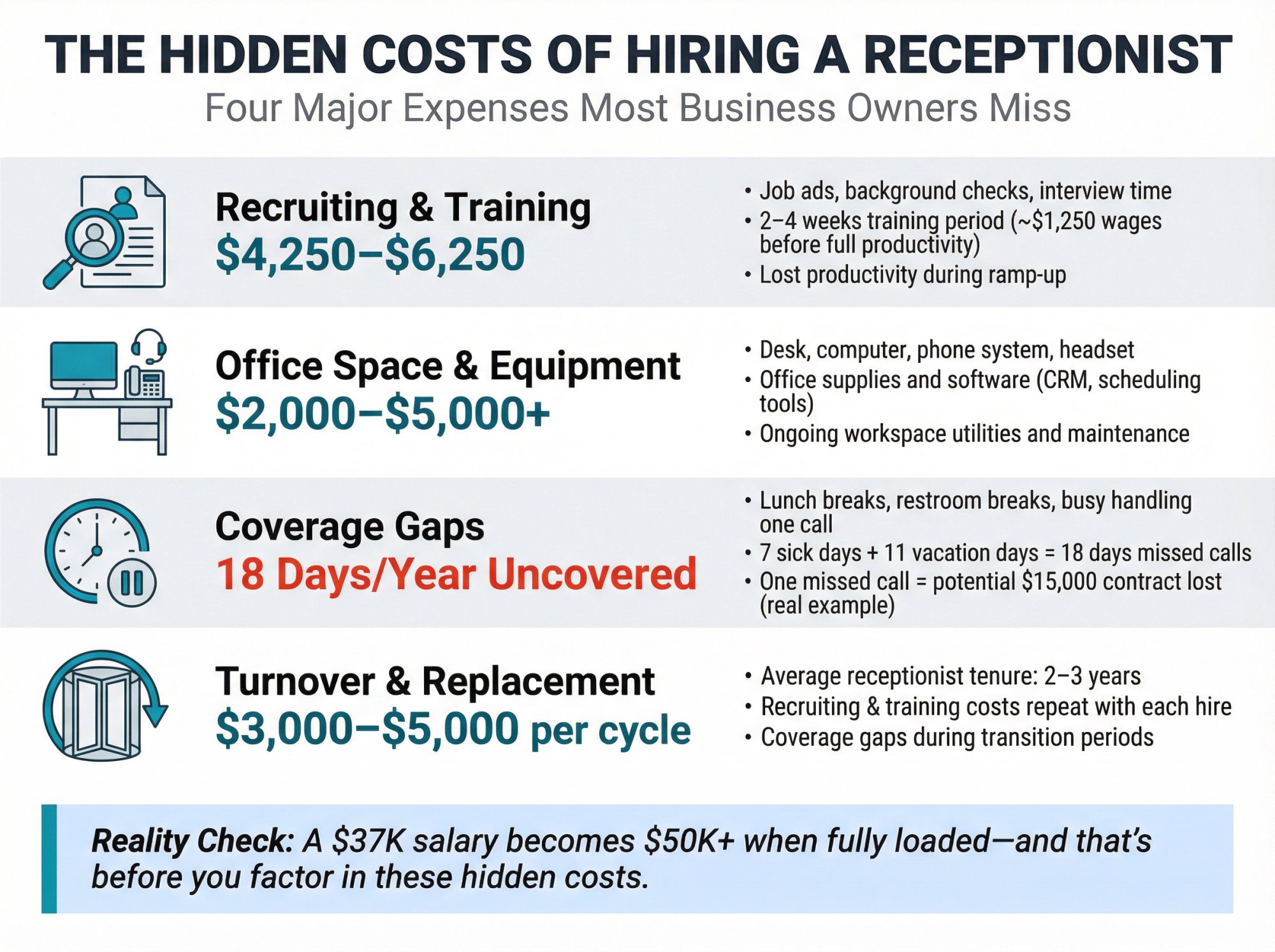
• Job ads, background checks, interview time: $3,000–$5,000 per hire typically
• Training period of 2–4 weeks means reduced productivity
• At $2,500/month in wages, two weeks of training costs ~$1,250 before they're fully productive
Office Space and Equipment Costs#
A receptionist needs:
→ Desk or front counter space (valuable real estate)
→ Computer, phone, headset
→ Office supplies
→ Software (phone system, scheduling tools, CRM access)
Initial setup can easily reach a few thousand dollars, plus ongoing utility costs for that workspace.
The Coverage Problem: Breaks, Lunch, and Busy Phone Lines#
Unlike an answering service, a human being needs breaks. During the workday, there are:
① Lunch breaks (30-60 minutes daily)
② Restroom breaks
③ Moments handling an in-office visitor
④ Times when they're already on one call and a second comes in
A single receptionist working standard hours can only be available about 40 hours per week, and even within those hours, they can handle only one call at a time.
If two calls come in simultaneously, one goes to voicemail. If they step away for five minutes, calls during that window are missed. Understanding how much business you lose from voicemail reveals the true cost of these gaps.
One real-world example: a business lost a $15,000 contract because their sole receptionist was away from the desk when an impatient caller rang. The caller moved on to the next company immediately.
What Happens to After-Hours and Weekend Calls?#
Most receptionists cover an 8-hour business day. What happens to calls at 6 PM, on Saturdays, or during holidays?
Those calls hit voicemail, and about 80% of callers who reach voicemail don't leave a message. They call your competitor instead. The revenue lost from unanswered calls adds up quickly.
To truly match the coverage an answering service provides (24/7), you'd need to hire three full-time people working shifts. That triples your $50K annual cost to $150K, which is utterly impractical for most small businesses.
The Hidden Cost of Receptionist Turnover#
The average receptionist tenure is about 2–3 years. When they leave, you're back to:
• Recruiting costs again
• Training time again
• Coverage gaps during the transition
This cycle can easily cost several thousand dollars each time it happens.
How Much Do Answering Services Actually Cost?#
Answering services price very differently from employees. You're buying minutes of active service, not hours of availability.
The 4 Answering Service Pricing Models Explained#
1. Pay-as-you-go per minute: Low fixed fee plus higher per-minute charges (flexible but can get expensive)
2. Monthly minute bundles: Most common model. You pay a monthly fee for a certain number of minutes, with overage charges if you exceed.
3. Per-call pricing: Less common. Can hide the impact of call length.
4. Flat-rate "unlimited": Rare. Usually has fair-use constraints in the fine print.
What matters isn't the "$X/month" number on the plan. It's the effective cost per minute at your usage level and the overage rate when you exceed your bundle.
What Answering Services Actually Charge (January 2026 Rates)#
Here are real, published rates from well-known providers. These aren't the only options, but they give you reference points for sanity-checking quotes.
Ruby Receptionists Pricing#
Ruby's pricing (updated December 11, 2025):
| Minutes Included | Monthly Cost | Overage Rate |
|---|---|---|
| 200 minutes | $720 | $4.40/minute |
| 500 minutes | $1,725 | $4.00/minute |
| 1,000 minutes | $3,350 | $3.65/minute |
| 2,000 minutes | $6,400 | $3.40/minute |
Ruby often lands around $3–$4+ per minute depending on your tier and whether you stay within your plan. For a detailed comparison, see our Ruby Receptionists vs AI Receptionist breakdown.
PATLive Pricing#
PATLive's pricing (accessed January 2026):
| Plan Type | Monthly Cost | Overage Rate |
|---|---|---|
| Pay-as-you-go | $75 | $2.60/minute |
| 200 minutes | $460 | $2.20/minute |
| 350 minutes | $720 | $2.10/minute |
| 600 minutes | $1,170 | $2.00/minute |
Many SMBs will see costs around $2.00–$2.60 per minute once they're in a bundle plan.
Moneypenny Pricing#
Moneypenny's US pricing (accessed January 2026):
| Minutes Included | Monthly Cost | Overage Rate |
|---|---|---|
| 50 minutes | $165 | $2.85/minute |
| 100 minutes | $265 | $2.65/minute |
| 250 minutes | $555 | $2.39/minute |
| 500 minutes | $985 | $2.09/minute |
Abby Connect Pricing#
Abby Connect's pricing (accessed January 2026):
| Minutes Included | Monthly Cost |
|---|---|
| 100 minutes | $329 |
| 200 minutes | $599 |
| 500 minutes | $1,380 |
What You Pay For vs. What You Get With Answering Services#
With answering services:
You're not paying for idle time. If your phone doesn't ring for an hour, you don't pay for that hour.
24/7 coverage is typically included. Whether a call comes in at 2 PM or 2 AM, you pay the same per-minute rate.
Multiple operators handle simultaneous calls. No busy signals or missed calls because someone is already on the line.
But the bill scales with usage. If your call volume or call length increases, so does your monthly cost.
AI Receptionist Pricing: How Much Does Eden Cost?#
Traditional answering services use human operators, which means labor costs that get passed on to you. But in 2026, there's a third option that fundamentally changes the economics: AI receptionists.
AI-based services like Eden behave like answering services (always on, handle calls automatically) but price more like software (flat monthly tiers with high or unlimited usage).
Why AI Receptionists Are 85–95% Cheaper#
AI receptionist services typically cost 85–95% less than live answering services for comparable call handling.
The reason is simple: software can handle unlimited calls simultaneously and doesn't charge by the minute in the traditional sense.
Eden's Pricing (2026)#
| Plan | Monthly Cost | Minutes Included | Best For |
|---|---|---|---|
| Plus | $39 | 200 minutes | Solo or very small teams |
| Pro | $99 | Unlimited | Busy shops that need booking & transfers |
Compare that to traditional services:
• 200 minutes with Eden: $39
• 200 minutes with Ruby: $720
• Eden is 18× cheaper for the same call volume
Even at Eden's Pro tier with unlimited minutes, you're paying $99/month versus potentially thousands with human services at high volume. Want to understand the full cost breakdown of AI receptionists? We've got you covered.
What Features Come With Eden#
Eden's AI receptionist includes:
• 24/7 live answering with natural conversation
• Bilingual support (English and Spanish)
• Instant lead capture with real-time notifications
• Call summaries and transcripts after every call
• IntelliSpam™ filtering to block robocalls automatically
• Appointment scheduling (Pro plan) with calendar integration
• Call transfers (Pro plan) to route urgent calls to the right person
• 6+ voice options to match your brand
Which Businesses Can Use Eden?#
Eden is built for US-based small and medium businesses.
Important limitations to know upfront:
• We don't serve restaurants
• We're not HIPAA-accredited, so healthcare providers needing HIPAA compliance should look elsewhere
But for most service businesses, professional firms, trades, and local operations, Eden handles the full range of receptionist duties at a fraction of traditional costs. Check out our industry-specific solutions to see if we're a fit for your business.
Break-Even Calculator: When Does Hiring Cost Less?#
The simple equation that cuts through all the noise:
Break-even minutes per month = (monthly fully loaded receptionist cost) ÷ (answering service cost per minute)
Using the SMB fully loaded receptionist estimate (~$4,183/month):
Break-Even at Typical Answering Service Rates#
At $2.20/minute (common bundle overage rate):
$4,183 ÷ $2.20 = ~1,900 minutes per month
That's about 32 hours of talk time.
At $3.60/minute (Ruby's effective rate on lower-tier plans):
$4,183 ÷ $3.60 = ~1,160 minutes per month
That's about 19 hours of talk time.
How to Decide Based on Call Volume#
• Under 1,000 minutes/month: Answering service is almost always cheaper (unless you need physical presence)
• 1,000–2,000 minutes/month: Depends heavily on provider pricing, average call length, and whether your receptionist does other valuable work
• Above 2,000 minutes/month: A full-time receptionist starts to compete on pure cost, especially versus premium providers
Important assumption check: This break-even logic assumes the receptionist's primary job is answering calls. If they also handle significant admin work, you should allocate only the phone coverage portion of their cost to this comparison.
How AI Receptionists Eliminate the Break-Even Point#
With Eden's Pro plan at $99/month for unlimited minutes, there's no traditional break-even point. Whether you get 100 calls or 1,000 calls, your cost stays at $99.
The comparison becomes:
• Full-time receptionist: ~$4,183/month
• Eden Pro: $99/month
• Savings: $4,084/month or nearly $49,000 per year
When Should You Hire a Receptionist Instead?#
Despite the cost difference, there are scenarios where hiring is the right move.
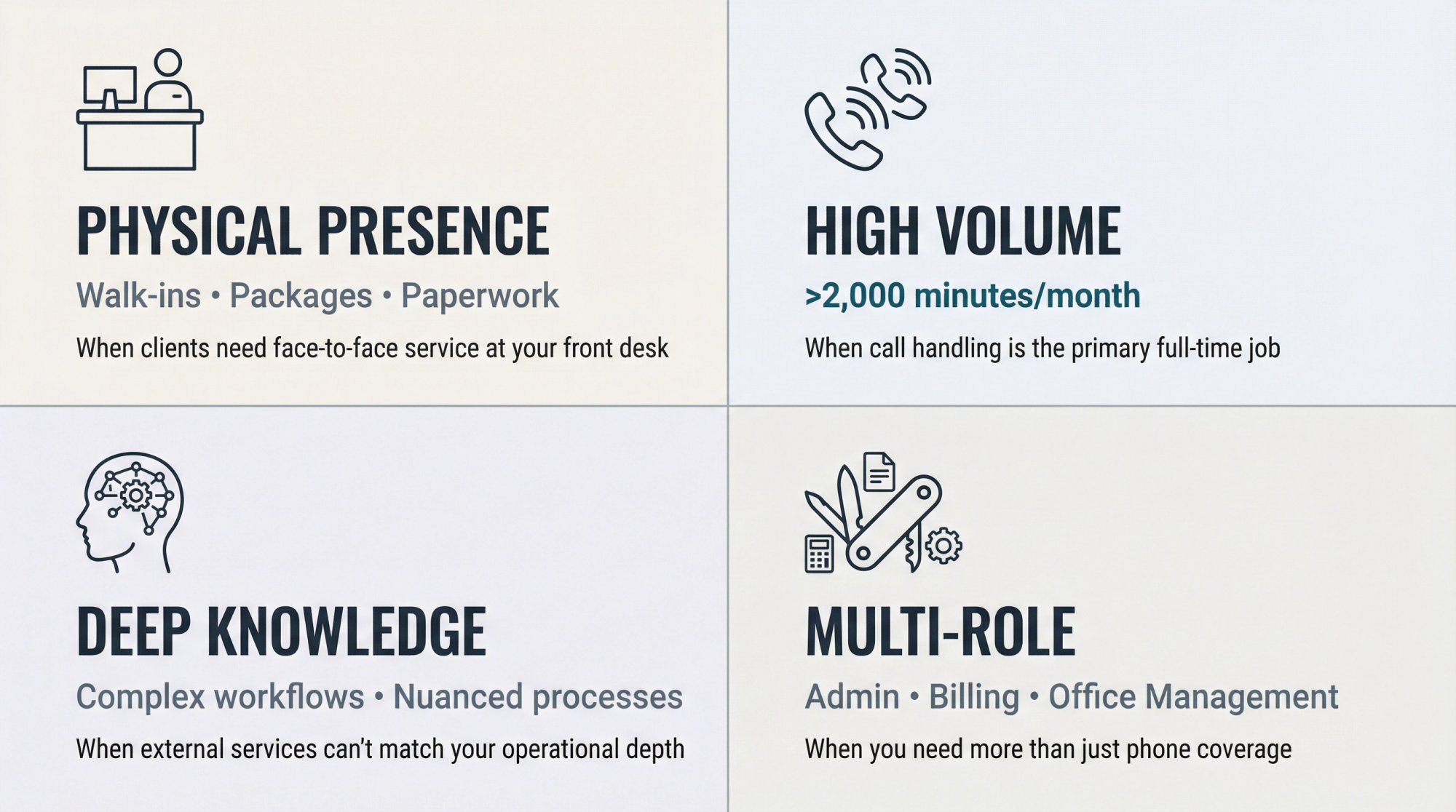
Hiring tends to win when at least one of these is true:
When You Need Someone Physically Present at the Desk#
Walk-in clients, packages, mail, paperwork, greeting visitors. An answering service or AI receptionist can't hand someone a form or escort them to a conference room.
When Your Call Volume Exceeds 2,000 Minutes Per Month#
If you're consistently above 2,000 minutes per month and the receptionist's job is primarily phone work, the math starts to favor hiring (at least for call handling cost alone).
When Your Calls Require Deep Internal Knowledge#
Some businesses have nuanced workflows that require someone who lives and breathes your operation daily. Training an external service on those details can be challenging.
When the Role Includes Significant Non-Phone Work#
If your "receptionist" is actually doing billing support, scheduling coordination, intake paperwork, data entry, and administrative tasks when calls are light, then you're not just paying for phone coverage. You're paying for a broader operational role.
In other words: If you're hiring someone to be a receptionist and an admin assistant and office manager rolled into one, the cost comparison changes. You're getting more than just answered phones. For businesses asking "what to do when you can't afford a receptionist," this distinction matters enormously.
When Answering Services Win (Most Small Businesses)#
For the majority of small businesses, answering services or AI receptionists deliver better value.
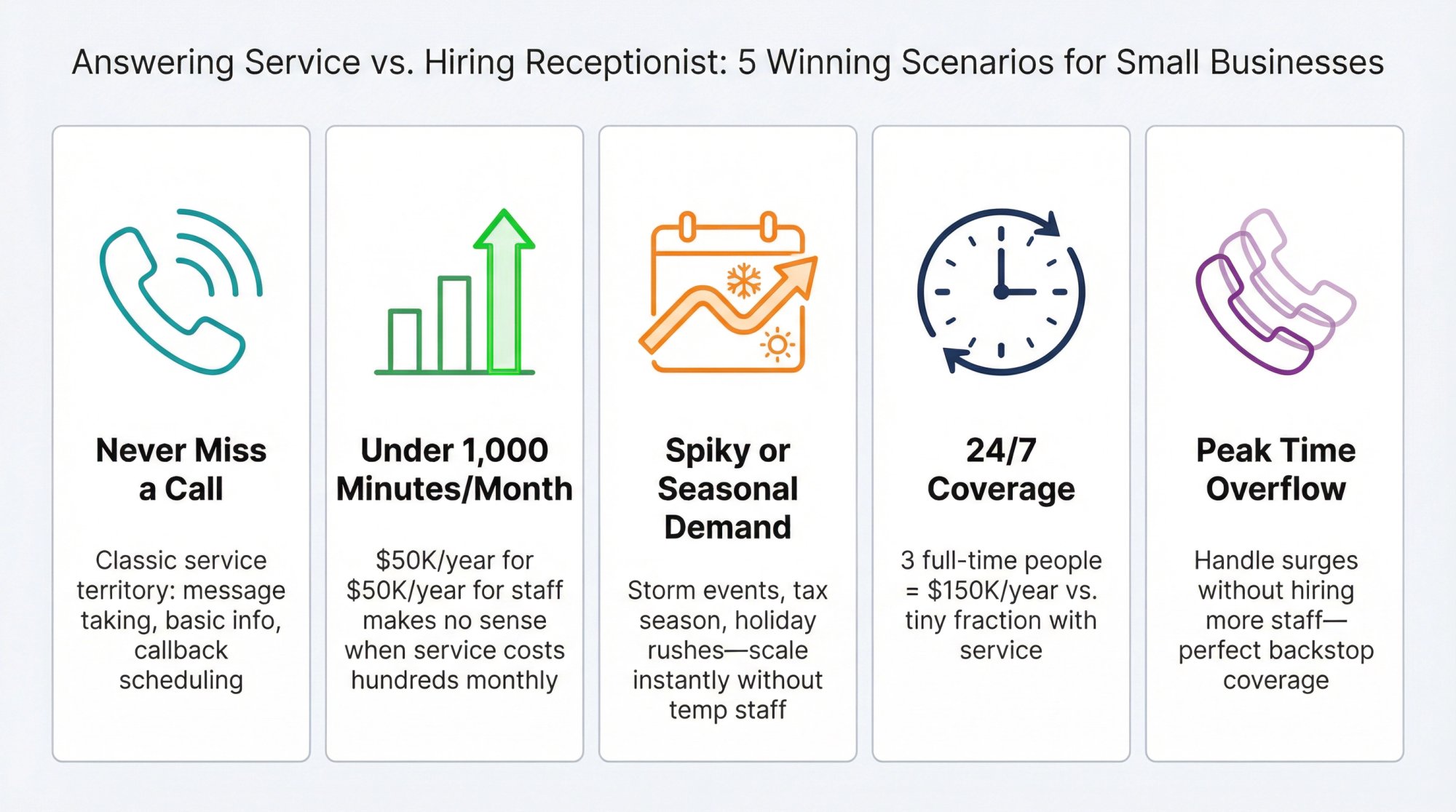
Services tend to win when:
When Your Main Goal Is "Don't Miss the Call"#
You mainly want to ensure every caller reaches someone who can take a message, provide basic info, or schedule a callback. This is classic answering service territory.
When Call Volume Is Low to Moderate (Under 1,000 Minutes)#
If you're under 1,000 minutes per month, paying $50K annually for full-time staff makes no financial sense when a service can handle it for a few hundred dollars monthly.
When Demand Is Spiky or Seasonal#
Storm events for contractors, tax season for accountants, holiday rushes for retailers. Services scale instantly without hiring temporary staff.
When You Need After-Hours Coverage Without Multiple Shifts#
To cover 24/7 with employees, you'd need three full-time people (3 × $50K = $150K per year). An answering service or Eden's AI receptionist gives you 24/7 coverage for a tiny fraction of that cost.
When You Need Overflow Support During Peak Times#
Even if you have front desk staff during business hours, they get overwhelmed during peak times. A service handles overflow without hiring more people.
Services also shine as a backstop even if you hire. Staffing perfect coverage with humans is harder than it sounds.
Why Most SMBs Use a Hybrid Approach#
Many businesses discover that the best approach isn't "either/or" but "both."
A common hybrid structure:
In-house receptionist during core hours for:
• Walk-in customers
• Front desk presence
• Administrative tasks when phones are quiet
Answering service or AI for:
• Lunch breaks (11:30 AM–1:30 PM)
• Overflow when the desk is busy
• After-hours and weekends
• Sick days and vacations
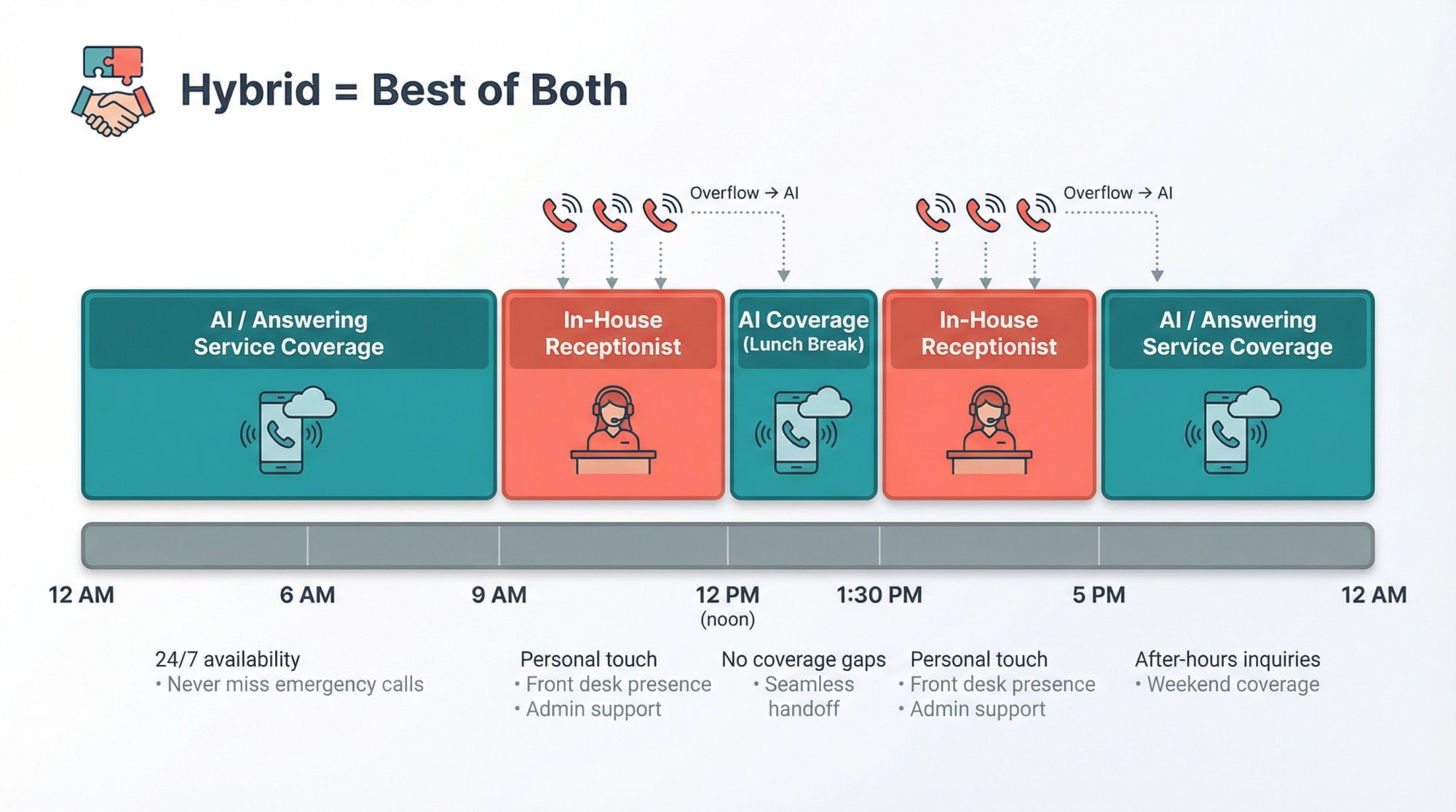
This gives you the personal touch where it matters most and complete coverage without the shock of "we hired someone and still miss calls."
If you're already leaning toward hiring, plan for this hybrid reality upfront. It avoids disappointment and captures the benefits of both models.
Copy-Paste Cost Calculator for Your Business#
Use these frameworks to calculate costs for your specific situation.
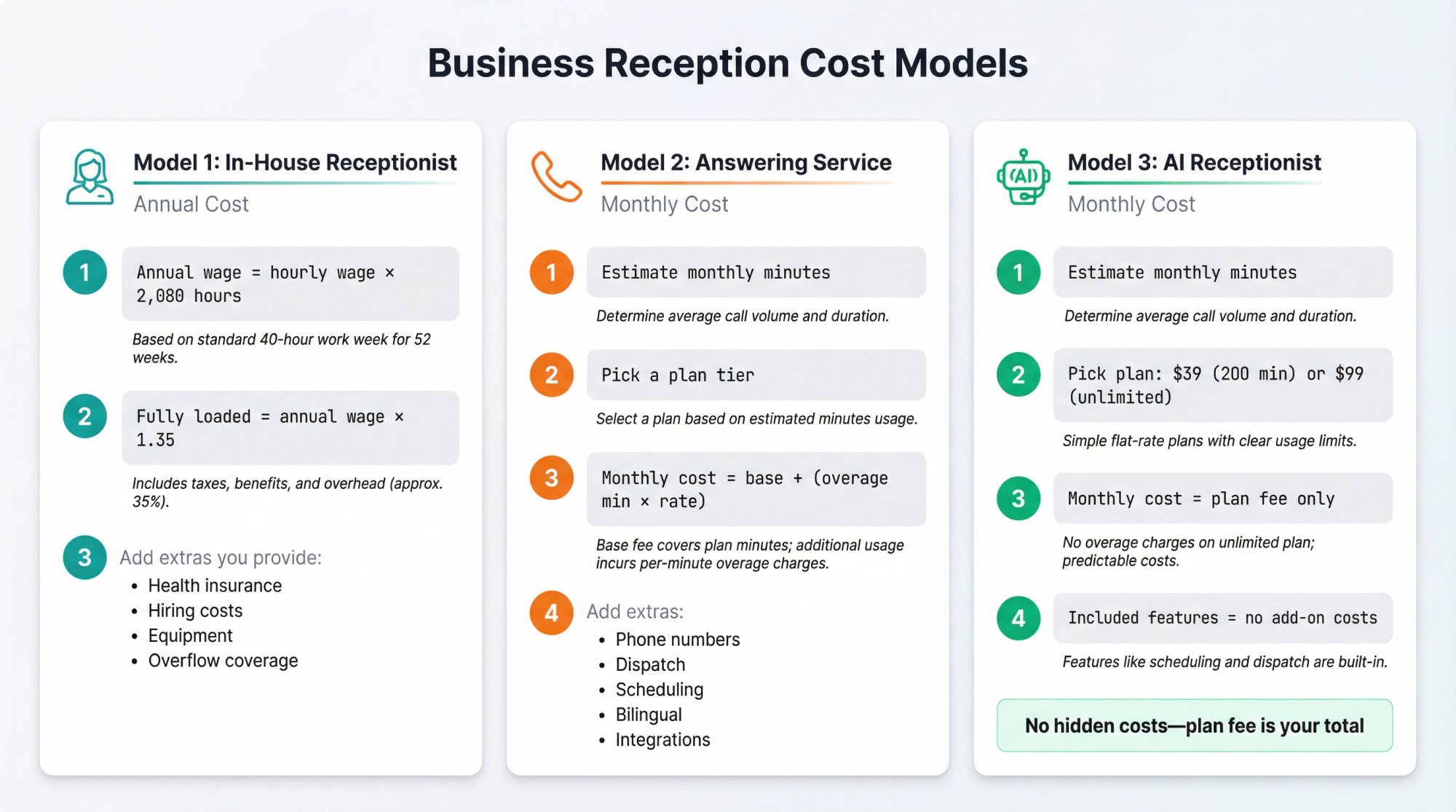
Model 1: In-House Receptionist (Annual Cost)#
① Annual wage = hourly wage × 2,080 hours
② Fully loaded estimate = annual wage × 1.35 (SMB burden shortcut from BLS data)
③ Add extras you specifically provide:
-
Health insurance contributions (if applicable)
-
Hiring costs (ads, background checks)
-
Desk, phone, computer, software
-
Overflow coverage (answering service for gaps)
Model 2: Answering Service (Monthly Cost)#
① Estimate monthly minutes based on your call logs
② Pick a plan tier that matches your expected volume
③ Calculate monthly cost = base plan fee + (overage minutes × overage rate)
④ Add potential extras:
-
Additional phone numbers
-
Dispatch services
-
Appointment scheduling features
-
Bilingual coverage
-
CRM integrations
Model 3: AI Receptionist (Monthly Cost)#
① Estimate monthly minutes (or determine if unlimited makes sense)
② Pick a plan: Eden's Plus ($39 for 200 min) or Pro ($99 unlimited)
③ Monthly cost = plan fee (no overage charges on unlimited)
④ Included features eliminate most add-on costs
Common Questions About Receptionist vs. Answering Service Costs#
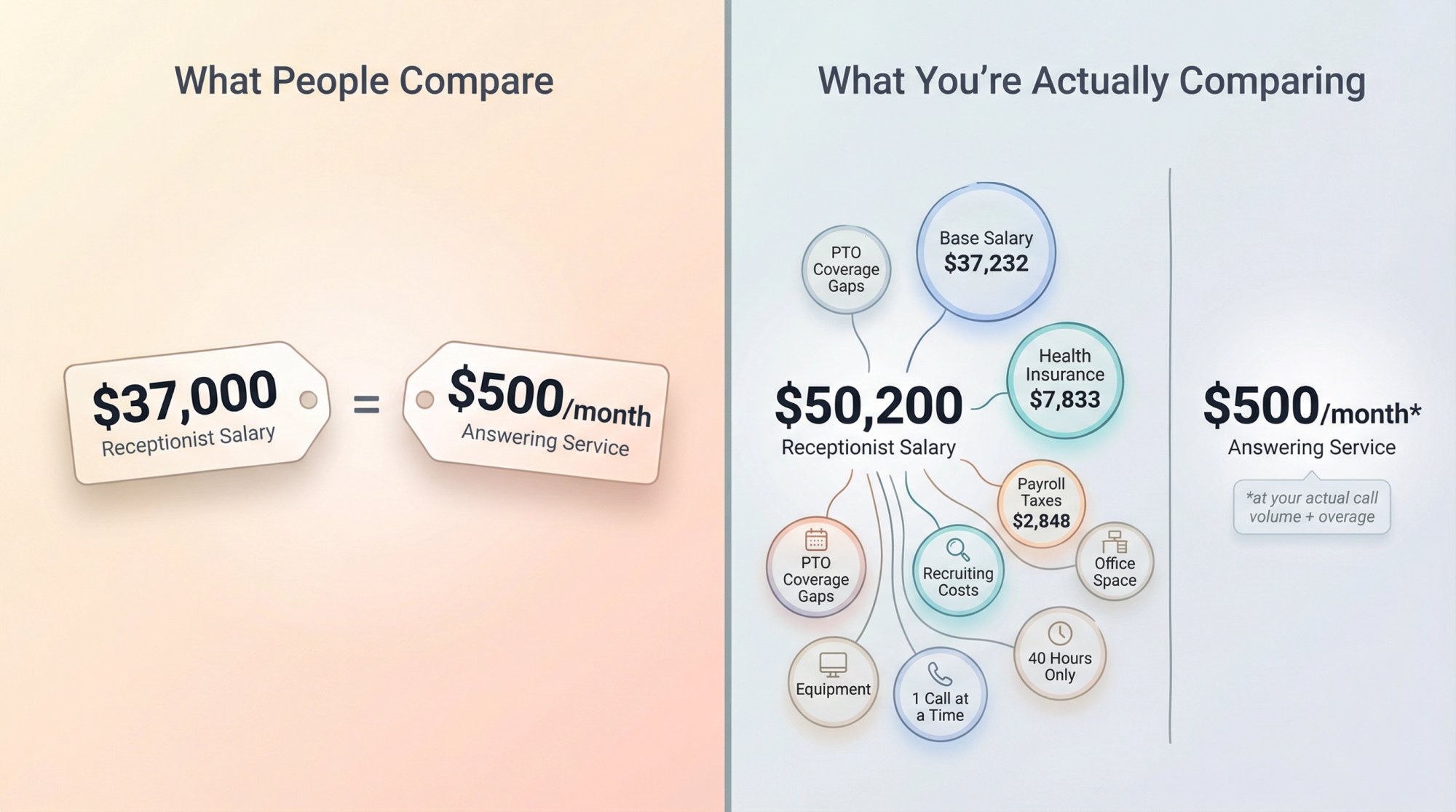
Should I Compare Receptionist Salary vs. Answering Service Monthly Fee?#
No. That's fake math.
Compare:
• Fully loaded receptionist cost (wage + employer burden + benefits + coverage gaps)
versus
• Answering service cost at your actual minutes (base plan + overage charges at your realistic call length)
The salary number and the monthly service fee aren't the same unit. You have to translate to total monthly cost including all the hidden expenses.
What's the Biggest Pricing Trap With Answering Services?#
Underestimating call length.
If your calls average 90 seconds and you start doing better lead qualification (asking more questions, gathering details), those calls might jump to 4 minutes each. Your bill increases even if call count stays the same, because you're paying for minutes.
Always estimate conservatively when projecting usage.
What's the Biggest Trap With Hiring a Receptionist?#
Believing one person equals full coverage.
Sick days, vacations, lunch breaks, bathroom breaks, and simple "busy at the desk" moments create gaps. Unless you have backup staff or (ironically) supplement with an answering service, you'll still miss calls.
How Does Eden Compare to Traditional Answering Services?#
Eden's AI receptionist handles the same core functions as human services (answering, message taking, lead capture, appointment scheduling) but at dramatically lower cost.
200 minutes of calls:
• Traditional service (Ruby): $720/month
• Eden Plus: $39/month
• Savings: $681/month or $8,172 annually
Unlimited calls:
• Traditional service: Often $2,000–$4,000+/month at high volume
• Eden Pro: $99/month flat
• Savings: $24,000–$48,000+ annually
The quality difference? Modern AI like Eden handles natural conversation, bilingual support, and complex call routing. It's not the robotic phone tree from 2010. We also have detailed comparisons for Smith.ai vs AI receptionist if you're evaluating multiple options.
What if My Call Volume Is Unpredictable or Seasonal?#
This is where answering services and AI receptionists really shine.
With a hired employee, you pay the same $4,183/month whether you get 10 calls or 1,000 calls. You can't scale down in slow months.
With an answering service, you might pay more in busy months (overage charges) but less in slow months.
With Eden's Pro plan, you pay $99/month whether you get 10 calls or 10,000 calls. Perfect for businesses with unpredictable or seasonal demand. Learn about the cheapest way to answer business calls 24/7 for your specific situation.
Can I Try Before Committing?#
Most modern services offer trials.
Eden provides a 30-minute free trial so you can test how the AI handles your real calls before you commit to a paid plan. No credit card required.
This lets you verify call quality, test the greeting and responses, and make sure it fits your business before spending a dollar.
What if I Need Someone to Do More Than Answer Phones?#
If your "receptionist" role includes significant non-phone duties (admin work, paperwork, in-person customer service), then you're not comparing equivalent functions.
In that case:
• Calculate what percentage of their time is actually phone coverage
• Apply that percentage to their fully loaded cost
• Compare that number to the answering service cost
Example: If 60% of their day is phone work and 40% is admin tasks, compare 60% of $4,183 ($2,510) to service costs. The admin tasks are a separate value you're paying for.
What About Call Quality and Customer Experience?#
Legitimate concern. Honestly, it's worth thinking through.
Traditional answering services: Trained human operators who can handle nuanced conversations but might not know your business deeply. Quality varies by provider.
AI receptionists like Eden: Modern AI handles natural conversation surprisingly well. Our system understands context, speaks multiple languages, and follows custom scripts. The technology has improved dramatically in the past two years.
In-house receptionist: Knows your business intimately but is limited to one call at a time and has coverage gaps.
For most routine calls (basic info, message taking, appointment scheduling), all three options work well. For highly complex or sensitive conversations, you might want direct transfer to a team member regardless of who answers first.
Which Option Saves You the Most Money?#
When you focus on pure cost, the data is overwhelming.
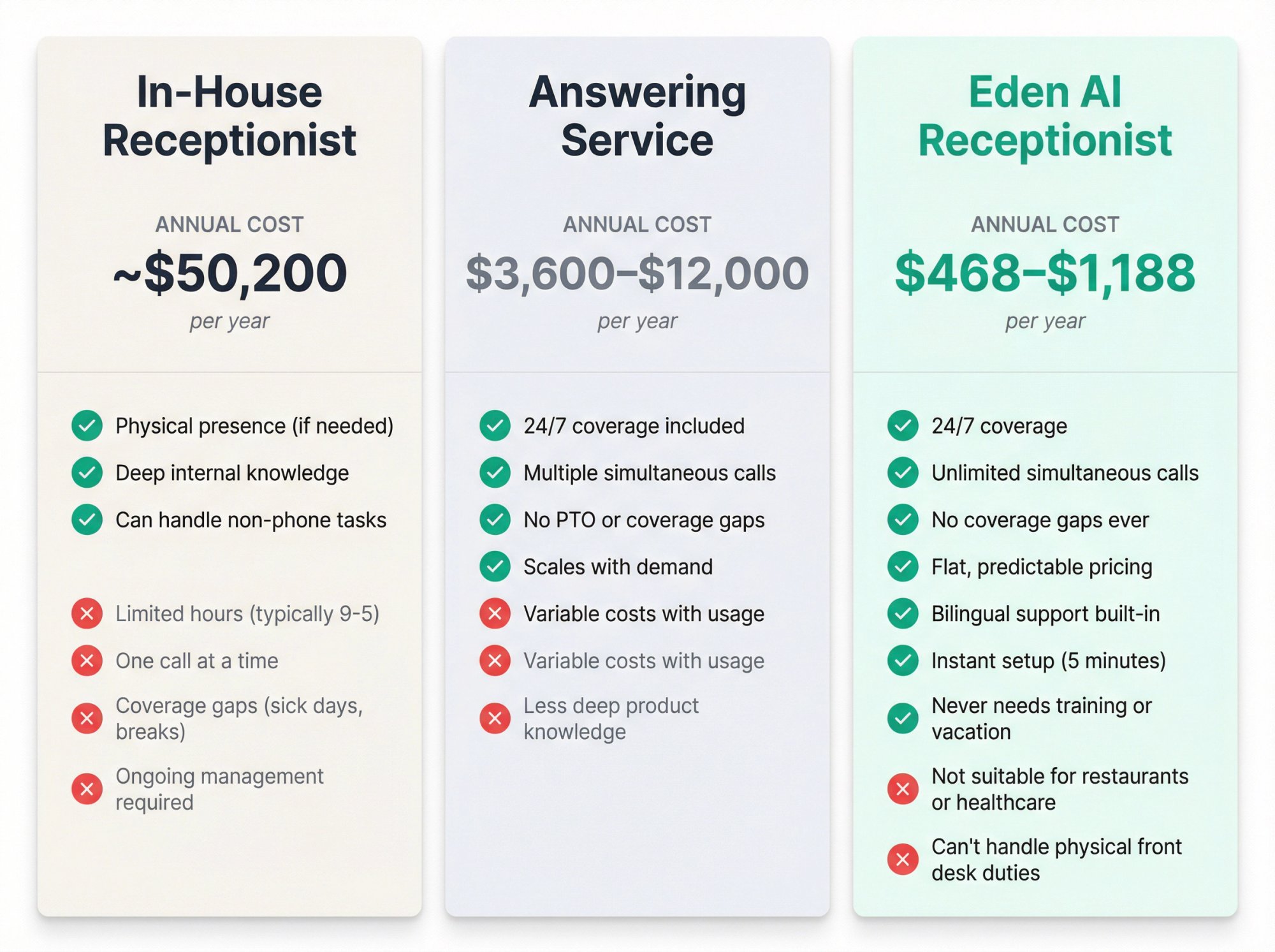
Annual Cost Comparison: All Three Options#
• In-house receptionist: ~$50,200 per year (base case with benefits)
• Traditional answering service: $3,600–$12,000 per year for typical SMB usage
• AI receptionist (Eden): $468–$1,188 per year ($39–$99/month)
Over five years, the difference between hiring and using an AI receptionist can exceed $250,000 in savings.
What You Get for the Money#
With a receptionist:
✓ Physical presence (if needed)
✓ Deep internal knowledge
✓ Can handle non-phone tasks
✗ Limited hours (typically 9-5)
✗ One call at a time
✗ Coverage gaps (sick days, breaks)
✗ Ongoing management required
With an answering service:
✓ 24/7 coverage included
✓ Multiple simultaneous calls
✓ No PTO or coverage gaps
✓ Scales with demand
✗ Variable costs with usage
✗ Less deep product knowledge
With Eden's AI receptionist:
✓ 24/7 coverage
✓ Unlimited simultaneous calls
✓ No coverage gaps ever
✓ Flat, predictable pricing
✓ Bilingual support built-in
✓ Instant setup (5 minutes)
✓ Never needs training or vacation
✗ Not suitable for restaurants or healthcare
✗ Can't handle physical front desk duties
How to Decide Which Option Is Right for You#
Choose hiring if:
• You need physical presence for walk-ins
• Call volume exceeds 2,000 minutes/month and the role includes significant admin work
• Your process is so complex that only a dedicated internal person can handle it
Choose an answering service if:
• Your main goal is "never miss a call"
• Call volume is moderate but unpredictable
• You want 24/7 coverage without multiple employees
• You're okay with per-minute pricing that scales with usage
Choose Eden's AI receptionist if:
• You want the lowest possible cost with full coverage
• You need predictable monthly expenses regardless of call volume
• You want 24/7 answering, bilingual support, and smart routing without training anyone
• You're a US-based SMB (not restaurant or healthcare)
For most small businesses answering phones, Eden delivers equivalent or better results for a tiny fraction of the cost. It's hard to ignore a solution that can save you tens of thousands of dollars annually while ensuring you never miss that next important call.
Try Eden Risk-Free: 30-Minute Free Trial#
Try Eden with our 30-minute free trial. Test how our AI receptionist handles your real calls before you commit to anything.
What you'll experience:
• Instant setup (seriously, about 5 minutes)
• Natural conversation with your callers
• Bilingual support if needed
• Real-time call summaries sent to you
• No credit card required for trial
See for yourself why hundreds of businesses have switched from expensive answering services or hiring decisions to Eden's AI receptionist.
Your next caller could be your next customer. Make sure someone answers.
Ready to Transform YourCustomer Experience?
Join hundreds of businesses using Eden AI to handle calls, book appointments, and provide 24/7 customer support.