How Much Does a Full-Time Receptionist Cost? (2026 Guide)
Most businesses underestimate receptionist costs by 50%. Learn the real monthly budget (salary + benefits + overhead) with 2026 data here.
January 28, 2026

If you're researching receptionist costs right now, you're probably trying to answer one of these questions:
• Should we hire an in-house receptionist or find another solution?
• If we do hire, what's the real monthly budget we need (not just the hourly wage)?
• What are all the "hidden" costs beyond salary that catch businesses off guard?
• At what call volume does hiring full-time make financial sense compared to alternatives?
This guide will walk you through the complete cost picture with current 2026 data you can actually defend to stakeholders.
The short version? Most businesses discover their receptionist costs 1.5× to 2× more than the salary number they started with. We'll show you why that happens and how to calculate your specific number.
What Does a Full-Time Receptionist Actually Cost in 2026?#
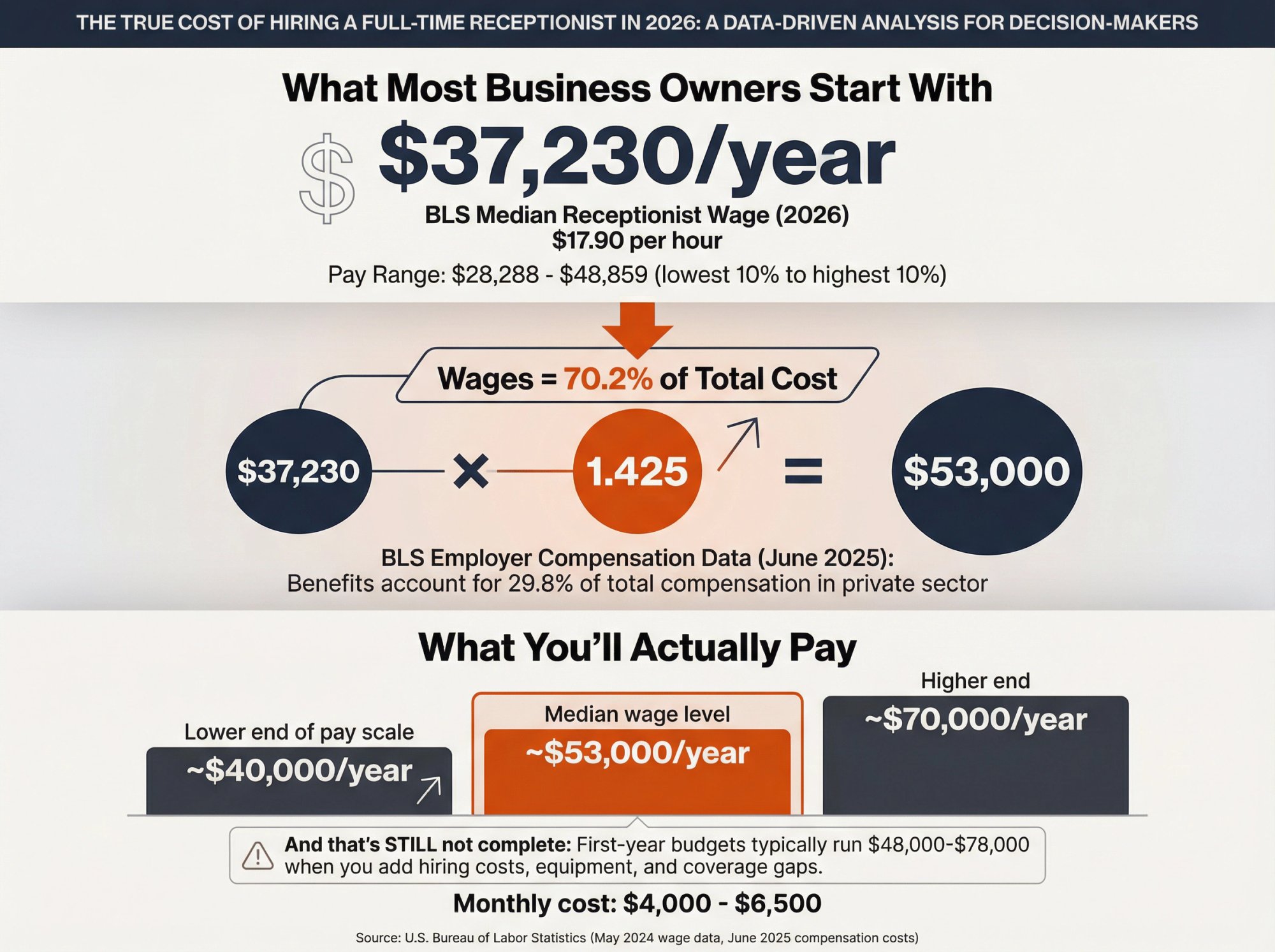
Let's start with the baseline. According to the U.S. Bureau of Labor Statistics, the median wage for receptionists is $37,230 per year (that's $17.90/hour, based on May 2024 wage data). The pay range varies significantly:
• Lowest 10%: Under $13.60/hour (~$28,288/year)
• Median: $17.90/hour (~$37,230/year)
• Highest 10%: Over $23.49/hour (~$48,859/year)
So far, pretty straightforward. But here's what most people miss: wages are only about 70% of what you'll actually pay.
The BLS also tracks employer compensation costs, and their June 2025 data shows that for private industry, wages make up roughly 70.2% of total compensation, while benefits account for 29.8%. That means:
Total compensation cost ≈ wage ÷ 0.702 ≈ wage × 1.425
When you apply this to receptionist wages, the real compensation cost often lands around:
• ~$40,000/year (lower end of the pay scale)
• ~$53,000/year (median wage level)
• ~$70,000/year (higher end)
And that's still not the complete picture. Once you add hiring costs, equipment, and the reality of coverage gaps, a practical first-year budget typically runs $48,000 to $78,000 (about $4,000 to $6,500 per month).
That number might feel high if you were anchoring on wage alone. Let's break down exactly where it comes from.
Why Do Most Businesses Underestimate Receptionist Costs?#
The most common mistake? Thinking "We'll pay $18/hour, so that's about $37,000 a year."
That's only one layer of the cost.
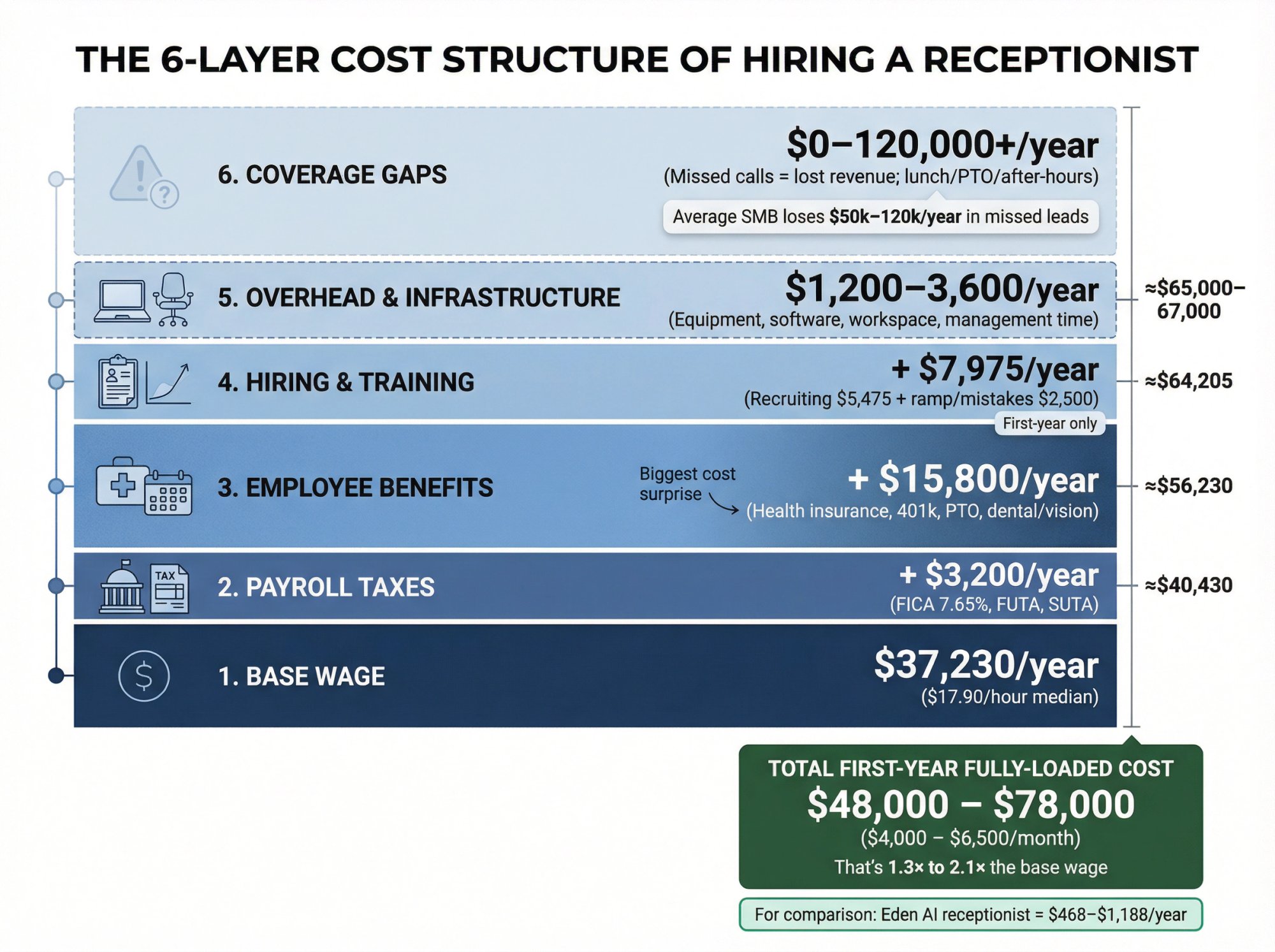
When you hire a full-time receptionist, you're not just buying phone coverage. You're buying capacity (a human being for 40 hours per week), and you pay for that capacity whether your phone rings once or 100 times. The actual employer cost stacks in six layers:
-
Wage (the number in the job posting)
-
Payroll taxes (employer-side FICA, unemployment insurance, workers' comp)
-
Benefits (health insurance, retirement, paid time off, disability)
-
Hiring and ramp (recruiting costs, training time, early mistakes)
-
Overhead (desk, computer, phone system, software, management time)
-
Coverage gaps (lunch breaks, PTO, sick days, after-hours)
The Reality Check: If you don't account for all six layers, you're setting yourself up for budget shock three months in.
What Are the Real Costs of Hiring a Receptionist? (Layer by Layer)#
What Is the Base Receptionist Salary in 2026?#
This is where everyone begins. The BLS median of $37,230/year ($17.90/hour) gives you a solid national benchmark. But actual wages vary by location and industry.
For example, receptionists in higher cost-of-living areas like Washington, D.C. or California often earn $45,000+ per year, while some regions pay closer to $30,000 to $35,000. Role complexity matters too. A medical office receptionist handling patient scheduling and insurance might command a premium over someone answering phones at a small retail shop.
For our calculations, we'll use $35,000 to $40,000/year as a typical full-time base salary for a competent receptionist.
Key insight: Paying the salary alone is significant, but it's only the foundation. Now come the costs most people forget.
How Much Do Payroll Taxes Add to Receptionist Costs?#
Federal and state governments require employers to pay several taxes on top of every employee's wages. Here are the big ones:
Employer FICA (Social Security and Medicare):
• Social Security: 6.2%
• Medicare: 1.45%
• Combined: 7.65%
The IRS sets the Social Security wage base at $184,500 for 2026, so the 6.2% applies to most receptionist salaries with no cap concerns.
Federal Unemployment Tax (FUTA):
The standard FUTA rate is 6.0% on the first $7,000 of wages, but most employers get a credit when they pay state unemployment on time. This brings the effective rate to 0.6%, or about $42 per year per employee.
State Unemployment Tax (SUTA) and Workers' Compensation:
These vary wildly by state and your company's claims history. Don't try to zero these out in your budget. They're real line items.
Bottom line: Even if you offer zero benefits, payroll taxes alone add roughly 8-10% to your wage cost.
For a $40,000 salary, that's an extra $3,000 to $4,000 per year you're paying to government agencies.
What Do Employee Benefits Actually Cost?#
This is where many business owners get sticker shock. The BLS reports that benefits account for about 29.8% of total compensation in the private sector. Let's unpack what that actually means.
Health Insurance: The Big One
The Kaiser Family Foundation's 2025 Employer Health Benefits Survey found that average annual premiums are:
-
$9,325 for single coverage
-
$26,993 for family coverage
Employers typically cover most of the premium:
-
84% of single coverage
-
74% of family coverage
That works out to roughly:
-
Single coverage: $7,833/year employer cost
-
Family coverage: $19,975/year employer cost
For a receptionist earning $35,000 to $40,000, health insurance alone can represent 20% to 50% of their base wage depending on whether they need single or family coverage.
Other Common Benefits:
-
401(k) matching contributions
-
Dental and vision insurance
-
Life and disability insurance
-
Bonuses or performance incentives
-
Paid time off (you pay full salary for ~2-3+ weeks they don't work)
Even a modest benefits package can easily cost $6,000 to $10,000+ per year. More generous packages push significantly higher.
Reality check: Using the BLS compensation ratio, if wages are 70.2% of total cost, a $37,230 salary implies total compensation of about $53,000/year. That extra ~$15,800 is benefits.
How Much Does Hiring and Training a Receptionist Cost?#
Your receptionist doesn't start at full productivity on day one. There are real costs to bringing someone new on board.
Recruiting and Hiring:
The Society for Human Resource Management (SHRM) reports an average cost-per-hire of $5,475 for non-executive positions (October 2025 data). This includes job postings, interview time, background checks, and onboarding paperwork.
Training and Ramp Time:
For the first few weeks, your new receptionist will be learning your:
-
Phone system and call routing
-
Scheduling software
-
Customer names and common requests
-
Internal processes and who to transfer calls to
During this ramp period, they'll make mistakes. Maybe they schedule someone in the wrong time slot, or miss capturing a lead's callback number.
These aren't huge disasters, but they have a cost in lost efficiency and customer experience.
Training and onboarding typically cost $1,000 to $5,000 in direct resources and productivity loss.
Turnover Risk:
If your receptionist leaves after a year or two, you'll repeat this entire cycle.
Research from the Work Institute suggests replacement costs run about 33.3% of annual salary (that's $16,500 to replace a $50,000 employee). Administrative roles often see higher turnover than specialized positions, so budget for the possibility.
What Overhead Costs Do Receptionists Need?#
Your receptionist needs infrastructure to do their job:
Equipment and Workspace:
-
Computer, monitor(s), keyboard, mouse
-
Headset or desk phone
-
Desk, chair, office supplies
-
Portion of your office rent and utilities
Software and Systems:
-
Phone system licenses and extensions
-
Scheduling software (calendar integration)
-
CRM or customer database access
-
Email, password manager, internal communication tools
Management Time:
-
Weekly one-on-ones
-
Performance reviews
-
Process updates and training
-
Quality assurance on calls
You can model this as a one-time setup cost (equipment) plus ongoing monthly overhead (software licenses, space allocation). Even a basic setup might run a few hundred dollars per month when you add it all up. More sophisticated operations with premium software can easily exceed $1,000/month in overhead per seat.
What Are the Hidden Costs of Coverage Gaps?#
Here's the reality that surprises most business owners:
A full-time receptionist works about 40 hours per week. That's only 24% of the total 168 hours in a week.
That means:
Nights and weekends? Voicemail.
Lunch breaks? Voicemail or another employee covering (poorly).
Sick days and vacation? Voicemail or scrambling for coverage.
When they're already on a call? Your second caller gets voicemail or hold music.
The cost of these gaps is enormous. Studies show:
• Roughly 80% of callers who reach voicemail don't leave a message (they hang up and call your competitor)
• Analysis of millions of calls found 18% of weekday calls and 41% of weekend calls go unanswered
• The average small business loses over $120,000 in revenue annually from missed calls
Let's make that concrete.
If your average customer is worth $500 in profit and you miss just two calls per week, that's potentially $50,000+ in lost revenue per year. For many service businesses (law firms, real estate agencies, HVAC companies), the profit per new customer is even higher.
The coverage trap: One full-time receptionist can't give you true 24/7 answering. If you want comprehensive coverage using in-house staff, you'd need at least three full-time employees (plus part-timers for shift gaps and weekends). Very few small businesses can afford that payroll.
Real Example: What Does a Median-Wage Receptionist Actually Cost?#
Let's walk through a real calculation using the BLS median wage as our starting point.
Starting point: $37,230/year salary (BLS median)
Apply the BLS compensation ratio:
→ If wages are ~70.2% of total compensation...
→ Total compensation ≈ $37,230 ÷ 0.702 ≈ $53,000/year
→ Implied benefits cost: ~$15,800/year
Add first-year costs:
→ Recruiting/hiring: ~$5,475 (SHRM average)
→ Equipment/setup: ~$1,500 (computer, desk, phone, initial supplies)
→ Training productivity loss: ~$1,500 (first two weeks at reduced effectiveness)
First-year fully loaded budget: approximately $61,000 (about $5,100/month)
And remember, that's before you solve for coverage gaps. It also assumes this person stays at least a year (if they quit sooner, add replacement costs).
Why Can't One Receptionist Give You 24/7 Phone Coverage?#
Even the most dedicated receptionist has natural limits. Here's what one full-time hire actually gives you:
What you get:
-
40 hours per week of phone coverage
-
Likely Monday-Friday, 9am-5pm (or similar)
-
One call answered at a time
What you don't get:
✗ After-hours coverage (evenings, weekends, holidays)
✗ Simultaneous call handling (if two lines ring at once, someone waits or hits voicemail)
✗ Backup when they're out (PTO, sick days, lunch breaks)
✗ Instant availability (they might be in the restroom, at the printer, or helping someone in person)
For many service businesses, calls don't respect business hours. A homeowner with a burst pipe calls at 9pm. A potential client researching lawyers Googles from their couch on Saturday morning. A patient needs to reschedule on their lunch break when your receptionist is at their lunch break.
The math problem: True 24/7 coverage requires multiple employees working shifts. If you wanted comprehensive live answering every hour of every day, you'd need:
-
At least 3 full-time receptionists (to cover 168 hours/week in 56-hour shifts)
-
Plus part-time or per-diem staff to fill gaps, handle PTO, and prevent burnout
At $4,000 to $5,000 per month per person, that's $12,000 to $15,000/month minimum for around-the-clock coverage. Most small businesses simply can't justify that expense.
How to Calculate Your Real Cost Per Minute of Phone Coverage#
Here's a perspective shift that helps clarify the decision:
If your receptionist exists primarily to answer calls, your real question becomes: how many minutes of calls do we actually need answered each month?
A full-time receptionist is a fixed cost. You pay them the same whether your phone rings 10 times or 500 times. So the cost-per-minute of answered calls depends entirely on your volume:
Cost per minute = (Monthly fully loaded cost) ÷ (Answered call minutes per month)
Example scenarios:
| Monthly Call Minutes | Fully Loaded Monthly Cost | Cost Per Minute |
|---|---|---|
| 300 minutes | $4,400 | $14.67 |
| 600 minutes | $4,400 | $7.33 |
| 1,200 minutes | $4,400 | $3.67 |
| 2,400 minutes | $4,400 | $1.83 |
This isn't to say high cost-per-minute means don't hire. It means be honest about what you're buying.
If you need a front-desk presence plus admin work (filing, package handling, office coordination), a full-time hire makes perfect sense regardless of call volume.
If you're mainly paying for phone coverage and lead capture, and your call volume is low or bursty, you might be buying far more capacity than you actually use.
Understanding your cost-per-minute helps you evaluate alternatives fairly.
How Do Virtual Receptionists and AI Compare to In-House Hiring?#
Given the costs we've outlined, it's no surprise many businesses explore other options. Let's look at how they compare on price and capabilities.
What Do Human Virtual Receptionist Services Cost?#
Instead of hiring in-house, you pay a specialized company to handle your calls. These services employ trained receptionists who answer on behalf of multiple businesses.
Typical pricing (based on industry standards):
| Plan | Minutes Included | Monthly Cost |
|---|---|---|
| 50 minutes | 50 | $245 |
| 100 minutes | 100 | $385 |
| 200 minutes | 200 | $705 |
| 500 minutes | 500 | $1,695 |
That works out to roughly $3.39 to $4.90 per minute of receptionist time.
What you're buying:
→ Professional call answering without the hiring hassle
→ Variable cost (scales with your usage)
→ Often includes 24/7 or extended-hours coverage
→ Agents trained in customer service
What to watch:
→ Overage charges if you exceed your plan
→ Integration limitations (can they actually book in your calendar or just take messages?)
→ Quality consistency (agents handle many companies, not just yours)
→ "Per minute" can add up fast during busy periods
Even at the high end ($1,695/month for 500 minutes), this is significantly less than a full-time in-house hire ($4,000-5,000/month), and you get broader hours of coverage.
How Much Does an AI Receptionist Cost?#
The newest alternative is AI-powered virtual receptionists like Eden. These use advanced voice AI to answer calls, have natural conversations with callers, gather information, schedule appointments, and route calls appropriately.
Typical pricing (using Eden's published plans):
-
Plus plan: $39/month for 200 minutes (24/7 answering, bilingual English/Spanish, spam blocking)
-
Pro plan: $99/month for unlimited minutes (adds calendar integration, appointment booking, call transfers)
What you're buying:
① 24/7/365 coverage with zero time off
② Unlimited simultaneous calls (no busy signals ever)
③ Consistent quality (doesn't have bad days or forget training)
④ Software pricing model instead of per-person staffing cost
Cost comparison to in-house:
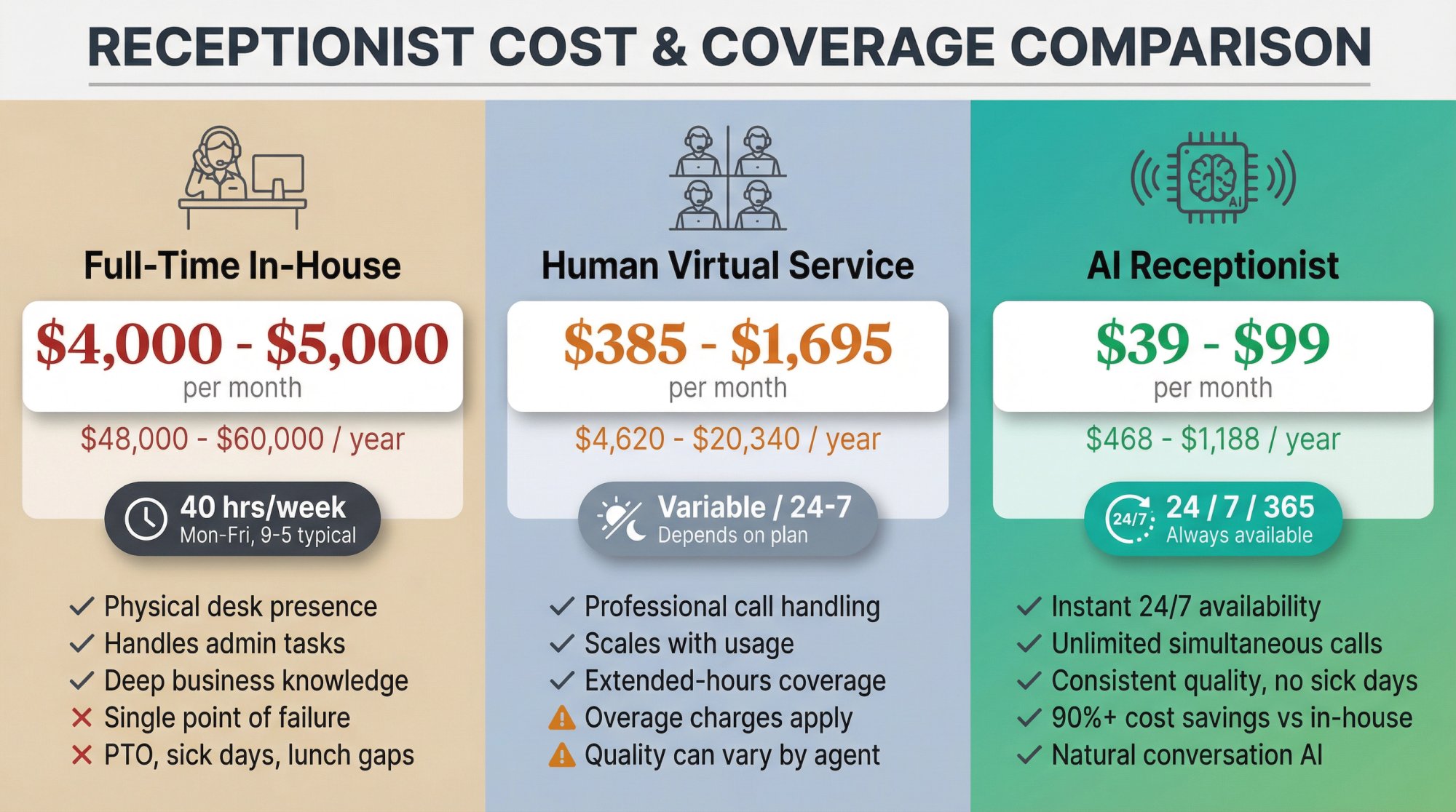
| Solution | Monthly Cost | Annual Cost | Coverage |
|---|---|---|---|
| Full-time in-house | $4,000-$5,000 | $48,000-$60,000 | 40 hrs/week |
| Human virtual service | $385-$1,695 | $4,620-$20,340 | Variable/24-7 |
| AI receptionist (Eden) | $39-$99 | $468-$1,188 | 24/7 |
The AI Advantage: An AI receptionist can cost 90%+ less than hiring full-time while actually providing better availability.
AI isn't a perfect human replacement for every situation. Complex, highly nuanced conversations or sensitive customer service scenarios might still need a human touch. But for the high-ROI tasks (answering every call immediately, capturing lead information, scheduling appointments, routing calls correctly), modern AI receptionists are remarkably effective. Many callers don't even realize they're talking to AI.
Hybrid approach: Many businesses use AI to handle routine calls and after-hours inquiries, while forwarding the most important or complex calls to a human (either someone on their team or an outsourced live agent when needed).
How Do I Choose Between In-House, Virtual, and AI?#
Here's a simple framework:
Choose full-time in-house if:
✓ You need physical front-desk presence (walk-ins, visitors, package handling)
✓ The role includes significant admin work beyond phones
✓ Call volume is consistently high and requires deep business knowledge
✓ You can support the full operational reality (management, coverage, turnover)
Choose virtual or AI if:
✓ Your primary goal is "answer every call and capture every lead"
✓ Call volume is bursty or seasonal
✓ You need after-hours and weekend coverage
✓ You want to avoid the "single point of failure" problem (one sick employee = missed calls)
For many small businesses, Eden provides the best of both worlds: professional answering with immediate availability, at a fraction of the cost of hiring. You can get started with a free trial to see how it works with your actual calls before committing.
When Does Hiring a Full-Time Receptionist Make Sense?#
We've spent a lot of time on costs and alternatives, so let's be clear: hiring a full-time receptionist absolutely makes sense for many businesses.
The key is being honest about what you actually need.
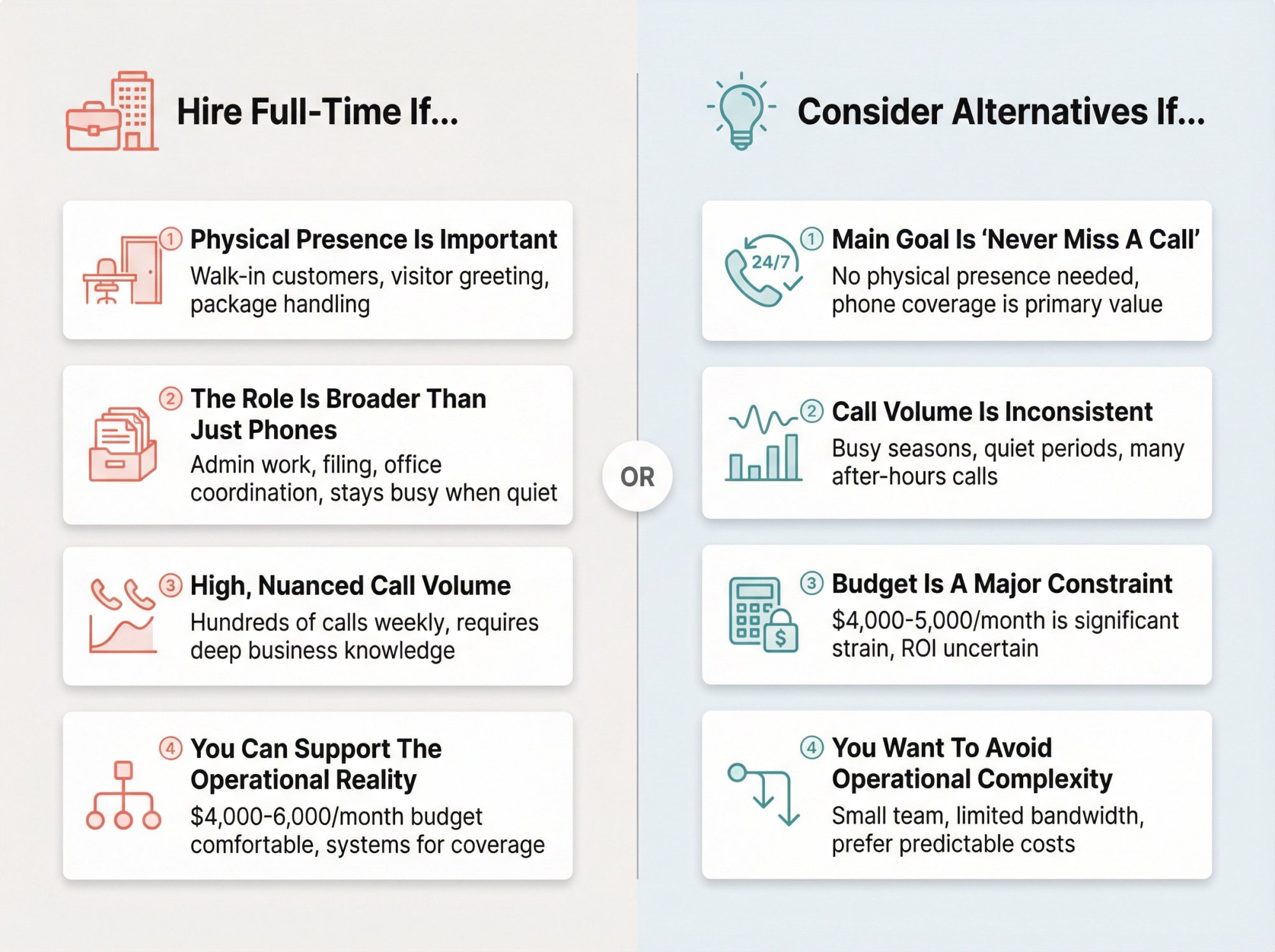
Hire full-time if most of these are true:
① Physical presence is important
• You have walk-in customers or clients
• Someone needs to greet visitors, sign for packages, manage office access
• The front desk is part of your customer experience
② The role is broader than just phones
• You need ongoing administrative support (filing, data entry, coordination)
• Accounts receivable/payable assistance
• Office management tasks
• The person will stay busy even when phones are quiet
③ High, nuanced call volume
• You receive hundreds of calls per week
• Conversations require deep knowledge of your business
• Calls frequently involve complex problem-solving or judgment calls
④ You can support the operational reality
• Budget for $4,000-$6,000/month is comfortable
• You have systems for training, management, and coverage gaps
• You're prepared for potential turnover and the replacement cycle
Consider alternatives if most of these are true:
① Main goal is "never miss a call"
• You don't need physical presence
• Administrative work is minimal or handled elsewhere
• Phone coverage is the primary value
② Call volume is inconsistent
• Busy seasons followed by quiet periods
• Most calls happen outside business hours
• You're currently missing many calls to voicemail
③ Budget is a major constraint
• $4,000-$5,000/month is a significant strain
• You need coverage but can't afford multiple employees
• ROI on a full-time hire is uncertain
④ You want to avoid operational complexity
• Small team with limited management bandwidth
• Don't want to deal with PTO, sick days, turnover
• Prefer predictable, lower monthly costs
Neither option is "wrong." It's about matching the solution to your actual needs and constraints.
What Questions Should You Answer Before Hiring?#
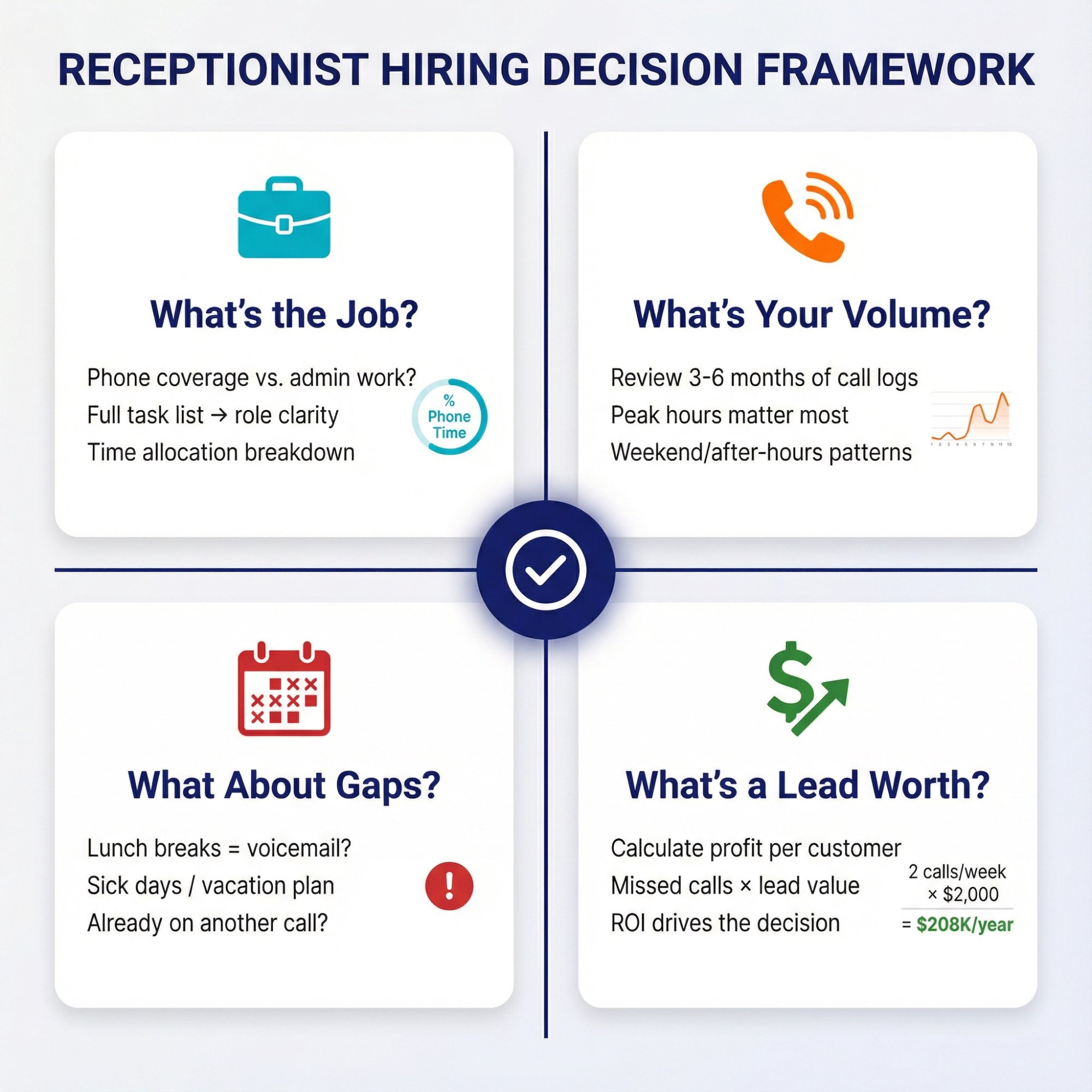
Before you make the hire/don't hire decision, force yourself to answer these questions in writing:
What is this receptionist's job actually responsible for?#
Write out the full list.
If you expect "answer phones + scheduling + billing + office management + client intake," you're not hiring a receptionist. You're designing a different role entirely, probably at different compensation.
Be specific: What percentage of their time will be phone coverage vs. other tasks?
How many call minutes do we get per month, and when do they happen?#
Don't guess. Look at your call logs for the past 3-6 months.
→ Average minutes per day?
→ Peak hours? (These matter more than totals)
→ Weekend and after-hours calls?
→ Seasonal patterns?
Why this matters: If you get 90% of your calls between 2pm-5pm Tuesday-Thursday, a full-time hire sitting idle the rest of the week might not make sense.
What happens when the receptionist is unavailable?#
Right now, imagine your receptionist is:
• At lunch (12:00-12:30 every day)
• Out sick for three days
• On vacation for a week
• Already on another call
Who covers? What's the actual plan?
If your honest answer is "calls go to voicemail," then your "full-time receptionist" plan is actually a "part-time coverage" plan. That might be fine, but acknowledge it.
What is one captured lead worth to us (profit, not revenue)?#
This is the number that changes everything.
If one new customer is worth $200 in profit and you miss 2 calls per week, that's $20,800/year in lost opportunity. Painful, but maybe not catastrophic.
If one new customer is worth $2,000 in profit (high-ticket service business), missing 2 calls per week is $208,000/year in lost revenue.
Suddenly a $60,000/year receptionist looks like a bargain, and a $1,200/year AI receptionist looks like a no-brainer.
Do the math for your business specifically.
How to Calculate Your Specific Receptionist Costs#
Here's a simple framework to calculate your specific fully-loaded cost:
Step 1: Determine your base salary
→ Use the BLS wage data as a starting point ($37,230 median)
→ Adjust for your local market (higher in expensive cities, lower in rural areas)
→ Factor in experience level and role complexity
Your base salary: $___________
Step 2: Calculate compensation cost (salary + benefits)
→ Quick method: Multiply salary by 1.425
→ Detailed method: Add up actual benefits (health insurance, 401k match, PTO cost)
Your compensation cost: $___________
Step 3: Add first-year costs
→ Recruiting and hiring: ~$5,000
→ Equipment and setup: $500-$2,000
→ Training and ramp: $1,000-$2,000
Your first-year total: $___________
Step 4: Calculate monthly cost
→ Divide annual total by 12
Your monthly cost: $___________
Step 5: Determine your cost-per-minute (if relevant)
→ Estimate monthly answered call minutes
→ Divide monthly cost by call minutes
Your cost-per-minute: $___________
Step 6: Compare to alternatives
→ Human virtual receptionist: Multiply estimated call minutes by $3.50-$5.00
→ AI receptionist (Eden): $39-$99/month for unlimited coverage
Quick decision flowchart:
Do you need physical front-desk presence?
├─ YES → Do you have >$4,000/month budget?
│   ├─ YES → Hire full-time makes sense
│   └─ NO → Consider part-time + AI for after-hours
└─ NO → Is phone coverage your main need?
    ├─ YES → Compare virtual/AI (likely better ROI)
    └─ NO → What are you actually hiring for? (Re-evaluate role)
Frequently Asked Questions#
What's the average receptionist salary in 2026?#
According to the U.S. Bureau of Labor Statistics, the median wage is $37,230/year ($17.90/hour) based on May 2024 data.
The range typically spans from about $28,000/year (lowest 10%) to $49,000/year (highest 10%), with significant variation by location and industry.
How much should I budget above base salary?#
Use the BLS compensation ratio as your guide: wages are about 70% of total cost, which means total compensation (including benefits) is roughly 1.4× to 1.5× base salary.
Then add first-year costs (hiring, equipment, training) of $5,000-$10,000. For a $40,000 salary, budget around $60,000-$65,000 for the first year.
What's the most overlooked cost?#
Coverage and continuity.
One person can't cover sick time, PTO, lunch breaks, after-hours, and weekends. You either accept missed calls (which have real revenue cost) or you build in backup plans (which add expense).
The "hidden" cost isn't on your P&L; it's the $50,000 to $120,000+ in missed leads when calls go unanswered.
Is hiring still worth it?#
Absolutely, for the right role.
If you need a front-desk presence for walk-ins plus administrative support, hiring makes great sense. If you're primarily solving for "answer every call," alternatives like Eden's AI receptionist can give you better coverage (24/7) at a fraction of the cost ($39-$99/month vs. $4,000-$5,000/month).
How do I know if I need 24/7 coverage?#
Look at your call logs.
If you're receiving significant inquiries outside business hours, or if competitors in your industry offer after-hours answering and you're losing leads, you probably need it.
The question then becomes: can you afford 3+ full-time employees for shift coverage (unlikely for most SMBs), or does a virtual/AI solution make more sense?
Can I hire part-time to save money?#
Yes, if your call volume is concentrated in specific hours.
A part-time receptionist (20-25 hours/week) might cost $25,000-$35,000 fully loaded annually. Just be clear about when they'll work and what happens outside those hours. Many businesses pair part-time staff with AI coverage for off-hours.
What about contract or temp receptionists?#
Contract receptionists (through temp agencies) can cost $20-$35/hour in placement fees. That's $3,200-$5,600/month for full-time (40 hours/week).
You avoid benefits and hiring costs, but pay a premium on hourly rate. Good for short-term needs or trial periods before committing to a hire.
How does Eden compare for small businesses?#
Eden provides AI-powered reception starting at $39/month for 200 minutes of coverage and $99/month for unlimited calls with appointment booking and transfers. That's roughly 95% less expensive than a full-time hire while providing 24/7 coverage with no sick days, PTO, or coverage gaps. Many small businesses use Eden as their complete reception solution, while larger businesses use it to supplement in-house staff during peak times and off-hours. You can try Eden free to see if it fits your needs.
The Bottom Line#
Here's what you need to remember:
A full-time receptionist typically costs $45,000 to $70,000+ per year ($4,000-$6,000/month) when you include salary, taxes, benefits, hiring costs, and overhead. That's for 40 hours per week of coverage, with inherent gaps for lunch, PTO, sick days, and all the hours your office is closed.
The coverage problem often makes it even more expensive. If you actually need round-the-clock answering, you're looking at multiple employees and dramatically higher costs.
Alternatives exist that deliver better coverage at lower cost. Services like Eden's AI receptionist provide 24/7 answering, bilingual support, appointment scheduling, and intelligent call routing for $39 to $99 per month (a fraction of the cost of hiring while actually improving availability).
The right choice depends on your specific situation:
-
Need physical presence + admin work → Full-time hire makes sense
-
Need comprehensive phone coverage → Virtual or AI likely better ROI
-
Need both → Consider hybrid (part-time front desk + AI for off-hours)
Take action:
① Calculate your real fully-loaded cost using the framework above
② Review your call logs to understand your volume and timing
③ Calculate what missed calls are costing you right now
④ Compare the math: in-house vs. virtual vs. AI
If you're spending $4,000-$5,000/month on receptionist costs but still missing after-hours calls and weekend inquiries, it's worth exploring Eden. You can answer every call, capture every lead, and provide better customer service for less than you're paying now.
See how Eden works → | Try Eden free → | Compare receptionist costs →
Ready to Transform YourCustomer Experience?
Join hundreds of businesses using Eden AI to handle calls, book appointments, and provide 24/7 customer support.