Emergency Answering Service: Complete Guide (2026)
Complete 2026 guide to emergency answering service: costs, features, AI vs human options, setup steps, and ROI for businesses that can't miss calls.
January 5, 2026

A burst pipe at 2 AM. A furnace failing in the dead of winter. An urgent legal matter that can't wait until morning.
When customers face genuine emergencies, they need help right now. Not tomorrow. Not when you check voicemail. Now.
Here's the uncomfortable truth: research shows that roughly 75% of callers won't leave a voicemail, and about 85% won't call back after getting no answer. They'll just call your competitor instead.
In emergency situations, you don't get a second chance.
That's where emergency answering services come in. They ensure every critical call gets answered immediately, 24/7, by someone who can actually help. Whether you run a plumbing business, manage properties, or practice law, missing an urgent call isn't just an inconvenience. It's lost revenue, damaged reputation, and a customer you'll never get back.
This guide covers everything you need to know about emergency answering services in 2026: what they are, why they're essential, how to choose the right one, and what to expect when you implement this lifeline for your business.
What Is an Emergency Answering Service?#
An emergency answering service is a specialized call handling system that answers your phone around the clock and manages urgent situations according to your specific instructions.
Think of it as having a dedicated virtual receptionist who never sleeps, never takes breaks, and stays calm under pressure.
How Emergency Answering Services Work#
You forward your business line to the service (either permanently or just during specific times like after-hours or when you're busy). When calls come in, trained professionals answer on your behalf, gather critical information, and take the appropriate next steps.
For genuine emergencies, they might:
→ Dispatch your on-call technician
→ Transfer the call directly to you
→ Provide immediate guidance to the caller
For less urgent matters, they take detailed messages and ensure you get the information to follow up quickly.
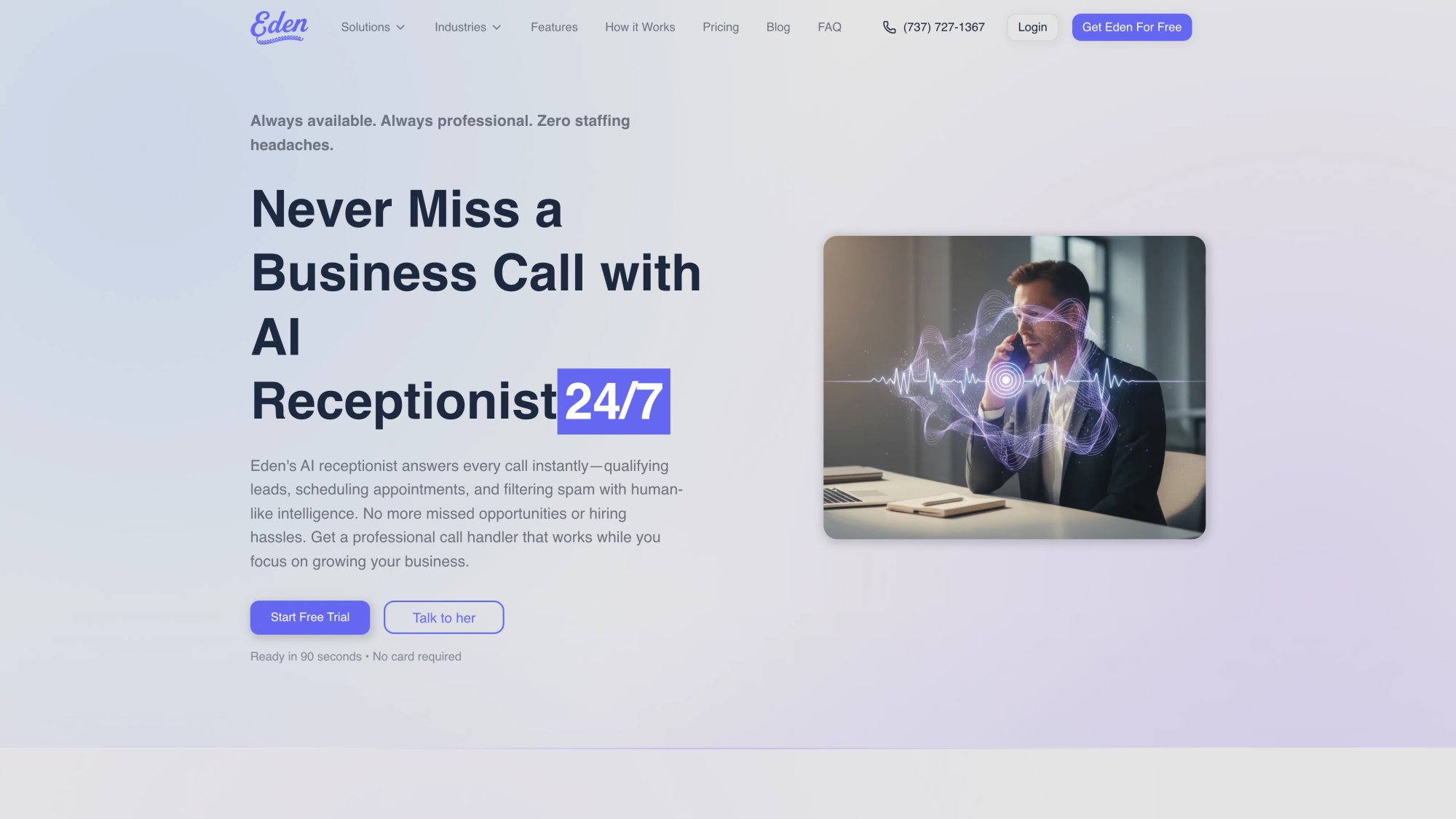
Eden's AI receptionist solution handles emergency calls with natural language understanding, instantly recognizing urgent keywords and routing calls appropriately.
Human vs AI Emergency Call Handling#
Traditional emergency answering services use live operators in call centers. These professionals are specifically trained to handle high-pressure calls and stay composed when callers are panicked or distressed.
Modern options also include AI-powered virtual receptionists like Eden, which use natural language understanding to handle emergency calls with impressive accuracy. The AI can recognize urgent keywords ("burst pipe," "no heat"), instantly transfer calls to your on-call team, and provide callers with immediate reassurance.
Important distinction: These services handle your customers' emergencies, not life-threatening 911 situations. A property manager might use one to field tenant calls about broken heaters. A lawyer might use one to catch urgent client calls after hours. An HVAC company might use one to ensure emergency service requests never go to voicemail.
Why Emergency Services Do More Than Take Messages#
The best emergency answering services do far more than record caller information.
They act as an extension of your team rather than a generic call center. They follow protocols you define, screen and triage calls based on urgency, and ensure routine inquiries don't wake you up at 3 AM while genuine emergencies get handled immediately.
Many businesses also incorporate emergency answering services into their disaster recovery plans. If a hurricane knocks out your office phones or a power outage shuts down your local systems, the remote answering service keeps your communication lines open. Your customers can still reach a friendly, helpful voice even when your business is dealing with its own crisis.
Why Do You Need 24/7 Emergency Call Coverage?#
We live in an on-demand world. Uber arrives in minutes. Amazon delivers overnight. Google answers questions instantly.
Your customers have been trained to expect immediate help.
Emergencies amplify that expectation by 100x.
When something urgent happens, waiting hours for a callback simply isn't acceptable. People want help now. If you can't provide it, someone else will.
How Much Revenue Do Missed Calls Cost You?#
The numbers are brutal.
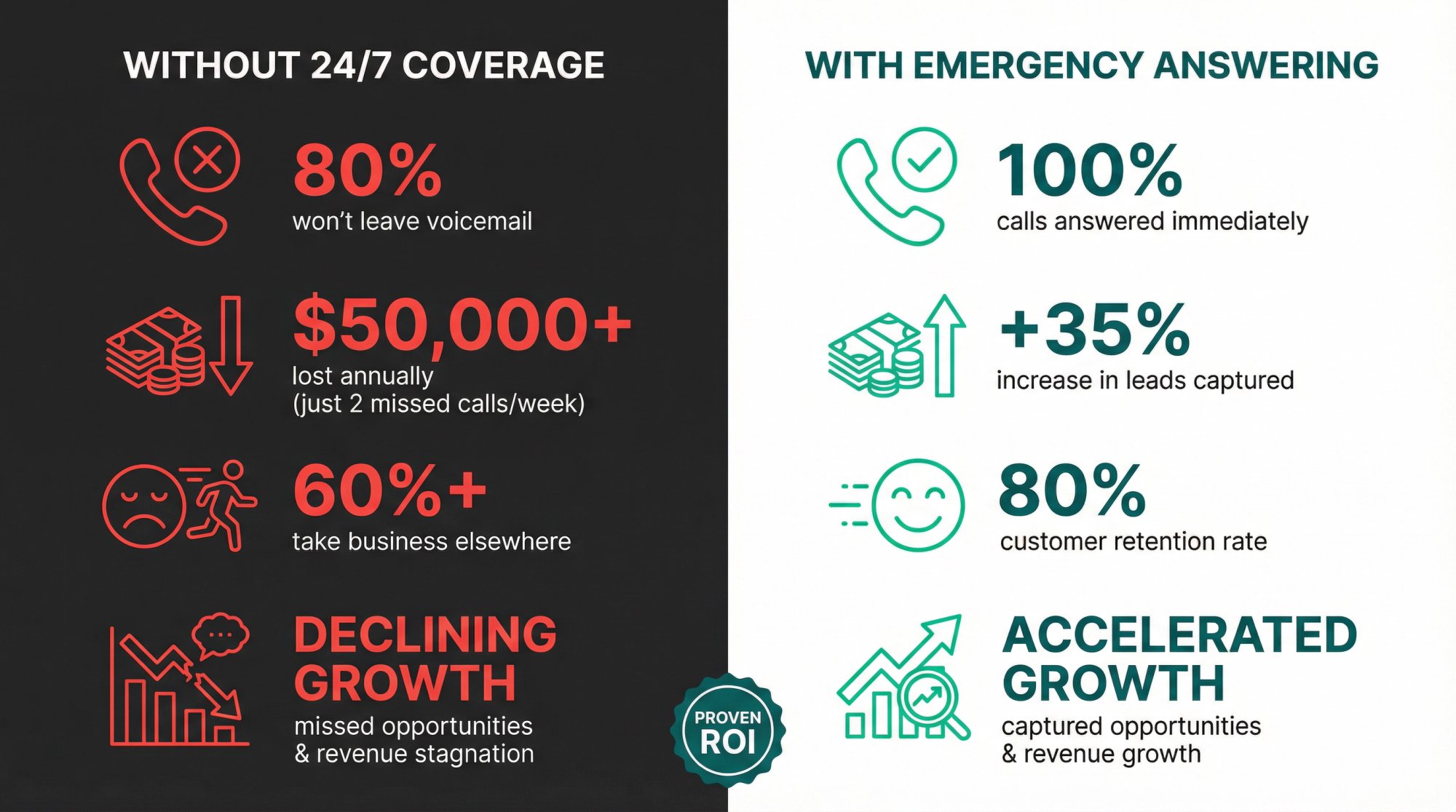
Roughly 80% of callers who hit voicemail will hang up. Even worse, about one-third of people who get no answer won't ever attempt to contact that business again.
One strike and you're out.
Think about the financial impact: If your average customer transaction is $500 and you miss just two urgent calls per week, that's $1,000 weekly slipping through the cracks.
Over a year? Over $50,000 in potential revenue lost to unanswered calls.
And that's a conservative estimate. Many small businesses miss far more than two calls weekly, especially after hours. One industry study found home service companies missing ~27% of calls were losing hundreds of thousands of dollars annually in aggregate business.
How Missed Emergency Calls Damage Your Reputation#
Beyond immediate revenue, failed emergency response signals to customers that you're unreliable or don't care.
Research shows that over 60% of unhappy callers will take their business elsewhere. In the age of online reviews, one bad experience ("couldn't reach them when my basement flooded!") snowballs into reputational damage that affects future customer acquisition.
On the flip side, being there in a crisis builds massive goodwill. People remember who helped them during emergencies. They tell others about exceptional service. They become loyal customers for life.
Companies that prioritize rapid, live response see significantly higher customer satisfaction and retention rates. One analysis found that offering 24/7 live support can improve customer retention to around 80% and even increase sales by 20%, simply by capturing opportunities that would otherwise be lost.
When Do Most Emergency Calls Happen?#
Many emergencies happen outside 9-5. Burst pipes don't wait for business hours. Power outages happen at midnight. Homeowners with day jobs call contractors in the evening.
If you're only answering phones during business hours, you're effectively unreachable when customers need you most.
After-hours calls represent a massive portion of potential business in service industries.
An emergency answering service plugs this gap completely. You can honestly say "call us anytime" and know someone will actually answer.
Why First to Answer Wins the Customer#
In urgent situations where customers are frantically calling down a list, the first business to pick up often wins.
The legal field demonstrates this clearly: 62-78% of clients hire the first lawyer who responds to them, and 94% are more likely to hire a firm that responds quickly. Speed isn't just important, it's critical for winning business.
The same principle applies across industries. If your phone gets answered and your competitor's doesn't, you've got a massive advantage.
One survey found firms following up within 5 minutes of an inquiry saw 400% higher conversion rates than those waiting an hour or more.
Instant response captures hot leads that would otherwise go cold.
What Results Do Businesses See with 24/7 Answering?#
The evidence is clear: businesses replacing voicemail with live answering see dramatic improvements.
One case study documented a 35% increase in leads captured after implementing 24/7 live answering. Contractors using answering services report double-digit increases in new bookings simply by ensuring no call goes unanswered.
Which Businesses Need Emergency Answering Services?#
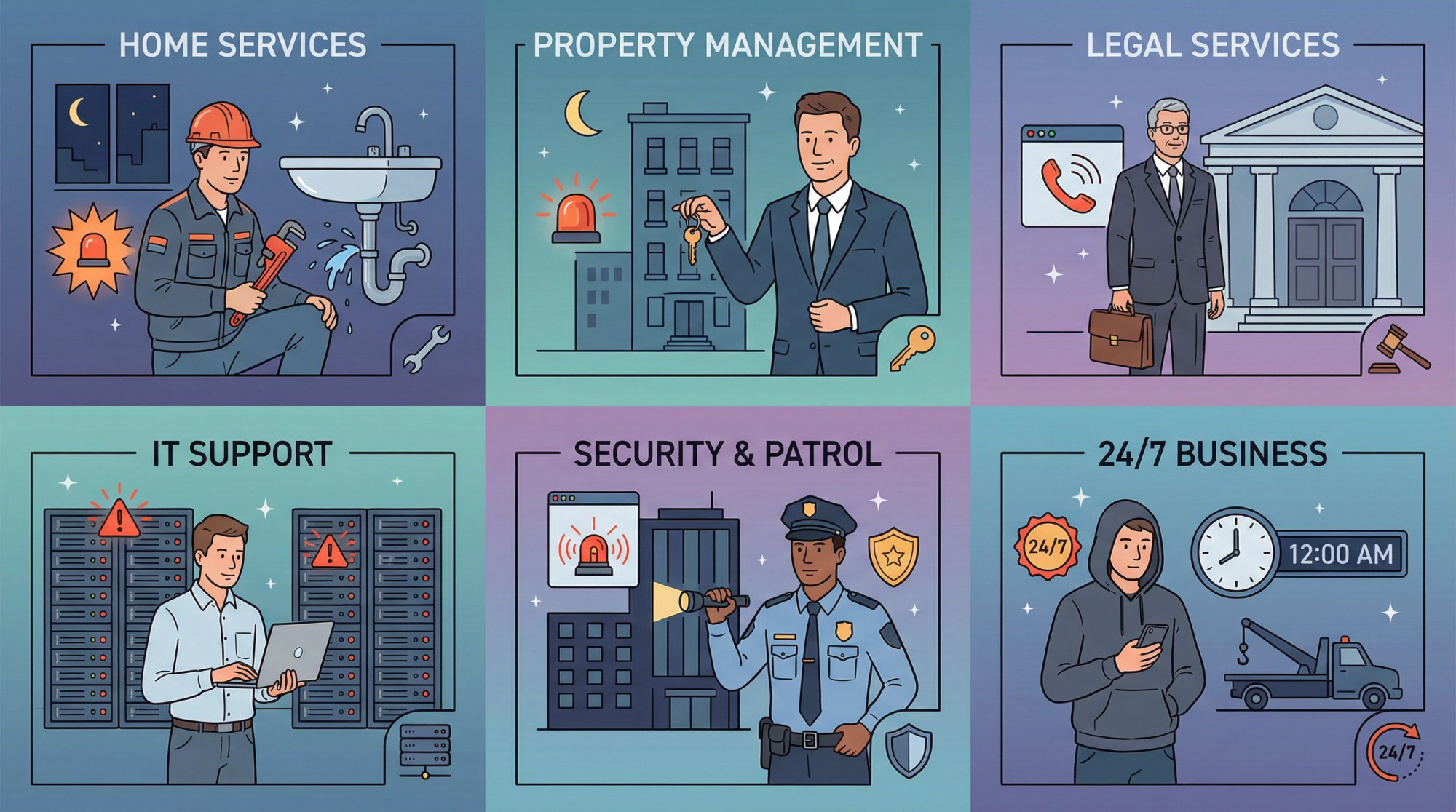
Any business dealing with time-sensitive customer needs or urgent calls can benefit. But certain industries depend on this capability to meet customer expectations and stay competitive.
Emergency Answering for Home Service Businesses#
Emergency calls for burst pipes, power outages, broken AC units, and roof leaks often happen after hours and need immediate attention.
Homeowners will call down a list until someone answers. The contractor who picks up that panicked 2 AM call about a furnace outage in winter "wins that customer for life".
Emergency answering ensures there's always someone to calmly gather details and dispatch your on-call technician. This not only lands you the job, it demonstrates reliability that customers never forget.
Many plumbing, electrical, and HVAC companies advertise 24/7 emergency service. A live answering partner lets you actually deliver on that promise without personally staying up all night.
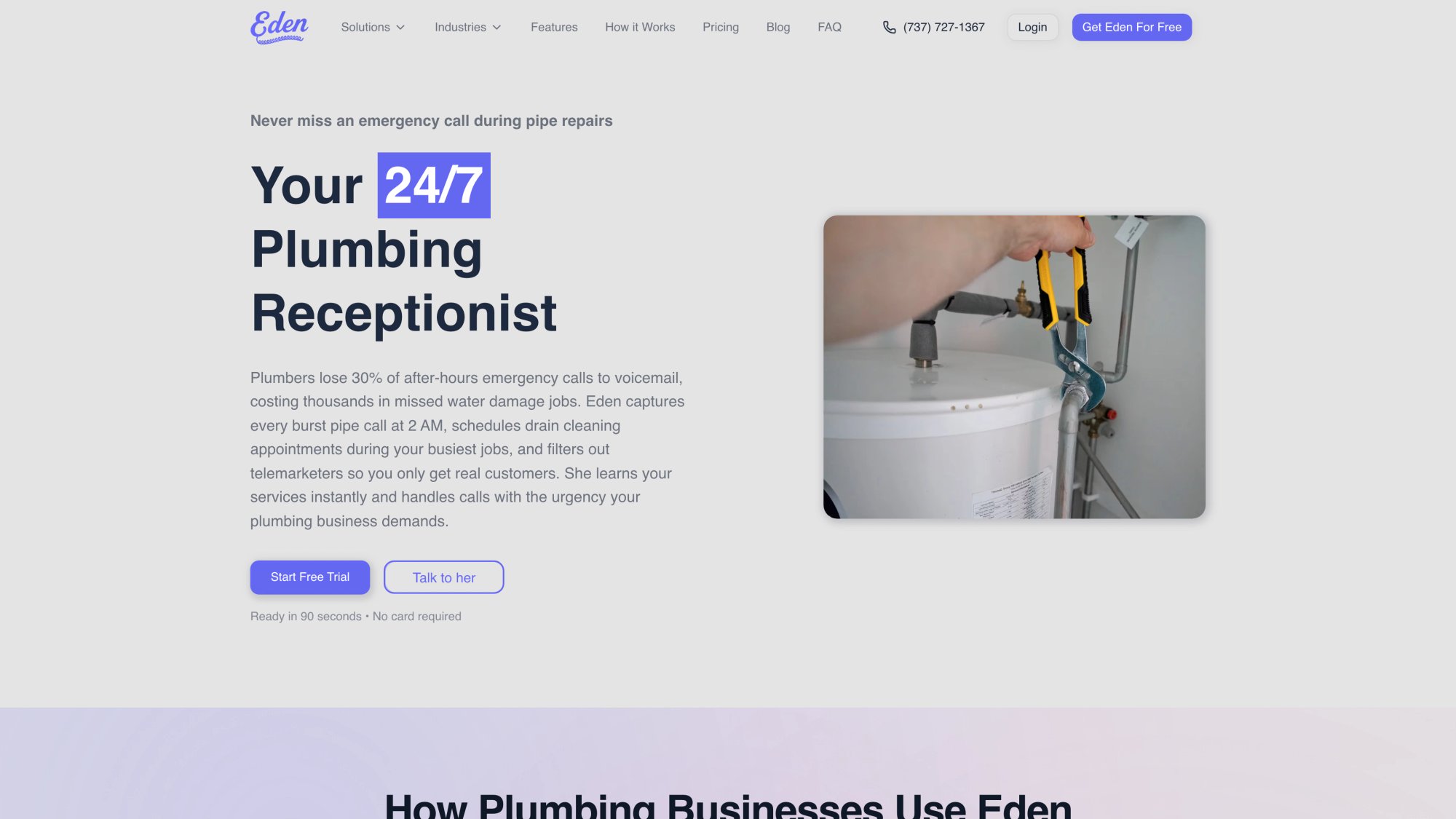
Eden's dedicated plumbing answering service page demonstrates how AI can field emergency calls about burst pipes, water heaters, and other urgent plumbing issues—dispatching the right technician immediately.
Emergency Answering for Property Managers#
If you manage rental properties or facilities, tenant emergencies can occur anytime. Pipes burst. Doors break. Heat stops working. Alarms go off.
Property managers must remain accessible 24/7 to address tenant concerns, both to protect tenants and prevent property damage.
An emergency answering service fields those 3 AM tenant calls, handles them per your protocols (contact on-call maintenance for genuine emergencies, log non-urgent issues for next day), and ensures tenants always reach a human who can help. This keeps residents safe and satisfied while shielding you from liability.
Property managers using Eden can route tenant emergencies directly to on-call maintenance while logging routine requests for next-day follow-up—ensuring nothing falls through the cracks.
Emergency Answering for Law Firms#
Legal emergencies don't respect business hours. Arrests happen at midnight. Urgent court filings have tight deadlines. Clients face crises that need immediate legal help.
If you're unavailable, prospective clients quickly call another attorney. Remember: 62-78% of legal clients hire the first attorney who responds, and almost all prioritize quick response when choosing a firm.
A legal answering service familiar with law firms can screen calls for urgency (differentiate a jail call from a general inquiry), patch through emergencies to your cell, and take detailed messages for others. This prevents lost clients while projecting professionalism.
Emergency Answering for IT Support Companies#
Tech companies promising uptime and rapid response face server outages, cybersecurity breaches, and system failures that might occur at 2 AM on Sunday.
An emergency answering service can troubleshoot issues and mobilize on-call engineers immediately, minimizing client downtime. The service answers tier-1 support calls, creates incident tickets, and escalates to your on-call tech team.
Clients always get a live response ("Yes, we're on it!") instead of voicemail. In SLA-driven environments, 24/7 call coverage is often mandatory.
Emergency Answering for Security Companies#
If you provide security or alarm services, clients expect perpetual vigilance. Alarms can trip at any hour. Security threats don't wait for business hours.
An emergency answering service ensures every alarm call or security emergency is answered promptly and action is taken without delay. Operators follow your scripts to verify details, dispatch on-call security personnel or contact emergency responders, and reassure callers.
Reliability here isn't just about business reputation. It's about safety. Missing a security call is unacceptable.
Any Business Advertising 24/7 Availability#
From towing companies to locksmiths, pet emergency clinics, funeral homes, appliance repair, and beyond: if you market 24/7 availability or serve customers in critical situations, you need a mechanism to answer the phone at all times.
If a missed call in your line of work equals a lost client or failed commitment, emergency answering support is essential. It lets you actually fulfill the promise of round-the-clock service without chaining you (or your staff) to the phone 24/7.
Quick assessment: Reflect on the past year of your business. How many urgent calls came in after hours or during busy periods? What happened when you missed them? If the answer is "lost business" or "angry customers," that's a clear sign you need better after-hours call coverage.
What Features Matter in Emergency Answering Services?#
Not all answering services can handle emergencies effectively. When evaluating providers, focus on these critical capabilities:
24/7/365 Live Call Availability#
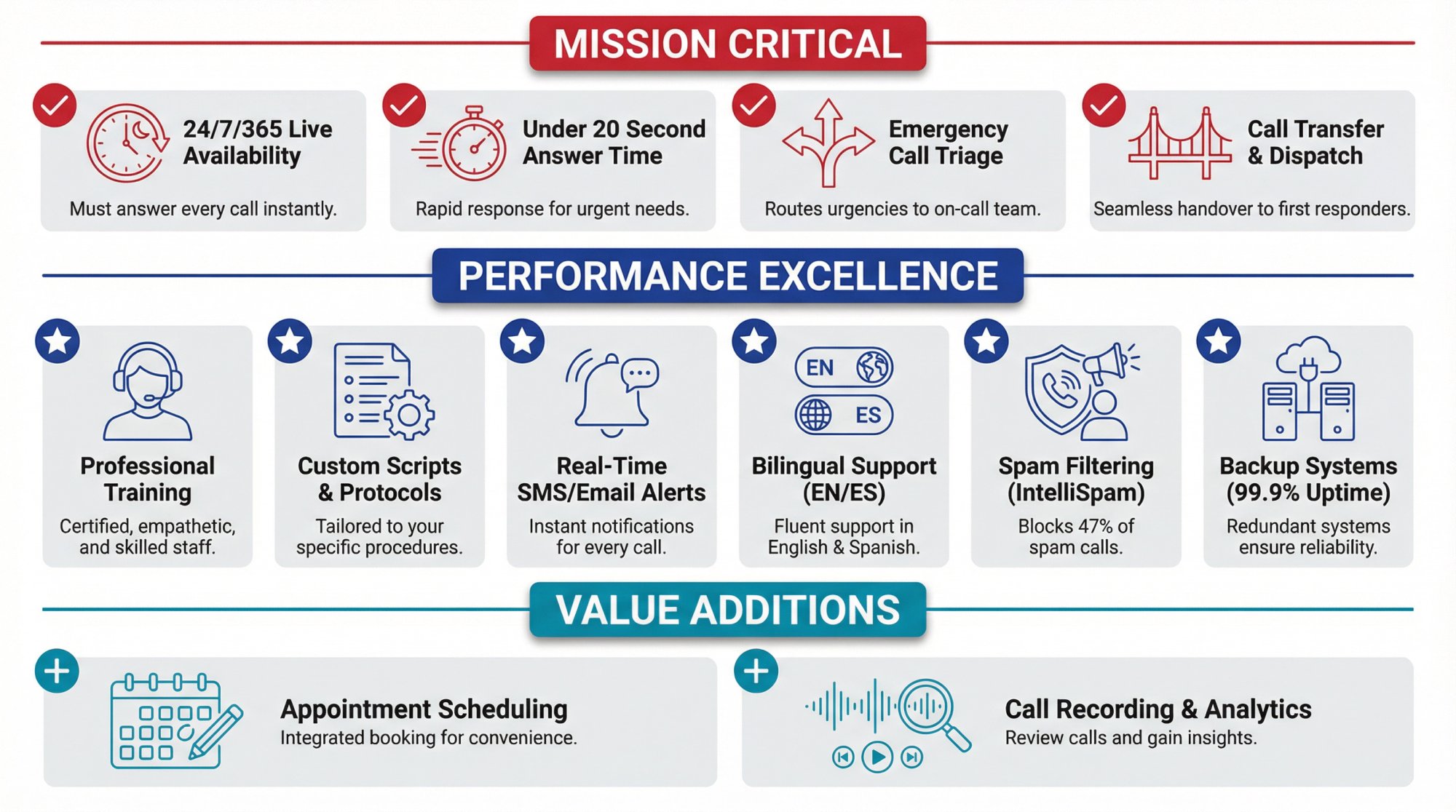
This is non-negotiable. The service must operate round the clock, including nights, weekends, and holidays.
Verify it's genuine 24/7 coverage. Some cheaper services only offer extended hours or charge extra for overnight and holiday calls. You want a partner that never sleeps.
Also ask about average answer time. The best services pick up within a few rings (under 20 seconds). Speed matters because research shows that 7 out of 10 callers will hang up if a call isn't answered by the third ring.
How Fast Can Emergency Calls Be Triaged?#
The service must be adept at recognizing which calls are emergencies versus routine, and handling them accordingly.
For human-staffed services, this comes from scripts and training you provide. For AI services, this comes from smart programming.
True emergencies should get immediate action. For example, Eden's AI receptionist can recognize phrases like "burst pipe" or "no heat" and instantly dial your on-call technician while keeping the caller on the line.
Make sure any service you choose has flexible call routing rules for emergencies: ability to call multiple backup numbers if the first on-call person doesn't answer, with fallback to taking a detailed message if no one is reachable.
Professional Emergency Call Handling Training#
Emergencies are high-stress situations. Callers might be panicked, upset, or angry.
The agents answering need to be calm, courteous, and confident. Look for services emphasizing specialized training for operators in handling urgent situations.
Top providers put staff through rigorous scenarios so they know how to stay cool under pressure, ask the right questions, and reassure callers. They act as first responders of communication.
Even with AI-driven services, pay attention to "personality" and voice options available. Eden allows you to choose tone and specific voices that suit your brand, creating interactions that feel warm and empathetic.
The quality of interaction matters. A good emergency answering service doesn't just answer. It engages with empathy and authority, leaving callers feeling heard and helped.
Custom Scripts for Your Emergency Protocols#
Avoid services offering one-size-fits-all scripts. Your business is unique, and the service should act like an extension of your team.
You should provide:
• Custom greeting messages
• Questions to ask callers
• Specific instructions for different scenarios
Example: "If it's a new customer with an HVAC emergency, get their address, ask if anyone is at risk, then page our on-call tech. If it's an existing client, use their name and check if they have a service contract."
Customization is non-negotiable. The service should follow your playbook, not shoehorn you into generic processes.
During onboarding, top services gather info like business hours, team contact list, how to handle various call types (urgent vs. non-urgent), FAQs about your business, and even specifics like how to pronounce technical terms or names.
For AI services, this equates to training the AI on your knowledge base and preferred responses. Eden lets you upload FAQs and set the AI's persona so it answers questions accurately in your style.
Real-Time Emergency Message Notifications#
In urgent situations, every moment counts.
If an answering service handles a call on your behalf, you should get that information right away. Look for services offering real-time message delivery via email and SMS.
Example: You get a text the moment an emergency call comes in, summarizing: "Call from Jane Doe at 10:32pm – reporting power outage at 123 Main St – dispatched to on-call electrician (John)."
Many services also provide a web or mobile portal where you can view all call logs, messages, and even listen to call recordings after the fact. This is invaluable for accountability and continuous improvement.
You should never be left wondering what happened on a call. The service should keep you in the loop instantly.
Emergency Call Transfer and Dispatch Options#
High-quality emergency answering services don't just take messages. They actively facilitate solutions.
Call transfer is common: if a call meets emergency criteria, the operator calls your designated emergency contact and bridges the call so you can speak directly with the caller. Options include:
① Warm transfer (the operator briefs you first)
② Blind transfer (they connect immediately)
This capability is vital if you need to intervene in real time. Make sure the service handles scenarios where the first contact doesn't answer (calling a secondary number or sending an urgent text).
For businesses with field teams, dispatching matters: can the service directly dispatch your on-call team via phone, pager, or app? The best services adapt to your dispatch method, whether ringing down a list until someone picks up or using your on-call scheduling system.
This feature gives you freedom. You can sleep while your service "chases down" the right person to handle the issue.
Can Emergency Services Schedule Appointments?#
While slightly more of a "bonus" for emergencies, this is extremely useful in many cases.
If a caller's problem can't be resolved immediately, the next best thing is booking them for service ASAP. Many services (especially AI receptionists) can directly schedule appointments on your calendar for the earliest available slot.
Example: A non-critical call at 11 PM ("water heater making noise, but not leaking") gets booked for first thing next morning. You secure the business and give the customer peace of mind.
Integration with popular calendars (Google, Outlook, etc.) is key so scheduling is real-time and avoids double-booking. For small teams, waking up to find appointments already arranged is fantastic.
AI services excel here. Eden can schedule appointments and even text scheduling links to callers if needed. This turns missed calls into booked customers with zero delay.
Bilingual Emergency Call Support#
Emergencies happen in every language.
If you serve communities with significant Spanish-speaking populations (or other languages), having bilingual answering can be a huge differentiator. Many leading services offer English/Spanish bilingual agents or AI voices.
Some stats show that in fields like construction, nearly 45% of calls can be bilingual. Being able to assist a panicked caller in their native language can literally save lives in some cases, and certainly saves sales.
Eden can swap between English and Spanish on the fly with certain voice models. Don't underestimate the goodwill earned by an HVAC company helping a Spanish-speaking grandmother at midnight who otherwise couldn't explain her furnace problem.
Spam Call Filtering for Emergency Lines#
You don't want your emergency line (or your on-call staff) buzzed at 3 AM by telemarketers or robocalls.
Businesses advertising 24/7 lines often attract spam calls (automated dialers don't care what time it is). A quality answering service provides intelligent spam filtering to weed these out.
This might include:
-
Automatically blocking known robocall numbers
-
Using AI to detect scam or sales pitches
Some services report nearly half of incoming calls for contractors are spam, and they intercept them.
Eden's IntelliSpam™ feature can automatically block obvious spam and politely turn away sales calls. One Eden user saw 47% of inbound calls blocked as telemarketers during peak season, meaning only real customer calls got through.
This keeps your line free for genuine emergencies and prevents false alarms from waking you at night.
What Backup Systems Prevent Service Outages?#
In emergencies, the answering service itself cannot go down. You're counting on them when your own phones or power might be out.
Top providers invest heavily in redundant systems: multiple data centers in different geographic regions, backup power generators, duplicate phone and internet circuits.
A quality service will have geo-redundant call centers. If one center is knocked offline by a hurricane, another in a different state seamlessly takes over. They'll have UPS power backups and failover carriers for phone lines.
They should be prepared to keep running even during regional disasters.
When researching, ask about uptime guarantees (99.9%+ is common) and notable outages. Also inquire about data backups. Do they back up call records and messages frequently to offsite servers? The answer should be yes.
An emergency answering service is only as good as its ability to be there during your worst-case scenario. The best ones take this responsibility seriously and have layers of contingency in place.
Call Recording and Emergency Documentation#
After urgent calls, you'll want to review what happened for follow-up, team coaching, or even legal protection.
Look for services providing call recordings or transcripts, time stamps, agent notes, and disposition of each call.
Many offer an online dashboard where you can log in and see all calls (sorted by time, tagged as "urgent" or "routine"), listen to recordings, and view metrics like how many calls came in after hours, average answer time, etc.
These analytics help you measure performance and justify the service's value. Thorough documentation also means nothing slips through cracks.
A modern service may integrate with your CRM, logging call details automatically into customer profiles or providing real-time dashboards during critical events.
Should You Choose Human or AI Emergency Answering?#
Traditionally, emergency answering meant live human operators in call centers. Today, AI virtual receptionists like Eden can handle calls with natural language understanding.
Can AI truly manage emergency calls, or are you better off with human touch?
Often the answer is a blend of both.
| Capability | Human Operators | AI Receptionists |
|---|---|---|
| Empathy & Emotional Intelligence | ✓ Excellent - nuanced understanding | Good - improving but not perfect |
| Complex Judgment Calls | ✓ Flexible with unique situations | Follows programmed logic |
| Consistency | Can vary - humans have off days | ✓ Perfect every time |
| Answer Speed | 10-20 seconds typical | ✓ Instant (every call) |
| Scalability | Limited by staffing | ✓ Unlimited parallel calls |
| 24/7 Availability | Requires shift coverage | ✓ Always on, no breaks |
| Cost | $1.00-$1.50/minute typical | $39-$99/month flat rate |
| Training Requirements | Ongoing staff training needed | One-time setup/knowledge base |
| Languages | Depends on staff hired | ✓ Instant switching (6+ languages) |
Why Choose Human Emergency Operators?#
There's no denying humans excel at empathy and complex judgment.
A skilled human receptionist can listen to a caller's tone, understand nuances, and provide reassurance in ways machines struggle to fully replicate (as of 2026). Humans handle complex, unstructured situations well: a distraught caller not making sense, or a unique scenario outside the script.
In fields where emotional support is critical (healthcare, legal crises), a human's ability to convey warmth can be essential. Live agents bring emotional intelligence and flexibility.
For some businesses, that personal touch in emergencies is worth the higher cost.
What Makes AI Better for Emergency Calls?#
AI-powered answering services offer incredible consistency, speed, and scalability.
An AI receptionist doesn't need coffee breaks or sleep. It answers every call instantly at 3:00 AM just as cheerfully as 3:00 PM. Modern conversational AI has improved drastically. These systems understand natural speech, identify keywords, and follow decision trees like humans.
They excel at routine tasks: gathering contact info, booking appointments, providing scripted info, and basic troubleshooting.
Perhaps most importantly, AI can handle unlimited calls in parallel. If 10 customers call at once during a storm emergency, 10 AI instances greet them. A small human team might be overwhelmed.
Cost-wise, AI solutions often have flat monthly rates and end up cheaper per call than paying humans by the minute. They're also instantly scalable for volume spikes.
AI never has an "off day." It follows scripts perfectly every time. There's no chance a well-trained AI will forget to ask for a callback number or skip a question (humans sometimes do).
For emergency use, AI can be programmed to detect trigger words and execute call routing automatically. Eden's AI recognizes phrases like "burst pipe" and immediately initiates on-call transfer.
In terms of reliability and response time, AI has an edge.
How to Combine Human and AI for Emergencies#
You don't have to choose one or the other. Many companies use a hybrid approach: AI answers first (ensuring instant pickup and basic info gathering), then escalates to a live person if the conversation exceeds AI's scope or the caller specifically needs human help.
Studies found blending AI and human support can dramatically improve customer engagement. One report noted companies using AI in sales/support saw a 50% increase in customer engagement while maintaining human agents for complex cases.
AI handled high volume of routine interactions. Humans took over where personal touch was needed. This synergy works brilliantly for emergency response: let AI handle front-line filtering and immediate needs, with humans in the loop for follow-up or high-emotion scenarios.
How to Choose Between Human and AI#
Evaluate your typical emergency calls:
If they often require calming, empathetic conversations and complex judgment, a human-staffed service (or hybrid with human escalation) might be best.
If calls are generally straightforward (take info, reassure, dispatch technician), an AI service could handle it perfectly and save money.
Many small businesses find AI solutions like Eden hit the sweet spot: callers get immediate helpful responses and often don't realize they're not speaking to a human, while business owners get the info or transfer needed without paying per-minute fees.
If you choose a human service, ensure they have training and experience for your industry's emergencies. Some services specialize by industry, which can be a big plus.
Both human and AI answering services can effectively cover emergencies, but each has distinct strengths. The trend in 2026 is toward leveraging AI for what it does best (speed, scalability, cost-efficiency) while keeping humans in the loop for high-touch or complex issues.
The ultimate goal is the same: no urgent call ever goes unanswered, and every caller gets help fast.
How Much Do Emergency Answering Services Cost?#
The good news: for most small and mid-sized businesses, emergency answering services are very affordable relative to the revenue they safeguard.
With multiple pricing models (and rise of AI-based services), you have options to fit your budget.
Emergency Answering Service Pricing Models#
| Model | How It Works | Typical Cost | Best For |
|---|---|---|---|
| Flat Monthly Plans | Set fee for bundle of minutes or unlimited calls | $50-$300/month | Predictable budgeting; businesses with consistent volume |
| Pay-Per-Minute | Small base fee + per-minute charges | $1.00-$1.50/min | Low, variable call volume |
| AI Flat Rate | Unlimited calls for fixed monthly fee | $39-$99/month | High volume; cost-conscious SMBs |
| Premium/Enterprise | Dedicated team, advanced features | $500-$1,000+/month | Large operations; specialized needs |
Flat Monthly Plans#
You pay a set fee per month for a bundle of minutes or calls. Example: 100 minutes for $100/month, or unlimited calls for $300/month.
This gives predictability, but check for overage charges if you exceed the bundle. Many small businesses opt for flat plans to know costs upfront.
Typical range: Basic plans start as low as $50-$100 per month for limited coverage (sufficient for ~50-100 minutes). Mid-tier plans might run $100-$300/month for more minutes and features.
Pay-Per-Minute Emergency Call Pricing#
You might have a small base fee and then pay $1.00-$1.50 per minute of call time used. Some charge per call (e.g., $2 per call answered).
This can be cost-effective if call volume is very low or variable. You pay only for what you use.
Be careful: a major storm or call spike can rack up bigger bills. If you foresee high volume, a flat or unlimited plan is safer.
Premium Emergency Service Pricing#
For businesses needing lots of minutes or specialized service (for example, HIPAA-compliant operators), pricing can scale to $500, $1,000 or more per month.
These plans often include extras like dedicated account managers, custom system integrations, etc. For most SMBs, this is overkill.
Watch for Hidden Emergency Service Fees#
Read the fine print. Some answering services advertise low base prices then add fees for:
• Setup or onboarding fees
• Holiday or night differentials (extra charge per minute at night)
• Transfer/patching fees (each time they transfer a call to you)
• Additional work (outbound calls on your behalf)
• Certain integrations
Not all providers do this, but many do. Ask upfront. One analysis warns to watch out for hidden fees like IVR usage costs and prices for call transfers.
Also, 24/7 coverage often costs more than strictly after-hours. Ensure that if you need true 24/7, the plan explicitly includes it.
Best approach: estimate your likely usage (how many calls, average length) and get a detailed quote including any add-on fees, so you can compare apples to apples.
What Does NOT Having Emergency Answering Cost?#
While budgeting for an answering service is important, consider the "opportunity cost" if you don't have one.
As calculated earlier, a single missed emergency call can potentially cost hundreds or thousands in lost business. If you lose even one customer due to an out-of-hours missed call, that could pay for months of service.
The damage from a missed emergency (lost lifetime value, negative word-of-mouth) can far exceed a monthly fee.
Think of emergency answering as insurance: you pay a relatively small fixed cost to protect against potentially very large losses. For many, that trade-off is obvious.
Real Emergency Answering ROI Examples#
Put it in perspective. Say you spend $150/month on a service (~$1,800/year).
If it helps you win just one big job you would have missed otherwise (let's say a $5,000 contracting project or a legal case with $10,000 fee), it's already paid for itself several times over.
Many business owners report that within weeks of using 24/7 answering, they caught leads they know they would have missed. Essentially making the service immediately profitable.
Consider the value of customer retention: if being reachable in emergencies keeps even a couple existing customers from defecting to competitors, that retention could be worth thousands in future business.
One service provider noted always answering leads to an 80% customer retention rate as opposed to much lower if calls go unanswered. Retaining customers equals future revenue secured.
AI vs Human Emergency Answering Costs#
If you opt for an AI service, costs are often even more favorable.
Eden's plans (as of 2026) start at $39 for a basic tier and around $99/month for unlimited 24/7 call handling with no per-minute fees. Compare that to a live service where 200 minutes might cost $200. That's significant difference.
Over a year, an AI solution could save thousands if you have heavy call volume.
Cost should not be a barrier to implementing some form of emergency answering coverage. Plans exist for even shoestring budgets, especially with AI in the mix.
Is Emergency Answering Worth the Investment?#
Expect to invest anywhere from a few dozen to a few hundred dollars per month for quality emergency answering for a small business, depending on your needs.
When you consider potential revenue saved or gained, plus stress reduction for you and your team, it's usually a very high-ROI investment.
Always circle back to this question: What is one missed emergency call worth to me? If the answer is "possibly a lot," then ensuring those calls are caught is worth the spend.
Many business owners, after implementing a service, say they wish they'd done it sooner.
The peace of mind alone is priceless.
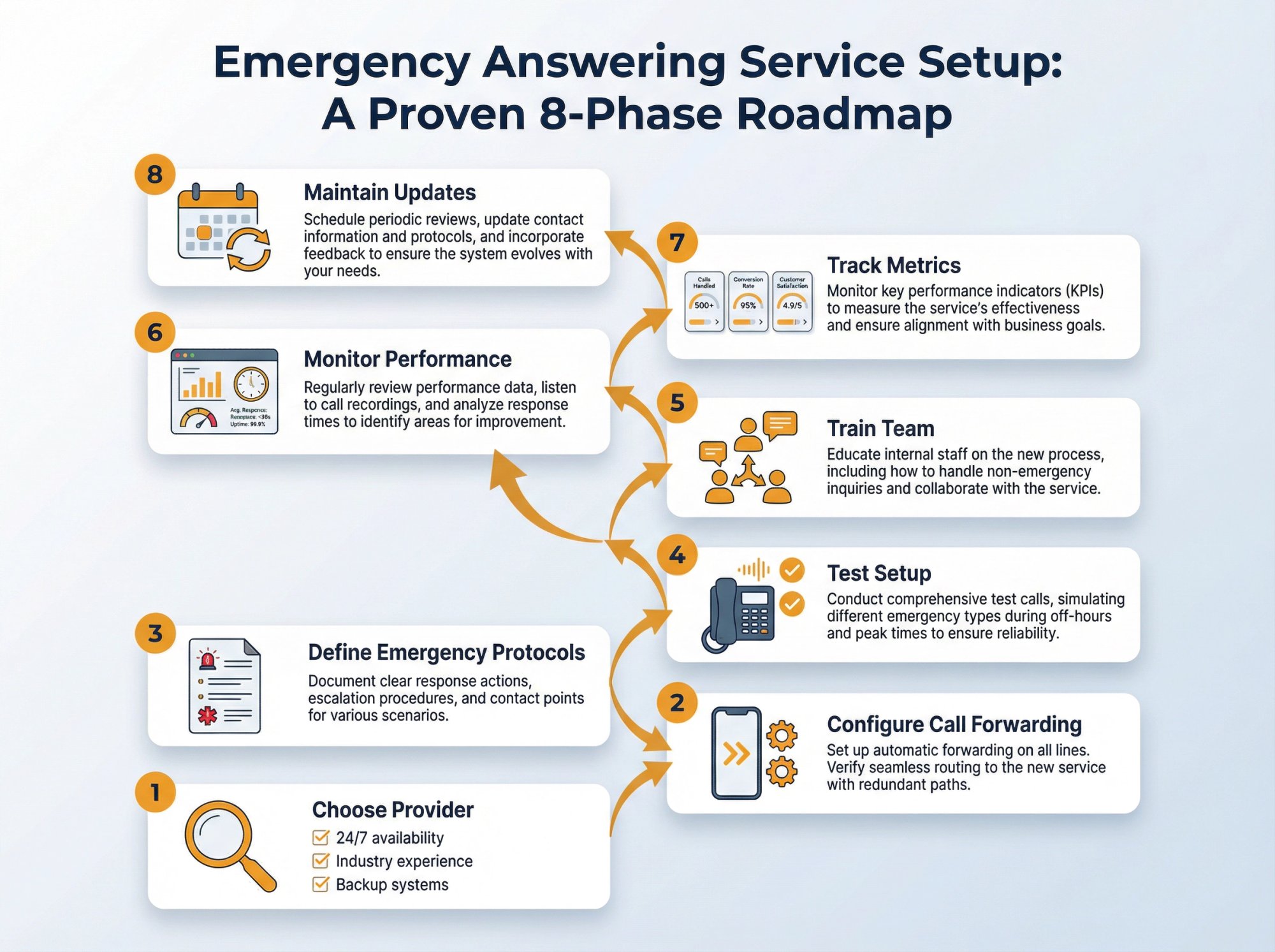
How to Set Up Emergency Answering Services#
Once you've decided to get an emergency answering service, implementation is usually straightforward and can often be done in a day or two.
To get maximum benefit, approach it strategically. Here's a step-by-step roadmap:
How to Choose the Right Emergency Service Provider#
Do your homework. Treat it like hiring a critical employee (check references, read reviews, ask tough questions).
Key things to verify:
① Do they truly offer 24/7 live answering? Ensure no gaps.
② How do they handle high call volumes or disasters? Ask about backup systems and redundancy.
③ What training do agents receive, especially for emergencies? This is crucial for quality service.
④ Have they worked with businesses in your industry? Industry familiarity can be a big plus.
Also inquire about integration with your current tools (scheduling software, CRM, etc.).
Don't be shy about requesting a demo or trial. Many top providers let you test their service or listen to sample calls. Trust is crucial here. You're putting customer relationships in their hands.
Pick a provider you feel confident in and who is responsive to your questions.
How to Configure Call Forwarding for Emergencies#
The core mechanism is call forwarding. You tell your phone system when to send calls to the service's number.
Common setups:
→ After-hours forwarding: Manually or automatically forward your main line to the service at closing time each day, turn it off in morning. Many phone systems allow scheduling this.
→ No-answer/busy forwarding: Set a rule that if you don't pick up after X rings (or if your line is busy), the call forwards to the service. Great for catching overflow calls during the day.
→ All-call forwarding: Forward all calls immediately to the service (some businesses do this 24/7 if they want every call screened).
The service will provide you with a dedicated number or access code to forward to. They often have guides for various phone providers.
Eden's onboarding, for example, guides users through selecting their phone carrier and provides step-by-step forwarding instructions. It usually takes just minutes.
Test the forwarding once set: Call your number after hours or simulate a no-answer and ensure it rings through to the service.
What Emergency Protocols Should You Provide?#
During onboarding, you'll supply information about your business and call handling preferences. The more thorough you are, the better the service can represent you.
Typically you'll cover:
• Basic business info: company name, address, website, brief description of what you do
• Emergency definitions: clearly state what you consider an emergency warranting immediate escalation
• On-call contacts: provide a list of who should be contacted for emergencies, in order (include backups)
• Escalation method: do you want the service to transfer calls to you, text you, or dispatch without bothering you?
• Questions to ask callers: list key information you need gathered (caller name, callback number, problem details, context)
• Your FAQs and approved answers: provide answers to common questions
The idea is to empower the answering service to handle as much of the call as possible without involving you for every little question.
Tone and etiquette: If you have preferences (formal greeting vs. casual, pronunciation of industry terms, don't put callers on hold for more than a minute), mention these.
The goal is for the service to feel like your receptionist. Give them the knowledge base to do so.
How to Test Your Emergency Answering Setup#
Once everything is set up, don't just wait for real emergencies.
Conduct test calls. Call at an odd hour and see how the call is handled. Have a friend call with a mock emergency scenario and see if the service follows the script and contacts the right person.
This "fire drill" reveals any kinks. You might discover the agent didn't ask a question you expected, or you didn't receive the text notification as quickly as you'd like. Services are usually happy to adjust based on feedback.
If it's an AI service, listen to how it interacts and tweak the knowledge base or phrasing as needed.
Pilot testing under various scenarios (different times, different issues) is like a dress rehearsal that ensures you're ready when a real critical call comes.
How to Train Your Team on Emergency Procedures#
Make sure everyone on your team knows the answering service is in place and understands how it works.
If you have field technicians who might get calls transferred to them, ensure they recognize the service's number or introduction (so they don't think it's spam and ignore it!).
If your policy is that on-call staff must respond within 5 minutes when the service contacts them, emphasize that.
Set expectations: your team should treat the service's messages with same urgency as if a customer called them directly.
Alignment between the service and your internal workflow is key. A quick team meeting to walk through a sample emergency call flow with the new service can be very helpful.
How to Monitor Emergency Service Performance#
In the first few weeks or months, keep a close eye on how things are going.
Review messages and call logs that come in. Are operators asking all the right questions and getting accurate information? Are they pronouncing names correctly and representing your brand well?
If you spot issues, communicate with your service provider. Good services welcome feedback and will retrain staff or adjust AI programming accordingly.
Listen to any feedback from customers. If a client mentions "your after-hours person was very nice" or "I called but got some call center and it was weird," those are clues.
If you have any hiccups (maybe an operator didn't escalate something they should have), address it immediately with the service manager and clarify the protocol.
Continuous improvement ensures the service truly becomes an asset and any initial wrinkles are smoothed out.
What Emergency Answering Metrics Should You Track?#
Track key metrics to quantify impact.
How many calls are being handled by the service per week? (This shows you how many you would have missed previously.)
What percentage are true emergencies vs. routine?
Did you convert those emergency calls into business?
Monitor any reduction in customer complaints about reaching you. If you send customer satisfaction surveys, you might see an uptick in people mentioning "always reachable."
Internally, see if your own stress levels improved. Are you no longer constantly glued to the phone? Many find they sleep better not worrying about missed calls.
All these are ROI indicators.
How to Keep Emergency Service Information Updated#
Treat your relationship with the answering service as ongoing.
If you change your on-call person or their number, update the service immediately. If you add a new service offering or adjust your process, let them know and update the script.
Many providers allow you to log into a portal to make changes to your instructions anytime. Use that to keep everything current.
Before major holidays or planned downtime, inform them if your handling should be different.
Regular communication ensures the service remains an effective partner.
Most providers make onboarding very easy since they've done it thousands of times. The key is giving it the attention it deserves: set it thoughtfully, test it, and maintain it like you would any customer-facing operation.
When done right, your customers will hardly notice anything except that, suddenly, someone is always available to take their call.
Never Miss Another Emergency Call with Eden#
In business, showing up is half the battle. When customers face emergencies or urgent needs, showing up for them by simply answering the phone and responding swiftly builds trust and loyalty that money can't buy.
An emergency answering service is ultimately about making sure you show up every time, any time. It's a safeguard for your revenue, a booster for your reputation, and a relief for your work-life balance.
Why Emergency Answering Matters for Your Business#
You'll never lose a customer to an unanswered call again. Every emergency lead is captured. Businesses replacing voicemail with 24/7 answering saw ~35% jump in leads captured on average. That's real growth from simply being available.
You'll differentiate your service from competitors. Being known as "the company that always picks up" is a powerful market position. Customers in distress remember that reliability and reward you with loyalty. Competitors who stick to 9-5 or let calls go to voicemail will fall behind.
Customer satisfaction and retention will soar. People value responsiveness. Quick, helpful responses (especially in urgent moments) translate to happy customers who stick around. Having 24/7 live support can boost customer retention to around 80%, and prevent the negative reviews that plague businesses who leave customers hanging.
Your team gets peace of mind. You and your employees can focus on work at hand (or get good sleep) without fear that important calls are being missed. The service acts as a safety net, filtering noise and alerting you only when truly necessary. Reduced stress and burnout for you and your staff is a huge benefit.
It pays for itself. The cost of emergency answering is trivial compared to revenue it protects. One saved customer or landed job easily covers months of fees. Plus, modern options like AI have made 24/7 coverage more affordable than ever, even for solo entrepreneurs.
How to Meet Modern 24/7 Customer Expectations#
In a world where customer expectations are 24/7, leveraging a service (or smart AI) to ensure you meet those expectations is quickly moving from nice-to-have to must-have.
The year is 2026. Consumers expect real-time responsiveness, and the technology is here to deliver it without breaking the bank.
Whether you choose a human answering service, an AI solution like Eden's AI Receptionist, or a combination, the important thing is putting a system in place that aligns with your commitment to customers.
Eden was built to give small businesses that always-on, professional presence normally only large companies could afford. So you never miss another call or emergency. Users who have adopted it often marvel at how they managed before. It's like having a tireless team member who covers your back around the clock.
By implementing an emergency answering service, you're not just buying a service. You're delivering peace of mind. Peace of mind for your customers, who know they can reach you whenever crisis strikes, and peace of mind for yourself, knowing those critical connections are being handled expertly even when you're not personally available.
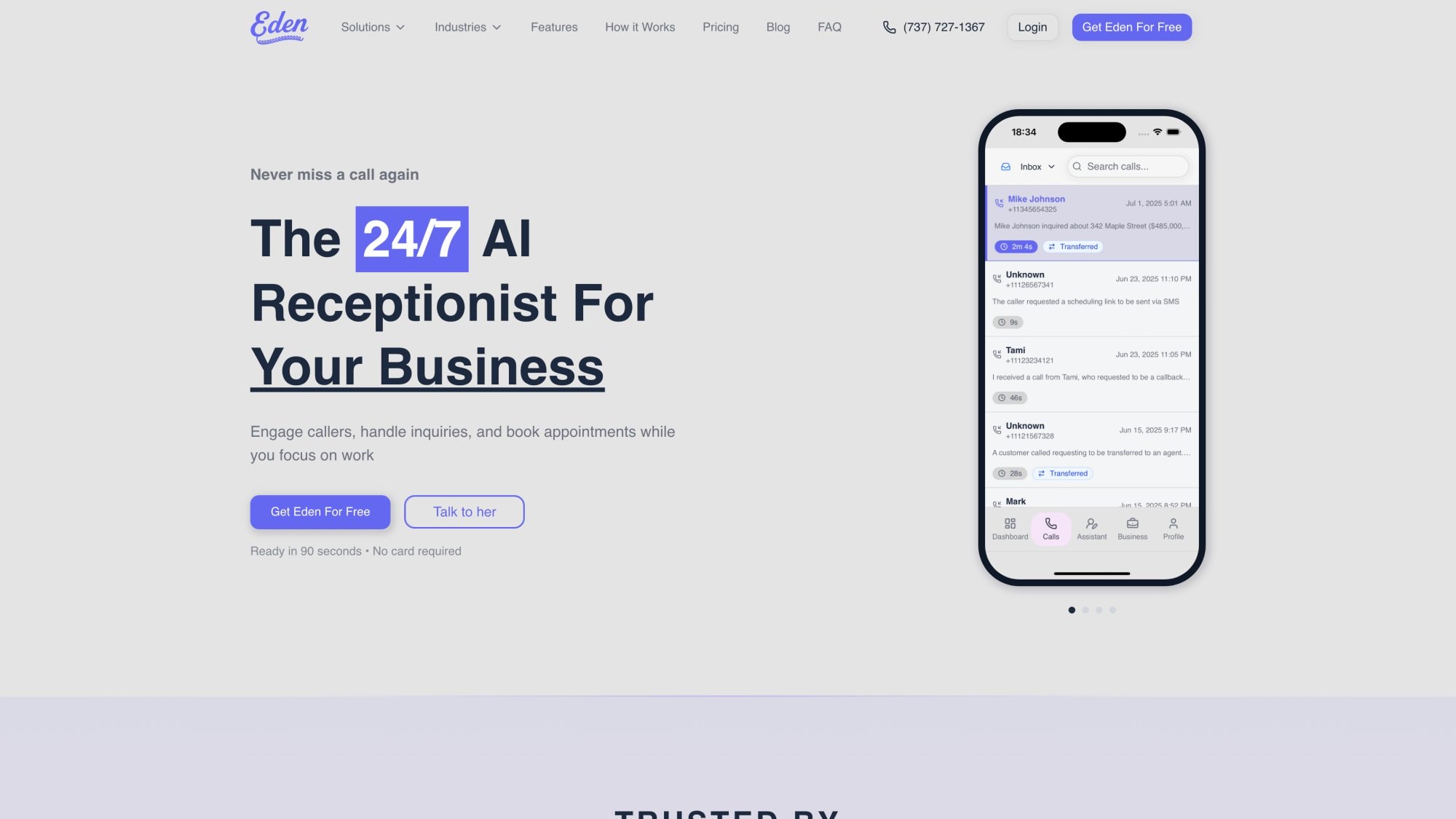
Eden's platform gives small businesses the always-on, professional presence that large companies rely on—capturing every emergency call and converting it into an opportunity.
Be the Business That Always Answers#
In closing, remember that an emergency (for your customer) is a make-or-break moment. Rise to that occasion by ensuring someone is there to answer the call.
The businesses that do will earn trust, loyalty, and revenue. Those that don't will hear dial tones and silence as their customers move on.
Be the business that answers. With the right emergency answering service in place, you will. Every time.
Emergency Answering Service FAQs#
What's the difference between an emergency answering service and regular voicemail?
An emergency answering service provides live, immediate response with trained professionals (or advanced AI) who can triage situations, gather critical information, and take action like transferring calls to your on-call team or dispatching help. Voicemail is passive: 80% of callers won't leave a message, and those who do might not get a callback for hours or days. In emergencies, that delay loses you the customer.
Can AI really handle emergency calls as well as humans?
Modern AI like Eden has become remarkably capable at handling emergency calls. It can recognize urgent keywords, gather information, transfer calls to appropriate contacts, and provide immediate reassurance to callers. While humans still excel at complex emotional situations, AI offers perfect consistency, instant response, unlimited scalability, and lower costs. Many businesses find AI handles 80-90% of emergency calls perfectly, with the option to escalate complex situations to humans.
How much does emergency answering service typically cost?
Pricing varies widely based on call volume and features. Basic plans start around $50-$100/month for limited minutes. Mid-tier plans run $100-$300/month. AI solutions like Eden start at $39/month for basic coverage and $99/month for unlimited 24/7 call handling. Human-staffed services typically charge $1-$1.50 per minute. For most small businesses, expect to invest $100-$300/month, which usually pays for itself by capturing just one or two leads that would otherwise be missed.
What industries benefit most from emergency answering services?
Home services (plumbers, electricians, HVAC), property management, law firms, IT support companies, security companies, disaster restoration, and any business promising 24/7 availability. Essentially, any industry where missing an urgent call equals lost revenue, damaged reputation, or failed customer commitments needs emergency answering capability.
How quickly can I set up an emergency answering service?
Most services can be set up in 1-2 days. You'll need to configure call forwarding (usually takes minutes), provide the service with your protocols and scripts (a few hours of work), and test the system. Eden's setup process is particularly fast, often completed in under 30 minutes with step-by-step guidance for configuring call forwarding based on your phone provider.
What happens if the answering service goes down during an emergency?
Top-tier emergency answering services invest heavily in redundancy to prevent this. They use geo-redundant call centers in different regions, backup power generators, duplicate internet circuits, and frequent data backups. Quality services maintain 99.9%+ uptime. Before choosing a provider, ask about their redundancy measures and disaster recovery procedures to ensure they'll be available even during widespread emergencies.
Can emergency answering services handle bilingual callers?
Yes, many services offer bilingual support, particularly English/Spanish. Some stats show nearly 45% of calls in certain industries like construction are bilingual. AI services like Eden can seamlessly switch between English and Spanish on the fly. If you serve diverse communities, bilingual capability is essential for ensuring all customers get help during emergencies, regardless of language preference.
How do I know if the answering service is representing my business properly?
Quality services provide detailed call records, recordings, and transcripts so you can review every interaction. Most offer online dashboards where you can listen to calls and see exactly how they were handled. During setup, you provide custom scripts, FAQs, and specific protocols. Start with trial runs: call at odd hours with mock emergencies to test how the service responds. Good providers welcome feedback and will adjust their approach based on your input.
What's the ROI of emergency answering service?
The ROI is typically very high. If you spend $150/month ($1,800/year) and the service helps you capture even one job you would have missed (say, a $5,000 contracting project or $10,000 legal case), it's paid for itself several times over. Studies show businesses implementing 24/7 answering saw 35% increases in leads captured. Beyond direct revenue, benefits include improved customer retention (up to 80%), reduced stress for your team, and enhanced reputation.
Do emergency answering services filter out spam and robocalls?
Yes, quality services include intelligent spam filtering to prevent telemarketers and robocalls from wasting your time and money. Eden's IntelliSpam™ feature can automatically block obvious spam and sales calls. Some businesses report nearly 50% of incoming calls being spam, so having this filtering is crucial to ensure only real customer calls reach you, especially during off-hours when spam dialers are often most active.
Ready to Transform YourCustomer Experience?
Join hundreds of businesses using Eden AI to handle calls, book appointments, and provide 24/7 customer support.