What Does a Receptionist Do? Complete Guide (2026)
Discover receptionist duties across industries, essential skills needed, and AI alternatives that answer every call for a fraction of the cost.
January 5, 2026
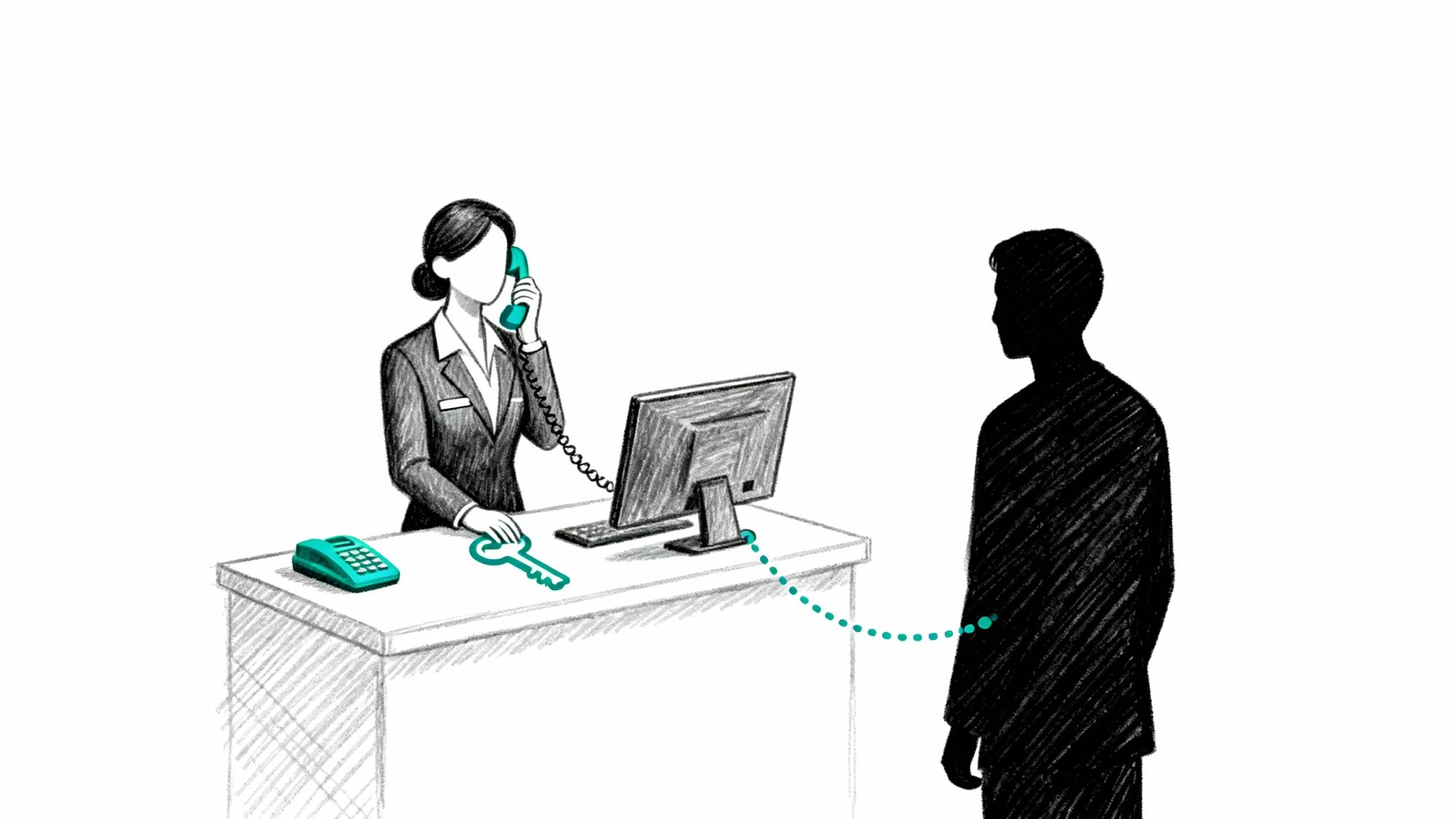
If you've ever called a business and been greeted by a friendly voice, you've interacted with a receptionist. But what exactly does a receptionist do beyond answering phones?
A receptionist is your business's first point of contact with the outside world. They're the gatekeepers, coordinators, and problem-solvers who keep your operation running smoothly. Research shows that a receptionist serves as the face of the company, handling the flow of people through the business and ensuring that all reception responsibilities are completed accurately, including receiving visitors, managing phone calls, and maintaining office security.
In practice, receptionists juggle everything from welcoming walk-in clients to coordinating appointments, screening calls, and even managing office security. They make sure every caller and visitor gets attended to promptly and professionally.
The role varies depending on the industry. But across law firms, medical offices, hotels, and service businesses, the core responsibility stays the same: facilitating smooth communication and creating a positive first impression.
Receptionist Daily Tasks: What They Actually Do#
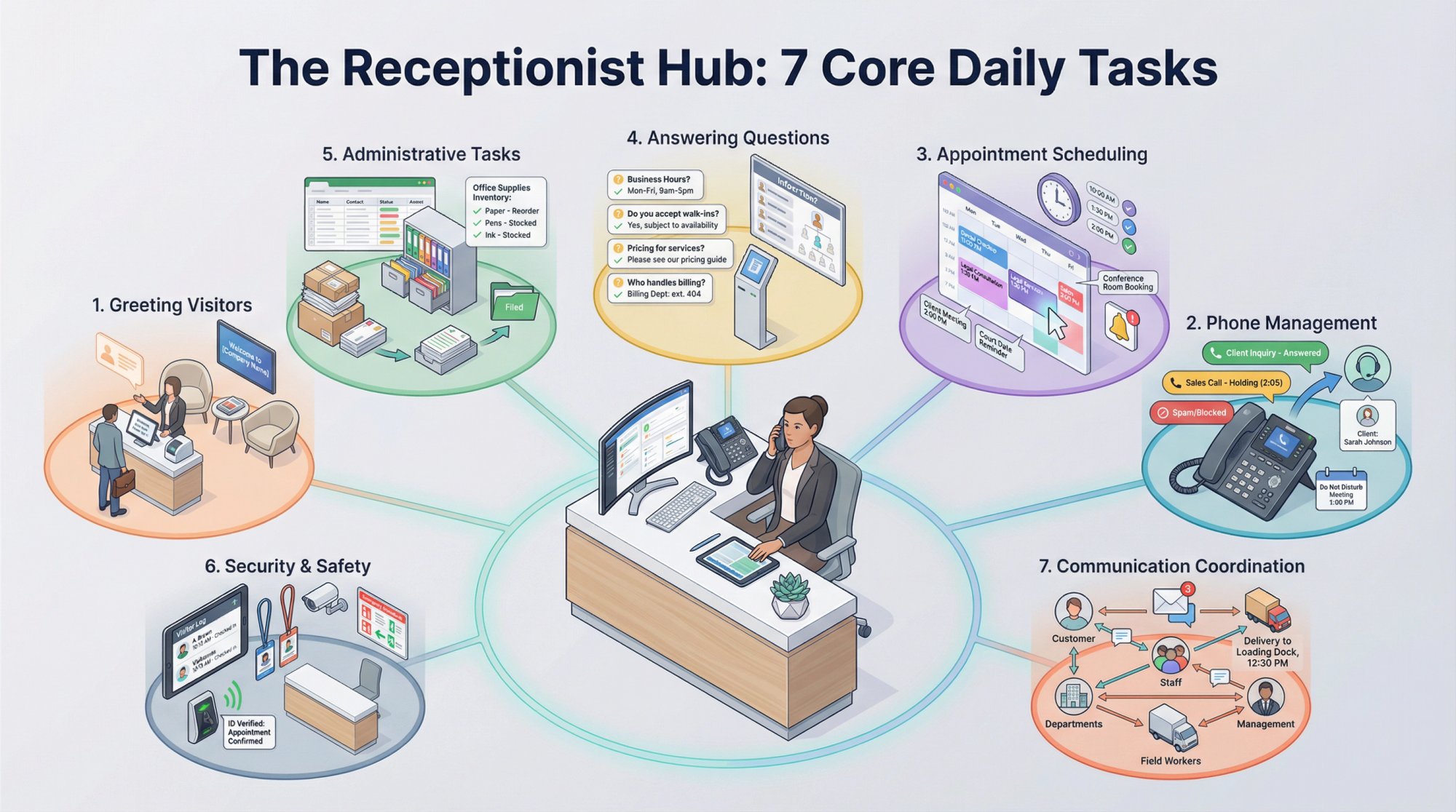
How to Greet Visitors and Make a Great First Impression#
Walk into any professional office, and the receptionist's usually the first person you see. Their job? Make you feel welcome immediately.
Receptionists greet visitors with a friendly demeanor, determine how they can help, and notify the appropriate staff member of the visitor's arrival. This is one of the primary duties across industries.
In secure facilities, they might also:
• Provide visitor badges
• Maintain sign-in logs
• Verify appointments before allowing access
The goal's simple: ensure guests reach the right person or department without delay while feeling comfortable and valued.
How to Manage Business Phone Systems Effectively#
This is where things get busy.
Receptionists handle incoming calls all day. They answer promptly, identify what the caller needs, and either transfer the call to the right employee or take a detailed message if that person's unavailable.
But there's more to it. They also screen calls to filter out:
-
Cold sales pitches
-
Spam and robocalls
-
Non-urgent inquiries during critical meetings
Professional call screening solutions help receptionists maintain this critical gatekeeping function. Receptionists need to be courteous and clear on the phone since they represent the company's image. Every call's an opportunity to make (or break) a positive impression.
They also ensure messages get recorded accurately and delivered to the right recipients. A missed detail can mean a lost client or opportunity.
How to Schedule Appointments and Manage Calendars#
In many organizations, receptionists act as appointment coordinators. They maintain business calendars by:
→ Scheduling client meetings and service appointments
→ Booking conference rooms
→ Avoiding double-bookings and conflicts
→ Sending appointment reminders and confirmations
For example:
-
A dental office receptionist books patient appointments
-
A law firm receptionist schedules consultations and court dates
-
A salon receptionist fills the stylist's calendar with cuts and color services
Effective appointment setting solutions keep calendars organized and ensure the office runs on time. Without this coordination, businesses descend into chaos.
How to Answer Customer Questions and Provide Information#
Receptionists are walking FAQs for the business. They handle inquiries from both in-person visitors and phone callers, including:
-
Business hours and location directions
-
Basic information about products or services
-
Pricing and payment options
-
Department or staff member contact details
A good receptionist can confidently respond to questions like "Do you accept walk-ins?", "What are your rates for X service?", or "Who should I talk to about billing?"
When they don't know the answer? They find someone who does, quickly.
This helpfulness improves customer satisfaction and saves your team time on routine queries.
What Administrative Tasks Do Receptionists Handle?#
Beyond the front desk, receptionists handle general office tasks that keep everything running. Common administrative duties include:
• Sorting incoming and outgoing mail
• Signing for packages and deliveries
• Data entry and record maintenance
• Filing paperwork and documents
• Updating customer contact lists
• Drafting email responses
• Managing office supply inventory
Research shows that in some settings, receptionists also assist with simple bookkeeping, invoicing, or helping staff with printing and faxing.
These clerical duties ensure day-to-day operations proceed efficiently without burdening other team members.
Front Desk Security: How Receptionists Protect Your Business#
A receptionist's responsible for keeping the reception area clean, organized, and welcoming. This means ensuring the waiting area stays tidy, arranging magazines and marketing materials neatly, maintaining professional displays, and creating an inviting atmosphere for visitors.
But there's also a security component to the role. Receptionists monitor who enters and leaves the premises, enforce visitor sign-in procedures, and issue visitor badges or keys when required.
By politely verifying appointments and identification, they ensure only authorized individuals enter certain areas. In emergencies, the receptionist might also guide visitors to safety or call for assistance.
This blend of hospitality and security's critical but often overlooked.
How to Coordinate Communication Between Departments#
Receptionists act as a communication hub for the entire business. They relay messages between customers and staff, different departments, field workers and office personnel, and vendors and management.
If a client leaves an urgent message for a manager, the receptionist ensures it gets delivered promptly via email or internal messaging. This liaison role's key to the position, especially when using comprehensive message taking solutions.
Receptionists also handle:
-
Incoming general emails and website inquiries
-
Delivery coordination
-
Service visit notifications
-
Inter-department information flow
By managing these small but important exchanges, receptionists prevent miscommunications and missed connections within the company.
Receptionist Jobs by Industry: How Duties Differ#
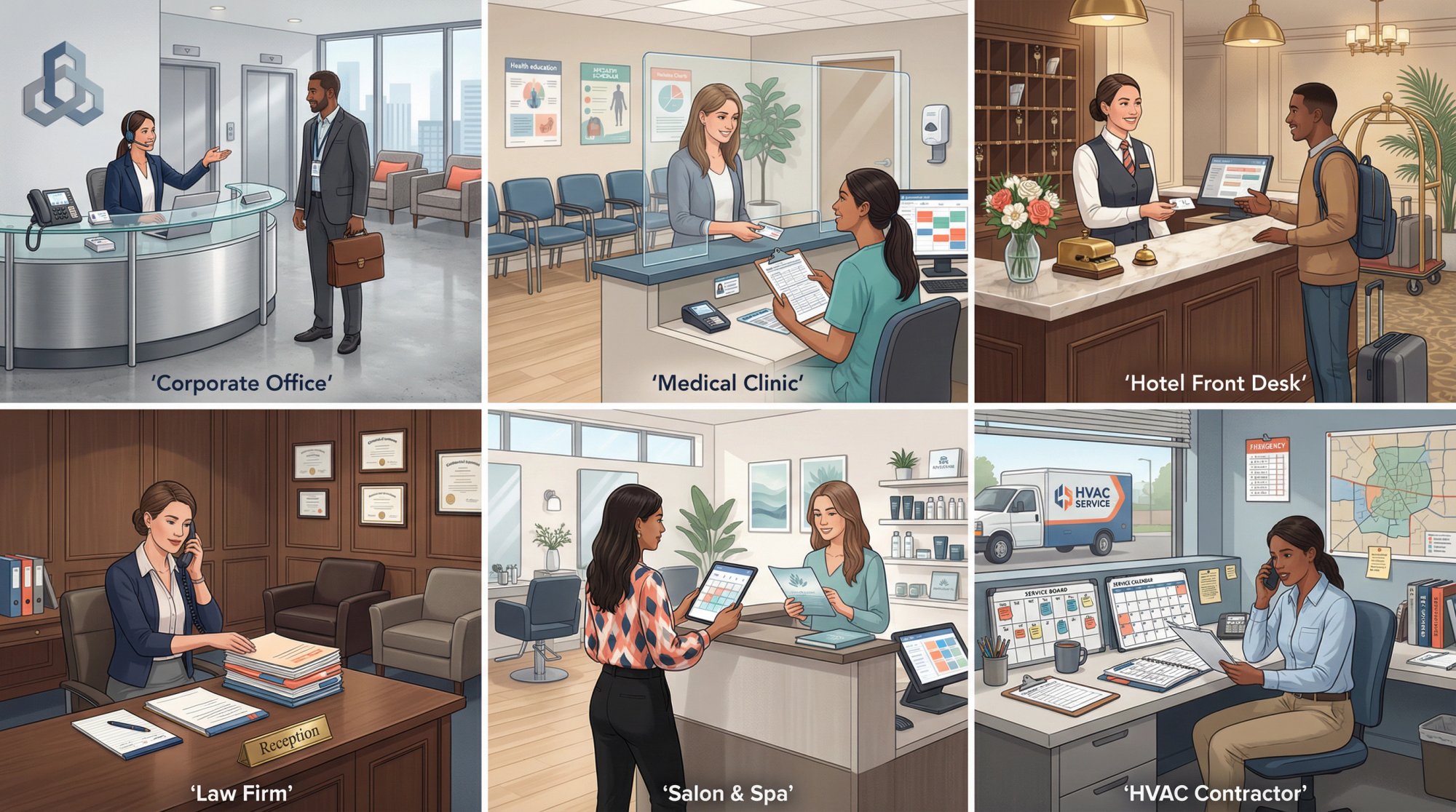
While the foundation stays consistent, specific duties can vary significantly depending on your business type.
What Does a Corporate Office Receptionist Do?#
Corporate receptionists work in business offices and headquarters. They serve a professional environment where corporate protocol and client comfort are paramount.
Key responsibilities:
-
Greeting business clients and vendors
-
Managing multi-line phone systems
-
Scheduling conference room meetings
-
Maintaining employee directories
-
Coordinating with security for visitor access
Medical Receptionist Duties and Responsibilities#
Medical receptionists handle specialized healthcare tasks beyond standard reception duties. They manage:
-
Patient intake and appointment scheduling
-
Medical charts and dental records
-
Insurance verification
-
Co-pays and billing inquiries
-
HIPAA-compliant confidentiality
Note: Privacy regulations mean some healthcare providers require trained medical office assistants or HIPAA-certified services. But the front-desk concept remains the same.
Hotel Receptionist: What Front Desk Staff Do#
In hotels, front desk receptionists (also called desk clerks or guest service agents) focus on guest experience. They handle:
-
Guest check-ins and check-outs
-
Reservations (phone and online)
-
Questions about amenities
-
Guest requests (extra linens, local directions)
-
Payment processing and room key issuance
The receptionist's central to the guest experience. In a bed-and-breakfast, the owner might double as receptionist, personally greeting arriving guests.
Legal, Accounting, and Real Estate Receptionist Roles#
Many small professional firms rely heavily on receptionists. A legal receptionist in a law firm will answer calls regarding sensitive legal matters, schedule meetings and depositions, handle incoming mail (including legal documents and court notices), and support lawyers with filing and billing.
In a real estate office, a receptionist might greet prospective buyers, take messages for agents showing properties, and track open house schedules.
The nuances differ across professions, but the receptionist remains the organizing force ensuring client inquiries get acknowledged.
Salon, Spa, and Gym Receptionist Responsibilities#
Salons, spas, gyms, and similar businesses often have a receptionist or front desk attendant. A salon receptionist, for example, books hair and spa appointments, welcomes clients for their services, informs stylists when clients arrive, handles point-of-sale transactions, and answers questions about services and pricing.
Research shows that in gyms, the front desk receptionist checks members in, schedules classes or training sessions, and fields calls about membership options.
In these roles, receptionists contribute directly to sales and customer retention through their friendliness and helpfulness.
Receptionist Roles in Plumbing, HVAC, and Contractor Businesses#
Even trades like plumbing, HVAC, or contracting need someone in a receptionist capacity (often titled an office coordinator). They handle incoming calls for service requests, scheduling service calls on technicians' calendars, and communication between customers and field workers.
For example, a plumbing company's receptionist answers an emergency call about a burst pipe, gathers customer details, then dispatches the on-call plumber while reassuring the customer help's coming.
In these cases, the "receptionist" might work from a back office or even from home. But they perform the same critical function: triaging inquiries and keeping the business responsive.
Why Your Business Needs a Receptionist Right Now#
Having a competent receptionist can transform your customer service and operational efficiency.
Why First Impressions Determine Customer Loyalty#
The receptionist's typically the first person a client or customer interacts with, whether by phone or in person. A friendly, professional receptionist immediately puts people at ease and signals that your business is organized and customer-focused.
Research confirms that receptionists create a positive and welcoming impression for anyone who contacts the company. This can strongly influence whether that person becomes (or remains) a customer.
On the flip side? If phones go unanswered or visitors get ignored upon arrival, it sends a terrible message about your business.
How to Stop Losing Leads from Missed Calls#
From a revenue perspective, receptionists help capture leads and inquiries that might otherwise be lost. Here's the harsh reality:
Studies show that businesses only answer about 38% of incoming calls on average. The rest go to voicemail or ring out. Unfortunately, most people won't leave a voicemail or keep trying. Around 80 to 85% of callers won't bother leaving a message if their call isn't answered. They simply move on to another company.
Studies show that businesses only answer about 38% of incoming calls on average. The rest go to voicemail or ring out.
Unfortunately, most people won't leave a voicemail or keep trying. Around 80 to 85% of callers won't bother leaving a message if their call isn't answered. They simply move on to another company.
The bottom line: A missed call becomes a lost opportunity in most cases.
A receptionist who answers the phone live prevents this loss. They ensure potential customers talk to a real person on the first try. Even if the receptionist can't solve the caller's request personally, they can take down details or forward the call appropriately.
This responsiveness has massive financial impact. By one estimate, the average small or mid-sized business loses over $120,000 in revenue annually due to missed calls that weren't answered by a live person.
How Fast Response Times Win More Business#
In many industries, speed of response wins the business. Customers tend to go with the first company that responds to their inquiry.
About 78% of customers will choose the first company that gets back to them when seeking a product or service.
If your receptionist answers a call immediately while a competitor lets it go to voicemail, you've likely won that customer purely by being available.
This is especially true for urgent needs. Think of a client with a broken air conditioner on a hot day calling HVAC companies. They're going to book with whoever answers first and can schedule service.
Similarly, in legal services, responsiveness is critical. 62% of legal clients sign with the first law firm to return their call. If your firm has a receptionist picking up calls promptly, you're far more likely to land the client.
How to Improve Customer Satisfaction Immediately#
Receptionists handle customer issues and questions in real time, which dramatically boosts satisfaction. Customers appreciate reaching a knowledgeable human who can answer their questions or at least acknowledge their concerns.
Even if the receptionist can't solve the problem outright, the customer feels heard. That's infinitely better than being sent to voicemail or waiting on hold indefinitely.
In contrast, poor call handling actively hurts your reputation. One-third of customers will consider switching to a competitor after just one bad phone experience, such as not reaching a live person or not getting help when needed.
A receptionist ensures every caller's at least greeted and guided, reducing the chance of a bad experience.
How Receptionists Boost Team Productivity#
A receptionist doesn't just help customers. They significantly aid the internal organization of your business. By triaging calls and visitors, they free up other employees to focus on their work without constant interruptions.
Think about a small firm where employees might otherwise have to stop their tasks to answer the phone. A receptionist shields them from unnecessary interruptions by handling routine inquiries. They only involve other staff when necessary (for example, transferring a call that truly needs that person's attention).
This improves productivity across the team. Receptionists also keep schedules on track, remind people of appointments, and handle minor admin tasks that would otherwise pile up.
In these ways, a receptionist acts as a coordinator, preventing small administrative issues from overwhelming everyone else.
How a Receptionist Builds Your Professional Reputation#
For small businesses especially, having a receptionist projects a more professional image. It shows the business is organized enough to have dedicated personnel for client interactions. This builds trust.
If a potential client calls two companies and one is answered by a polite receptionist who says "Good morning, [Business Name], how can I assist you?" while the other goes to voicemail or is answered in a rushed tone, the client's inclined to trust the first company more.
The receptionist's presence signals reliability. In industries like finance or consulting, clients expect a certain level of formality. Having a receptionist contributes to that perception of stability and quality service.
Research shows that if calls routinely go unanswered or are handled unprofessionally, customers might worry the business is understaffed, struggling, or not interested in their needs.
In summary: A good receptionist ensures no call or visitor falls through the cracks. They help convert inquiries into appointments or sales, keep customers happy, and keep the team efficient.
42% of small businesses estimate they lose at least $500 per month from missed calls. That's over $6,000 a year in lost business simply because nobody answered in time.
An effective receptionist prevents those losses and pays for themselves many times over.
Receptionist Skills: What Makes Someone Great at This Job#
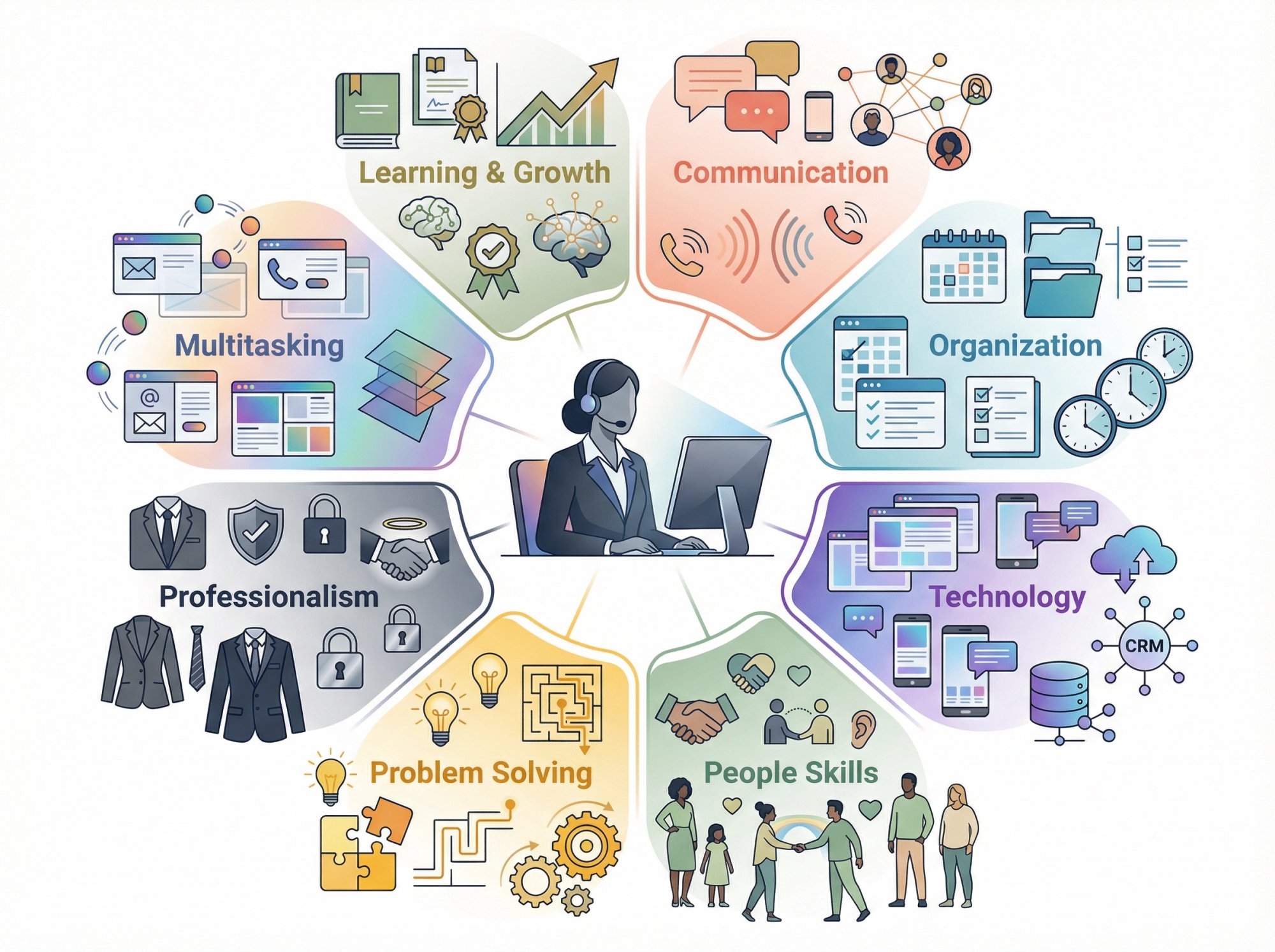
Not everyone's cut out to be a great receptionist. The role demands a unique blend of interpersonal skills, organizational ability, and technical know-how.
Why Communication Skills Matter Most for Receptionists#
Receptionists must have excellent verbal communication: speaking clearly, listening actively, and conveying information in a friendly yet professional manner. Strong writing skills are also useful for taking accurate messages and composing emails.
Because they interact with a wide range of people (from upset customers to important clients), receptionists need a good command of language and a positive, empathetic tone. They often have to convey information succinctly, like summarizing a caller's request to a busy manager.
How to Stay Organized While Multitasking#
The front desk can be chaotic. Phones ringing, visitors walking in, deliveries arriving, and multiple tasks to juggle at once. A great receptionist stays organized and calm under pressure.
Research shows they can handle multiple tasks simultaneously (answering a call while greeting an in-person visitor and perhaps signing for a package, all within a minute or two).
This requires:
-
Good time management
-
The ability to prioritize on the fly
-
An orderly approach to work
Receptionists maintain schedules, directories, and files. Losing track of messages or mixing up appointment times causes chaos, so attention to detail's a must.
Professional Behavior and People Skills That Win Customers#
Since they represent the company, receptionists are expected to maintain a professional demeanor and appearance. This means dressing appropriately for the office environment and having a courteous, respectful attitude toward everyone.
They must handle even difficult interactions with grace. If a caller's frustrated or a visitor's impatient, a skilled receptionist remains calm, listens, and responds politely.
Emotional intelligence is valuable here (knowing how to read a visitor's mood and respond appropriately). Being reliable and punctual is also part of professionalism. The receptionist generally needs to be at their post on time, as the whole office counts on them to open the phones or front door promptly.
Customer Service Mindset: Helping People Is the Job#
A receptionist's fundamentally in a customer service role, whether the "customers" are external clients or internal colleagues. Great receptionists genuinely enjoy helping people.
They have a welcoming, can-do attitude and patience when answering repetitive questions or assisting someone who needs extra guidance. This customer service attitude means the receptionist takes ownership of helping the person in front of them or on the line.
Rather than seeing questions as annoyances, they see them as opportunities to provide a good experience. Top receptionists often go the extra mile. If a visitor arrives for an appointment, a caring receptionist might offer them water or coffee while they wait. This hospitable mindset leaves a lasting positive impression.
Problem-Solving Under Pressure: What to Do When Things Go Wrong#
Receptionists frequently encounter unexpected situations. A visitor shows up with no appointment, a caller has an unusual request, or the internet's down and they can't use the scheduling software.
Good receptionists are resourceful and proactive when issues arise. They don't get flustered. Instead, they find a solution or workaround.
For example, if a client came on the wrong day, a receptionist might quickly coordinate with staff to see if anyone's available to meet them. This role requires a quick thinker who can make decisions when there's no specific instruction.
Flexibility's key. One moment they might be double-checking an invoice, the next they're calling building maintenance because the lobby lights went out.
Technology Skills Receptionists Need in 2026#
Modern receptionists use a range of office technologies. They should be comfortable with:
-
Multi-line telephone systems
-
Voicemail and call transferring
-
Email and scheduling software (Outlook, Google Calendar)
-
CRM databases
-
Industry-specific appointment systems
-
Office printers and scanners
-
Internal communication tools
Proficiency in standard office tools is often listed as a requirement. As more businesses adopt VoIP (internet-based phones) or live chat on websites, a receptionist might need to handle those channels too.
Tech-savvy receptionists can work more efficiently and handle multiple communication channels seamlessly.
Why Confidentiality and Trust Matter#
Receptionists are privy to a lot of information, from hearing conversations and voicemails to handling mail that might be confidential. A strong receptionist understands the importance of privacy and discretion.
For instance, they wouldn't divulge a client's business to another client or gossip about company matters they overhear. In fields like law, confidentiality's legally required.
Trustworthiness also extends to handling small cash transactions or sensitive keys and access cards. Employers and customers need to trust the receptionist to act responsibly and ethically.
Learning Your Business Inside and Out#
While this comes with experience, a top-notch receptionist makes an effort to learn the ins and outs of the company. The more they know about each department, the names and roles of key staff, and the products or services offered, the better they can serve customers.
For example, if they know which project each manager's handling, they'll know who can best answer a specific client question, leading to quicker call routing. They become a go-to person for internal questions as well ("Do you know if we have any more toner cartridges, or where the HR office is?").
This deep knowledge shows in how effectively the receptionist can handle inquiries.
In summary: A good receptionist's professional and well-organized, an excellent communicator, able to multitask and prioritize, and has a customer-oriented attitude. Many of these skills are developed on the job, but personality plays a role too.
Virtual Receptionist vs AI Receptionist: Modern Options#
Traditionally, a receptionist sits at the front desk during business hours. But today, businesses have more options to cover those crucial duties.
Virtual receptionists (either human or AI-driven) are changing the landscape of front-desk work. This is especially important for small businesses that may not have the budget for a full-time in-house receptionist or that need coverage beyond 9-to-5.
What Is a Human Virtual Receptionist?#
These are real people who perform receptionist duties remotely. Services (often provided by call centers or specialized agencies) have trained receptionists answer your business's calls in your company's name.
To the caller, it feels just like talking to an on-site receptionist, except the person might be sitting in a different city or country.
Virtual receptionist services will greet the caller, take messages or provide basic information, and transfer calls to you or your team's phones seamlessly.
They use scripts and information you provide about your business so they can answer FAQs and represent your brand accurately. For example, a human virtual receptionist service can answer, "Thank you for calling ABC Law Firm, how may I direct your call?" and then patch the call through to the appropriate attorney or book a consultation using a shared calendar.
Benefits:
-
The human touch for nuanced conversations
-
Can empathize with customers easily
-
Valuable for businesses with complex or sensitive needs
Downsides:
- Cost: These services charge typically by the minute or call, ranging from a few hundred up to over $1,000 per month depending on call volume
Still, this is often cheaper than employing a full-time person, and you get 24/7 coverage if needed by having a team of receptionists in shifts.
AI Receptionist Benefits: 24/7 Coverage at Lower Cost#
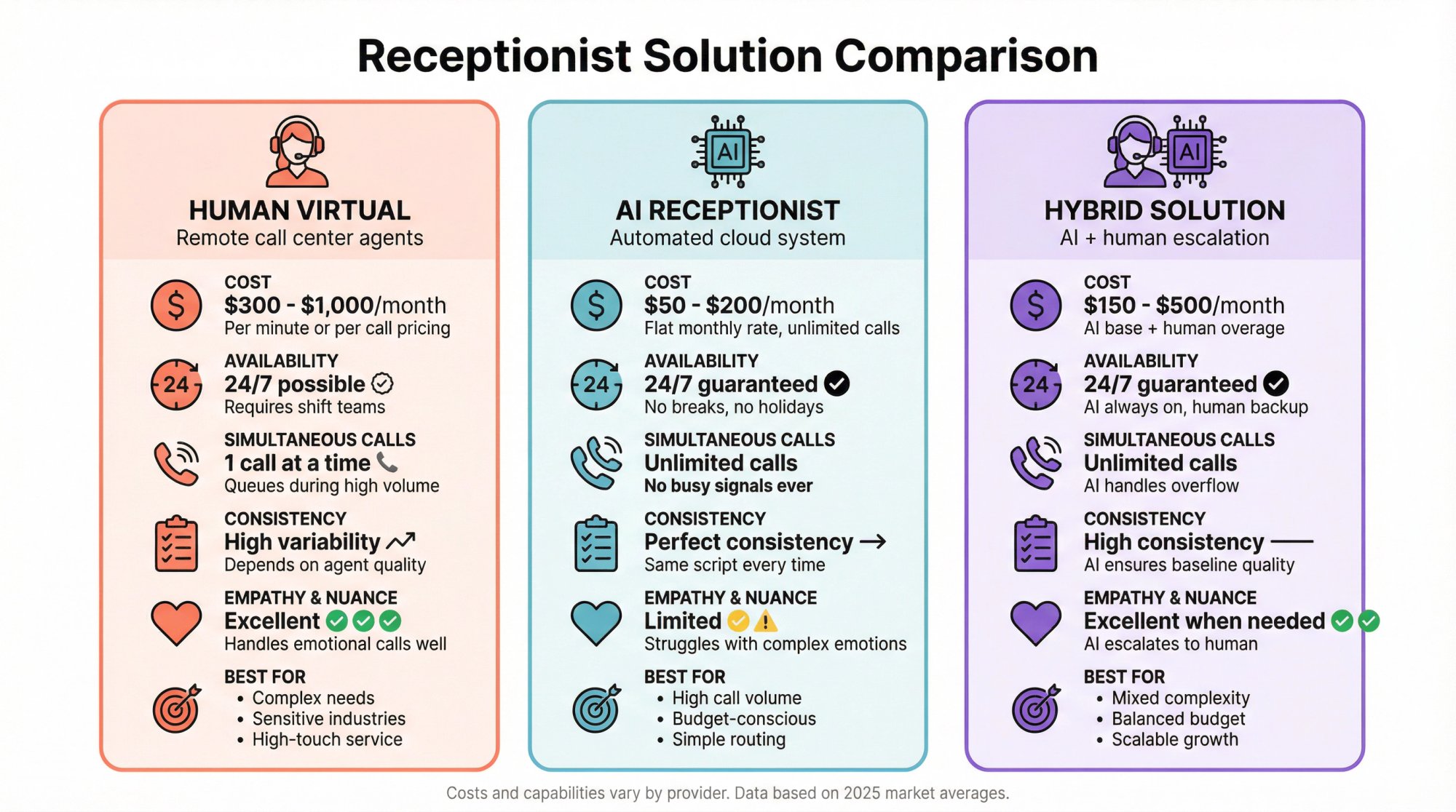
Thanks to advances in artificial intelligence and voice technology, AI-driven receptionists are now a viable option for many tasks a receptionist handles.
An AI receptionist is a smart software system (often cloud-based) that can answer calls, understand what callers ask using natural language processing, and respond with appropriate answers or actions.
Modern AI receptionists can have conversations with callers to collect information, answer questions, book appointments, and even transfer calls when necessary.
How it works in practice:
If someone calls a plumbing business after hours, the AI receptionist could answer, "Hello, thanks for calling Joe's Plumbing. How can I help you today?"
If the caller says they have an emergency leak, the AI can gather their address and urgency, automatically route the call to the on-call plumber's phone or send an alert, or take a detailed message and schedule an appointment for the next day.
AI receptionists are programmed with knowledge bases, so they can answer FAQs like "What are your hours?" or "Do you service my area?" immediately from a database of answers.
They can also integrate with calendars. For instance, checking your real-time availability and scheduling a booking on the spot, then emailing the customer a confirmation.
The advantages are significant:
24/7 Availability
The AI doesn't require sleep, lunch breaks, or vacations. Even at 2 AM on a holiday, if an important call comes in, it can be answered through an after-hours answering solution.
Unlimited Simultaneous Calls
AI systems can handle multiple calls at once, something a single human can't do. If five people call at the same time, an AI receptionist can engage all of them simultaneously without any getting a busy signal.
Consistency
The AI will follow the given protocol every time, never forgetting to ask for a callback number or missing a detail.
Cost-Effectiveness
This is where AI really shines. Many AI receptionist services charge a flat monthly rate, often $50 to $200 per month for unlimited or high-volume call handling. That's a fraction of a human salary.
Compare this to paying a full-time receptionist around $3,000 to $4,500 per month (when you factor in salary, taxes, and benefits for a 40-hour/week position).
For a small business, that difference is huge. Using an AI service can save 80 to 90% of the cost while covering 24/7/365 instead of just business hours.
When to Use Both: Hybrid Receptionist Solutions#
Of course, AI has limitations. By nature, it lacks human empathy. So if your business deals with emotional situations (say, a mental health clinic), a human receptionist might still be preferable for those conversations.
AI can handle routine and moderately complex interactions, but truly complex problems or upset callers might confuse it.
That's why some businesses choose a hybrid approach: use AI as the first line (answering immediately, handling common stuff), and if the call's beyond the AI's scope, it transfers the caller to a human.
This way, you get the efficiency of AI most of the time and the human touch when it really matters.
How Modern Receptionists Handle Chat, Text, and Email#
Beyond phone calls, the "receptionist" function has expanded to other channels: live website chat, text messages, and email inquiries.
Some virtual receptionist services also reply to chats that come through your website, using either AI or live agents. The idea's to maintain instant responsiveness across all the ways a customer might reach out.
Spam filtering has also become a big part of the modern receptionist's job. Businesses are inundated with robocalls and telemarketers. Receptionists (human or AI) act as a filter so the business owner or team doesn't waste time on these.
An AI receptionist can automatically detect likely spam calls (using blacklists or pattern recognition) and hang up or send them to voicemail. Human receptionists will politely turn away persistent sales callers.
This filtering saves significant time. Americans received an estimated 52.8 billion robocalls in 2024, so having a "shield" at the front desk prevents a lot of disruption.
In summary: The role of the receptionist's evolving with technology, but the goal remains the same: ensure every customer interaction's handled promptly and professionally.
How Eden AI Receptionist Works for Your Business#
At Eden, we've built an AI receptionist specifically designed for small and service businesses that can't afford to miss calls but also can't afford a full-time receptionist.
We understand the core problem: missed calls equal lost revenue.
That's why Eden offers:
24/7 Live Answering
Your AI receptionist never sleeps. No more voicemail. Every call gets answered, whether it's 3 PM or 3 AM.
Instant Lead Capture
Eden collects caller name, callback number, service need, and urgency, then sends it to you in real time through our lead qualification solution. You'll never lose a lead because someone couldn't reach you.
Smart Call Routing
Need calls transferred to your on-call technician? Eden can intelligently route calls based on context (emergencies go to one number, routine inquiries to another).
Appointment Scheduling
With our Pro plan, Eden can check your real-time calendar availability and book appointments on the spot, then send confirmations to customers automatically.
Bilingual Support
Flawless English and Spanish switching through our bilingual answering service so you never miss a customer due to language barriers.
IntelliSpam™ Filtering
Auto-blocks robocalls so your paid minutes go to real customers, not telemarketers.
Five-Minute Setup
Pick a local number, paste your website, forward your line. You're done. Eden scrapes your site for key information and is ready to answer calls immediately.
Eden vs Hiring a Full-Time Receptionist#
| Factor | Full-Time Receptionist | Eden AI Receptionist |
|---|---|---|
| Monthly Cost | $3,000+ (salary + benefits) | Starting at $39/month |
| Availability | 40 hours/week (business hours) | 24/7/365 |
| Simultaneous Calls | 1 at a time | Unlimited |
| Training Time | Weeks to months | 5 minutes |
| Sick Days/Vacation | Requires coverage | Never |
| Consistency | Varies by person/mood | Perfect every time |
The math's simple. 42% of small businesses lose at least $500 per month from missed calls. That's $6,000+ per year.
Eden ensures you capture those calls at a fraction of the cost of hiring.
Which Industries Use Eden AI Receptionist?#
We work with small businesses across:
• Legal services (capture every consultation request with our law firm answering service)
• Real estate agencies (never miss a buyer or seller inquiry through our real estate answering service)
• HVAC, plumbing, electrical (handle emergency calls 24/7 with industry-specific solutions for HVAC, plumbing, and electricians)
• Property management (answer tenant emergencies any time with our property management answering service)
• Salons and spas (fill your calendar automatically with our salon answering service)
• IT support companies (route urgent issues to on-call techs through our IT companies answering service)
• Accounting firms (manage tax season call volume with our accounting answering service)
• And many more service businesses across our full range of industries
Note: We currently serve all US-based small businesses except restaurants and healthcare providers (we don't have HIPAA accreditation).
Start Your Free Eden Trial Today#
Get started with Eden today with 30 free minutes for 1 week. No credit card required.
See how it feels to never miss a call again.
Common Questions About Receptionist Jobs#

What exactly does a receptionist do all day?#
Receptionists handle a wide range of tasks including answering and directing phone calls, greeting visitors, scheduling appointments, managing calendars, providing information to customers, handling mail and packages, maintaining the reception area, coordinating communication between departments, and managing office security. The specific mix depends on the industry, but the core responsibility's ensuring smooth communication and creating positive first impressions.
How much does it cost to hire a receptionist?#
A full-time in-house receptionist typically costs $3,000 to $4,500 per month when you factor in salary, taxes, and benefits. Human virtual receptionist services charge by the minute or call, ranging from a few hundred to over $1,000 per month depending on call volume. AI receptionist services like Eden start at $39 per month for 200 minutes (with unlimited plans available), making them 80-90% cheaper than traditional options while providing 24/7 coverage.
What skills does someone need to be a good receptionist?#
The most important skills are excellent verbal and written communication, strong organizational abilities, multitasking capability, professionalism, customer service orientation, problem-solving skills, technical proficiency with office software and phone systems, discretion and trustworthiness, and knowledge of the organization. Emotional intelligence and the ability to stay calm under pressure are also critical.
Can AI receptionists really replace human receptionists?#
AI receptionists excel at routine tasks like answering calls 24/7, screening spam, collecting caller information, answering FAQs, booking appointments, and routing calls based on context. They're consistent, cost-effective, and never miss a call. But they may struggle with highly complex or emotionally sensitive situations where human empathy's crucial. Many businesses use a hybrid approach, with AI handling most calls and transferring complex ones to humans when needed.
What's the difference between a receptionist and a virtual receptionist?#
A traditional receptionist works on-site at your office during business hours. A virtual receptionist works remotely (either a human from a call center or an AI system) and answers your business's calls as if they were in your office. Virtual receptionists can provide 24/7 coverage and are typically much more cost-effective, but they don't have a physical presence at your location.
How do receptionists handle multiple calls at once?#
Human receptionists can only handle one call at a time, though they can put callers on hold or use voicemail to manage overflow. Multi-line phone systems help them queue calls. AI receptionists like Eden can handle unlimited simultaneous calls, meaning no customer ever gets a busy signal even during high-volume periods.
Do small businesses really need a receptionist?#
Absolutely. Research shows businesses only answer about 38% of incoming calls, and 80-85% of callers won't leave voicemail. The average small business loses over $120,000 in revenue annually from missed calls. Plus, 78% of customers choose the first company that responds to their inquiry.
Having someone (human or AI) answering calls can dramatically increase lead capture, customer satisfaction, and revenue while projecting a professional image. Learn more about what to do when you can't afford a receptionist.
What industries use receptionists the most?#
Virtually every service and office environment uses receptionists. The most common include corporate offices, medical and dental practices, law firms, real estate agencies, hotels and hospitality, salons and spas, accounting firms, property management companies, HVAC and plumbing services, IT support companies, gyms and fitness studios, and professional service firms.
Each industry has slightly different needs, but all benefit from having someone manage front-line communications. Explore our industries that need outsourced receptionist services guide for more details.
How is Eden different from other virtual receptionist services?#
Eden combines advanced AI technology with extreme ease of use. Setup takes just 5 minutes (we scrape your website for business info automatically). We offer 24/7 bilingual support (English and Spanish), intelligent call routing, on-the-spot appointment booking with calendar integration, IntelliSpam™ filtering to block robocalls, and all at a fraction of the cost of human services. Plus, our AI learns your business specifics and handles calls consistently every time.
Can I try Eden before committing?#
Yes! We offer 30 free minutes for 1 week so you can test Eden with real calls from your business. Start your free trial today to see how it feels to never miss a call again. No credit card required to start.
What happens to calls that the AI receptionist can't handle?#
Eden can be configured to transfer complex calls to you or your team based on rules you set. For example, you might configure emergency calls to transfer immediately to your on-call phone, while routine inquiries get a message taken for callback during business hours. You're always in control of how calls get routed.
Does Eden work for my industry?#
Eden works for most US-based small businesses including legal services, real estate, contractors (HVAC, plumbing, electrical), property management, salons, IT support, accounting, insurance agencies, and many more. We currently don't serve restaurants or healthcare providers (as we don't have HIPAA accreditation). Contact us to discuss your specific needs.
Never Miss Another Call: The Future of Reception#
A receptionist's job encompasses far more than answering phones. It's a multifaceted role critical to a company's success.
Receptionists welcome visitors, manage communications, keep schedules organized, and uphold a positive image for the business through every interaction. They're the linchpin that connects customers to the services or people they need, all while keeping the office's day-to-day operations on track.
The phrase "director of first impressions" truly applies here. A great receptionist can enhance customer satisfaction, salvage potential sales that might have been lost to missed calls, and bring order to a busy workplace.
Today, businesses can fulfill the receptionist function in different ways: through on-site staff, with virtual human receptionist services, using AI-driven solutions like Eden, or combining these approaches.
But the fundamental duties remain the same.
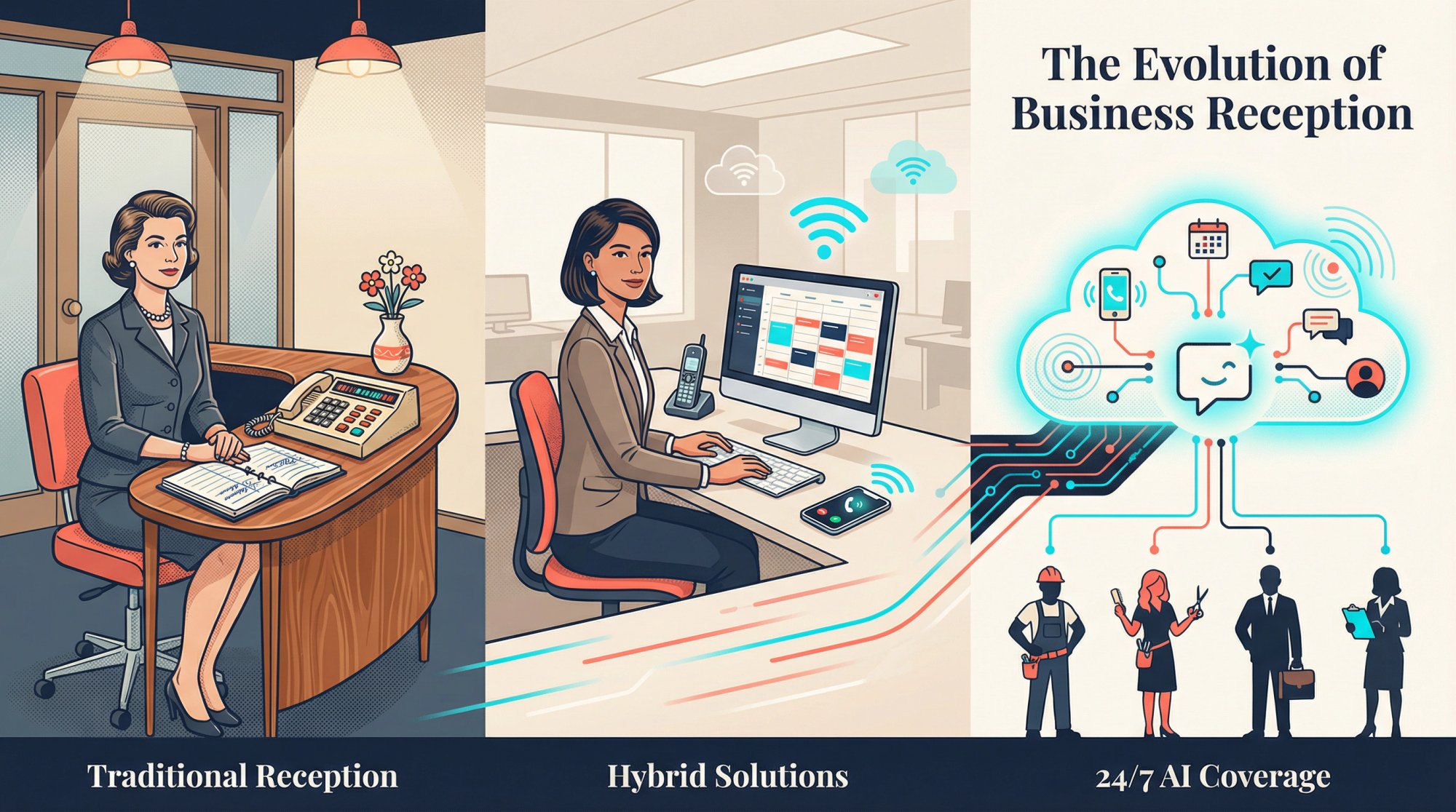
Whether it's a friendly face at a front desk or a 24/7 AI voice on the line, the receptionist's purpose is to ensure that no customer or opportunity falls through the cracks. By promptly greeting every caller or visitor, handling their needs with professionalism, and routing information to the right place, a receptionist (human or virtual) keeps the wheels of the business turning smoothly.
A receptionist provides peace of mind. For business owners, that means knowing every client's acknowledged and assisted. For customers, it means knowing whenever they reach out, someone competent's there to help.
It's a role of service, coordination, and communication. One that, when done well, can measurably boost a company's reputation and bottom line.
Whether you're considering hiring a receptionist or adopting an automated service like Eden, investing in this capability is investing in better customer experiences and more captured opportunities.
And that can make all the difference in today's competitive landscape.
Ready to Transform YourCustomer Experience?
Join hundreds of businesses using Eden AI to handle calls, book appointments, and provide 24/7 customer support.